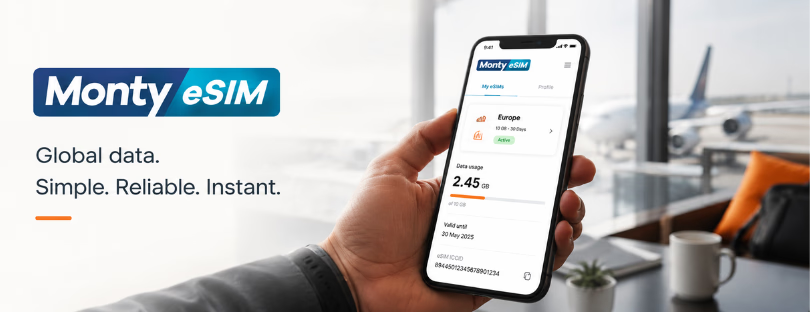
Monty eSIM: A Travel eSIM With a B2B Telecom Edge
The travel eSIM market is no longer a niche corner of telecom. It is a busy shelf: app-first brands, telco-backed offers, marketplace resellers, white-label engines, and operators trying to make roaming attractive again.
Monty eSIM sits in an interesting place on that shelf. At first glance, it looks like a straightforward travel eSIM app. You choose a local, regional, or global data plan, install the eSIM digitally, and avoid hunting for a SIM kiosk after landing. Many well-known eSIM providers’ names have already trained travelers to expect instant travel data.
But Monty eSIM has a different story behind it. The company behind the consumer product is Monty Mobile, a telecom technology group with a wider portfolio across CPaaS, operator solutions, eSIM enablement, messaging, fintech, and wholesale connectivity. In travel eSIMs, the app is only the front door. The harder question is what sits behind it: provisioning, routing, integrations, support, pricing control, and the ability to scale.
More than a travel app
Monty eSIM promotes coverage across 190+ countries and regions on its consumer-facing material. Monty Mobile’s B2B travel eSIM proposition goes broader, describing coverage across 200+ countries and regions, local, regional and global bundles, white-label portals, APIs, SDKs, partner storefronts, dynamic pricing and real-time monitoring.
That gives the product two lives. For travelers, it is a prepaid data tool. For travel agencies, platforms, enterprises, or telecom partners, it can also be a way to launch a branded eSIM storefront without building the whole telecom stack from scratch.
READ MORE: How Monty Mobile Expands Beyond Traditional Telecom
This is where Monty eSIM becomes more interesting than a simple “buy data before you fly” service. The consumer app is useful, but the strategic value is probably in the infrastructure layer. Monty Mobile is also positioning eSIM as a distribution product for other businesses.
GSMA Intelligence has been tracking consumer eSIM as it shifts from early adoption into mass-market behaviour, and its 2026 commentary points to travel eSIM propositions becoming more sophisticated. The next stage is not just cheaper roaming. It is embedded connectivity: eSIM inside airline apps, hotel journeys, banking apps, loyalty platforms, and online travel agencies.
Europe data offers
Prices shown in EUR. Check plan details, validity, coverage and supported devices before purchase.
The traveler experience
For the average traveler, Monty eSIM’s appeal is practical. The plans are prepaid, data-focused, and visible before purchase. App store descriptions highlight local, regional and global plans, QR-based installation, top-ups, and activation in a short flow. In plain English, you buy the plan, install it on a compatible phone, and use mobile data when you arrive.
The best use case is the traveler who wants a simple data plan for maps, messaging, ride-hailing, email, translation, and light browsing. It is also relevant for frequent travelers who prefer one familiar app rather than starting from zero every time they cross a border.
READ MORE: Monty Mobile launches new innovative technologies for enterprises
Where users should read carefully is the same place they should read carefully with every travel eSIM: plan type, validity, speed expectations, hotspot rules, fair-use language, destination coverage, and whether the plan is data-only. Some Monty eSIM country pages show data-only plans and eKYC status, which is useful, but the buying decision still depends on the destination and bundle.
Monty eSIM may not be the obvious first choice for someone who wants unlimited data everywhere, a local phone number, or a highly polished consumer brand. Holafly is stronger in unlimited data. Airalo has huge brand awareness. Ubigi has mobility credibility. Monty eSIM’s sharper angle is that it comes from a telecom company that also understands B2B enablement.
The B2B angle
Monty Mobile describes a travel eSIM platform that can support direct-to-consumer sales and B2B distribution through white-label apps, web portals, APIs, SDKs and partner storefronts. It also mentions partner dashboards for bundle management, analytics, activations, usage and pricing. That is the kind of backend travel brands need if they want to sell connectivity without becoming telecom companies themselves.
Airlines, hotels, OTAs and fintech apps want ancillary revenue, but they do not want telecom complexity. They want a product that can be inserted into an existing journey: “Your trip to Rome starts tomorrow. Add mobile data?” If Monty Mobile can make that simple and reliable, Monty eSIM becomes more than an app.
What could improve? The consumer-facing brand could explain its network quality and plan differences more clearly. Travelers increasingly want transparency: which network, what speed, what happens after the allowance ends, is hotspot supported, and when exactly does validity start?
Final take about Monty eSIM
Monty eSIM is not the loudest travel eSIM brand, and that may be both its weakness and its opportunity. In a consumer market dominated by polished app brands, it still needs sharper public storytelling. But behind it is Monty Mobile, a broader telecom technology player with operator, partner and platform experience. That gives it credibility in a market where many eSIM brands are storefronts sitting on top of someone else’s connectivity.
Compared with Airalo or Holafly, Monty eSIM feels less like a pure consumer travel brand. Compared with Ubigi or 1GLOBAL-style players, it sits closer to the platform-and-enablement side of the market. That position could work well if Monty leans into it: not just “buy data for your trip,” but “launch, sell and manage connectivity at scale.”
The bigger trend is clear. Travel eSIM is becoming less of a standalone product and more of an embedded service. The winners will not only have low prices. They will have trust, integrations, clear plan rules, and good support.