HotelWorld AI Launches Leo to Boost Direct Hotel Bookings
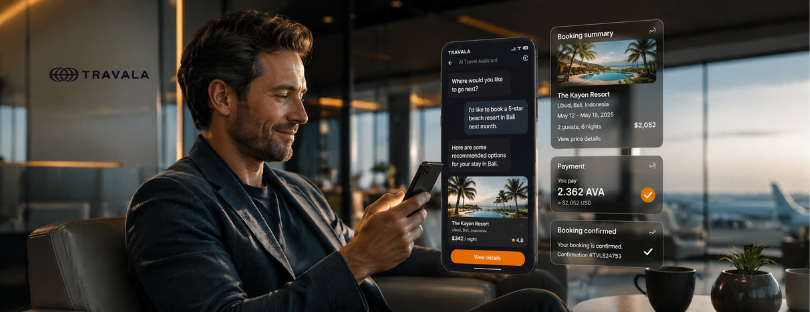
When AI assistants become the first stop for travel planning, hotels face a quiet but serious problem. If an AI cannot clearly understand or recommend a property, that hotel simply does not exist in the decision-making moment. This is the challenge HotelWorld AI is aiming to solve with the launch of Leo, its new AI marketing agent.
Founded in December 2024 and already part of the NVIDIA Inception Programme, HotelWorld AI positions itself squarely at the intersection of hospitality and artificial intelligence. Leo is the company’s first public product, designed to help hotels stay visible, relevant, and bookable as AI-driven discovery replaces traditional search.
Why hotel discovery is breaking in the AI era
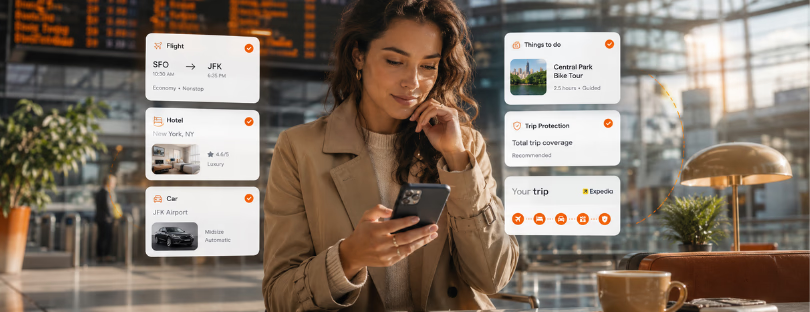
Search behavior is changing fast. Travelers are no longer scrolling through ten blue links or endless OTA listings. They are asking questions, often conversational ones, to tools like ChatGPT, Google AI, and Perplexity. The output is not a list of hotels, but a curated recommendation shaped by how AI interprets a property’s relevance, positioning, and trust signals.
That shift has serious commercial implications. If AI platforms favor intermediaries or misinterpret hotel data, direct bookings suffer. According to industry data from Phocuswright and Skift, direct channels already struggle to compete with OTAs on visibility. AI risks widening that gap unless hotels actively manage how they are represented.
This is where Leo enters the picture.
A human-first vision behind the technology
Despite its technical ambition, HotelWorld AI insists its approach starts with people, not algorithms.
“We believe people are at the heart of the hotel experience,” said Filip Boyen, Co-Founder of HotelWorld AI. “Our mission is to help hotels be discovered, enhance guest experiences, streamline operations, and allow hoteliers to focus on what truly matters.”
Boyen brings deep industry credibility to the company. He previously served as CEO of Forbes Travel Guide and COO of Belmond, roles that exposed him to both the operational and brand challenges hotels face globally. That background shows in how Leo is framed. It is not sold as a magic growth hack, but as a tool to protect and strengthen a hotel’s digital identity.
Turning AI visibility into direct bookings
The core promise of Leo is simple but powerful. It helps hotels understand how AI platforms interpret their brand and then optimizes that narrative to improve recommendations and direct demand.
“Hotels are leaving money on the table as discovery shifts toward AI-powered search,” said Boyen. “Leo helps hotels improve how they are understood and recommended by AI platforms such as ChatGPT, Google AI (Gemini), and Perplexity, turning that visibility into more direct bookings.”
This addresses a blind spot most hotels currently have. While revenue managers track ADR and RevPAR obsessively, almost no one monitors how AI describes their property. Is the hotel positioned as business-focused or leisure-driven. Is location context accurate. Are amenities clearly understood. Leo aims to surface those insights and give hotels control over them.


Owning the AI brand narrative
Geri Cupi, Co-Founder of HotelWorld AI, frames the issue even more directly.
“Search is no longer about keywords or listings; it’s about how AI understands and recommends hotels,” said Geri Cupi, Co-Founder at HotelWorld AI. “Leo helps hotels take control of their AI brand narrative, reduce dependency on OTA commissions, and drive more visibility and direct demand as AI becomes the primary interface for travel discovery.”
Cupi is not new to scaling AI-driven businesses. A Forbes 30 Under 30 alumnus, he has raised more than $50 million across previous ventures. His involvement signals that HotelWorld AI is not positioning itself as a niche hospitality tool, but as infrastructure for how hotels interact with AI platforms at scale.
The first piece of a larger platform
Leo is only the beginning. HotelWorld AI describes it as the first agent within a broader multi-agent system, each focused on a specific stage of the guest journey. All agents share a common data layer, allowing insights from marketing, operations, and guest experience to reinforce each other.
This modular approach mirrors trends seen in enterprise AI, where specialized agents outperform one-size-fits-all platforms. HotelWorld AI has already confirmed that additional operational agents will be announced in the coming months, signaling ambitions well beyond marketing alone.
Backed by hospitality and tech heavyweights
HotelWorld AI’s founding team and advisors include alumni from Accor, Oracle, Google, Mandarin Oriental, Experian, and Forbes Travel Guide. That blend of hospitality operations, enterprise tech, and data science is rare and likely necessary if AI is to be embedded meaningfully into hotel workflows.
Where Leo fits in the wider market
The hospitality tech market is crowded, but most AI solutions today focus on pricing, chatbots, or reputation management. Players like Duetto, RateGain, and Revinate apply AI to specific functions, while Google and OTAs increasingly control discovery itself.
Leo’s positioning is different. It does not try to replace revenue management systems or booking engines. Instead, it addresses AI visibility as a strategic layer that sits above distribution. This aligns with a broader trend identified by McKinsey and Gartner, where brand-controlled data and AI readiness become competitive advantages as platforms consolidate power.
Conclusion: why this launch matters now
Leo’s launch feels timely rather than speculative. AI assistants are already shaping travel decisions, even if hotels are not measuring it yet. By focusing on how AI understands and recommends hotels, HotelWorld AI is tackling a problem that is real, growing, and largely ignored.
If the company executes well, Leo could become a new category of essential hotel infrastructure, similar to how channel managers or revenue systems once did. The larger question is how quickly hoteliers will recognize that AI visibility is no longer optional. Those who move early may regain ground lost to intermediaries. Those who wait risk becoming invisible in the very tools travelers trust most.
For an industry built on being found, seen, and chosen, that is not a future hotels can afford to ignore.