Hotels Sell Rooms. Smart Ones Sell eSIMs
Hotels used to sell a room, a bed, breakfast, and maybe a late checkout if the guest was lucky. Then came spa packages, airport transfers, coworking spaces, branded experiences, local tours, parking, dining credits, loyalty upgrades, and digital concierge services.
Now there is another product sitting directly in front of them: connectivity.
Not hotel Wi-Fi. That already belongs in the “basic expectations” category. Guests expect strong Wi-Fi in the same way they expect clean towels and hot water. Comcast Business has described high-speed Wi-Fi as an expected in-room perk, while hotel technology commentators increasingly place Wi-Fi, mobile technology, and digital guest services among the most important shifts in hospitality operations.
The next opportunity is different. It is mobile (embedded) connectivity outside the hotel: the data plan a guest needs the moment they land, the eSIM they install before arrival, the connection they use for maps, ride-hailing, restaurant bookings, translation apps, mobile payments, train tickets, and messaging family back home.
For hotels, that is not a telecom side quest. It is part of the guest journey.
The guest already has the problem
Think about a traveler arriving in Istanbul, New York, Bangkok, Dubai, or Tokyo. Their first real pain point often happens before they see the hotel lobby. They land, turn off airplane mode, and immediately face the question: do I risk roaming, find airport Wi-Fi, buy a local SIM, or search for an eSIM while half-asleep at baggage claim?
That moment is ugly, and hotels usually ignore it.
But from a hospitality perspective, it is completely connected to the stay. If the guest cannot message the driver, open the booking confirmation, use Google Maps, or translate the taxi instructions, the hotel experience has already started badly, even if the room is perfect later.
This is where smart hotels should stop thinking like accommodation providers and start thinking like travel service platforms.
A hotel already knows several things that eSIM providers would love to know: destination, arrival date, length of stay, traveler type, booking channel, and sometimes even nationality. That is enough to suggest a relevant connectivity product without turning the guest experience into a spammy upsell.
“Your stay in Japan starts on Monday. Need mobile data before you arrive?”
That is useful. Not pushy. Not random. Useful.


Why is this bigger than an add-on?
Hotels understand ancillaries, but many still treat them too narrowly. Breakfast. Parking. Spa. Room upgrade. Airport transfer. Those are classic hotel add-ons because they happen inside or around the property.
Connectivity is more powerful because it travels with the guest.
It starts before arrival, continues during the stay, and can even remain active after checkout if the traveler is moving to another city or country. That gives hotels something they usually struggle to own: a digital relationship beyond the physical room.
This matters because the travel eSIM market is no longer niche. GSMA Intelligence has highlighted consumer eSIM as a market moving into new travel and business use cases, with mobile operators increasingly launching travel eSIM offers. Trusted Connectivity Alliance also reported continued eSIM ecosystem growth in 2025, with consumer adoption rising and estimated eSIM shipments increasing.
Counterpoint Research has also pointed to strong travel eSIM growth ahead, estimating that third-party travel eSIM downloads could grow nearly threefold between 2025 and 2030. In plain language, travelers are learning that roaming is not the only option anymore.
Hotels can either watch that behavior move through OTAs, airlines, fintech apps, and standalone eSIM brands, or they can become part of it.
Your customers will buy connectivity. The question is: from you, or from someone else?
We help airlines, banks, and travel platforms turn that demand into a built-in product — not a missed opportunity.
APIs change the hotel opportunity
A few years ago, this would have sounded too complicated for most hotel groups. Selling connectivity meant telecom contracts, operator relationships, support questions, compliance headaches, and technical infrastructure.
That is not really the model anymore.
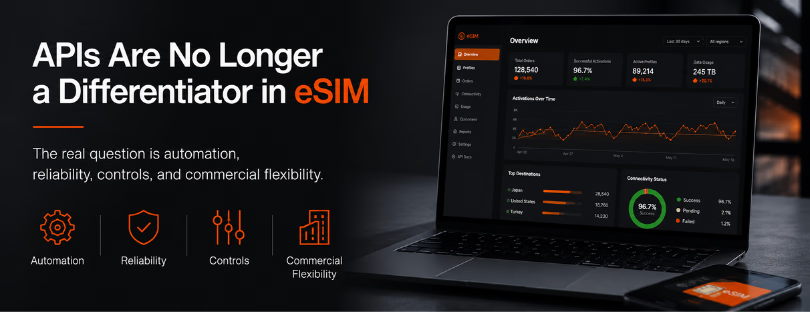
The rise of eSIM connectivity APIs means a hotel, booking engine, loyalty app, travel club, or hospitality group can integrate global connectivity without becoming a telecom company. But the real work is not simply adding an eSIM link to a confirmation email. Hotels need to understand the partner landscape, the commercial models, the guest experience risks, and the difference between a useful pre-arrival service and a forgettable upsell. Alertify helps hospitality brands make sense of that layer: from provider selection and market positioning to content, packaging, and smarter connectivity offers that feel natural inside the guest journey.
That matters because hotels do not need to “own” the telecom layer. They need to own the guest moment.
The better model is simple: offer the right plan at the right time, under the hotel’s brand or as a trusted partner recommendation. The guest gets convenience. The hotel gets ancillary revenue, a better arrival experience, and another reason for the guest to engage with its app or pre-arrival email.
This is exactly how modern travel retail works. Airlines have already trained customers to buy extras during the booking flow. OTAs bundle cars, insurance, attractions, and airport transfers. Fintech apps are moving into travel services because they already own payment and identity. Hotels should not be the last ones to notice that connectivity is becoming part of the same basket.
What smart hotels should actually sell?
The mistake would be selling “an eSIM” as if all guests need the same thing.
A weekend city-break guest does not need the same plan as a business traveler attending meetings for five days. A family may need several devices connected. A digital nomad may care more about reliability and hotspot usage. A luxury traveler may not care about the cheapest plan, but absolutely cares about arriving connected without friction.
So the hotel offer should be simple, but not dumb.
Pre-arrival eSIM
The easiest win. Add it to confirmation emails, hotel apps, and pre-check-in flows.
“Arrive connected” is a stronger message than “buy mobile data.”
Destination bundles
Hotels can package eSIMs with airport transfers, city passes, or local experiences.
This works especially well for resorts, city hotels, and international guests.
Business traveler plans
Corporate hotels and serviced apartments can treat connectivity as a productivity layer,
alongside meeting rooms, coworking access, and airport pickup.
Loyalty benefits
Instead of another forgettable 5% discount, loyalty programs can offer free or discounted
travel data. Modern, practical, and genuinely useful.
The brand risk is real
There is one important warning. Hotels should not throw a random eSIM link into an email and call it innovation.
Connectivity is close to the guest’s trust. If activation fails, coverage is weak, or the plan terms are unclear, the guest will blame the hotel as much as the provider. This is why partner choice matters. Hotels need providers with strong coverage, clean onboarding, transparent pricing, responsive support, and API flexibility.
This is also where the market starts to separate. Standalone eSIM brands have built consumer recognition in different ways. Some focus on app-first convenience, some on unlimited-style plans, some on regional coverage, some on infrastructure depth. For hotels, however, the question is not only “who has the cheapest plan?” It is “who can fit into our guest journey without creating operational noise?”
That is a very different buying decision.
The real conclusion
Hotels that sell connectivity are not trying to become mobile operators. That would be the wrong lesson.
The smart play is to recognize that the hotel stay no longer begins at reception. It begins when the guest books, plans, packs, lands, opens maps, messages the driver, checks train times, and tries to avoid roaming shock. Connectivity sits inside all of those moments.
Airlines are already moving closer to travel eSIMs. OTAs will bundle them. Fintech apps will add them because they understand payments, travel behavior, and digital convenience. eSIM providers will keep fighting for the traveler directly. If hotels stay passive, they will simply send guests into someone else’s funnel.
The better move is not to overcomplicate it. Start with pre-arrival connectivity. Make it clean. Make it relevant. Pick a serious partner. Treat it as a guest experience product, not a banner ad.
Because the next smart hotel upsell is not another bottle of prosecco in the room.
It is helping the guest land connected.