API is the new SIM card?
There’s a line I keep coming back to. It started as a throwaway observation and turned into something I genuinely believe describes where the connectivity industry is headed: the API is the new SIM card.
Stay with me.
For decades, the SIM card was the physical handshake between a user and a network. You wanted connectivity? You needed a card. A piece of plastic, roughly the size of a fingernail, that told the network who you were, what you were allowed to do, and how much it was going to cost you. It was unglamorous infrastructure. It was also enormously powerful. Whoever controlled SIM distribution controlled the relationship with the customer.
That control is dissolving. Not overnight, and not without resistance, but it is dissolving.
What eSIM Changed
The obvious story about eSIM is that it removes the plastic. The less obvious story, and the one that matters more, is that it moved the point of control. With a physical SIM, distribution was physical: retail shelves, airport kiosks, carrier stores. With eSIM, distribution is software. And once something becomes software, it can be automated, embedded, scaled, and sold through channels that never existed before.
That shift quietly opened a door. On the other side of it: APIs.
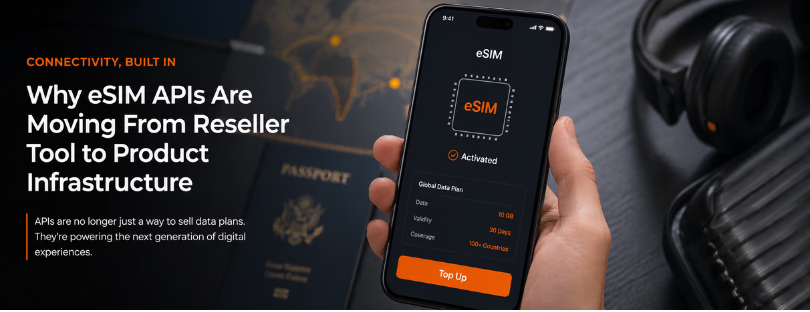
When an eSIM provider exposes an API, they are not just offering a technical integration. They are saying: our connectivity can now live inside someone else’s product. A travel app. A fintech platform. A corporate expense tool. A hotel booking engine. An airline app. The SIM card used to be a standalone product. The API makes connectivity a feature, something that can be bundled, white-labeled, triggered automatically, and priced programmatically.
That is a fundamentally different business model.
Infrastructure Bet
Look at what companies like 1GLOBAL, iBasis, or Gigs or eSIM Go have been building over the last several years. These are not consumer brands. Most travelers have never heard of them. But they are the layer underneath, signing wholesale agreements with operators across 100+ countries, building the SM-DP+ infrastructure, and making that infrastructure available to third parties via API.
Their customers are not end users. Their customers are fintechs, travel platforms, fleet management companies, and IoT manufacturers. The value proposition is not “cheap data in 50 countries.” It is “integrate once, deploy globally, and let us handle the regulatory and operational complexity.”
That is SIM card logic, applied at software scale.
Even on the consumer side, API thinking is reshaping the competitive dynamics. Airalo, Nomad, and Yesim have invested heavily in developer ecosystems. Airalo’s API program has attracted many partners. Yesim has been building out B2B tooling, including OneBalance and a Partner API that lets resellers manage pooled data across multiple devices. Nomad quietly powers white-label eSIM products for brands that do not want to build their own.
The consumer-facing eSIM market gets most of the attention. The API layer underneath it is where the structural bets are being made.

Beyond Telecom
The telecom industry has spent the better part of 30 years treating connectivity as a product you sell, not a feature you enable. The API shift challenges that model directly.
Think about what happened in payments. Stripe did not invent credit card processing. It made it trivially easy to embed into any application. The result was not just a new payments company. It was the commoditization of a layer that banks had treated as a moat. Suddenly, a two-person startup could accept payments from 40 countries on day one.
Something similar is happening in connectivity. When eSIM provisioning is accessible via a clean REST API, with clear documentation, predictable pricing, and reliable uptime, it stops being a carrier’s exclusive domain. Any platform with a user base that travels, moves across markets, or manages distributed assets becomes a potential connectivity distributor.
Airlines are the obvious play. Several are already piloting embedded eSIM offers through their apps. But the more interesting bets are less obvious: expense management platforms that provision data automatically when an employee’s card is used abroad, banking apps that bundle temporary data passes with international transfers, and insurance products that activate connectivity when travel is detected.
None of these required a carrier relationship five years ago. They do now, and the API is the mechanism.
Distribution War
Here is the competitive reality this creates: in the old model, winning in eSIM meant having the best plans, the best coverage, and the lowest price. Those things still matter at the consumer level. But they are table stakes.
At the platform level, winning means being embedded. It means your provisioning engine runs inside the travel app with 20 million monthly users. It means your infrastructure becomes the default when a fintech decides to add a connectivity benefit to its premium card. It means your API is the one that gets integrated, documented, trusted, and never replaced.
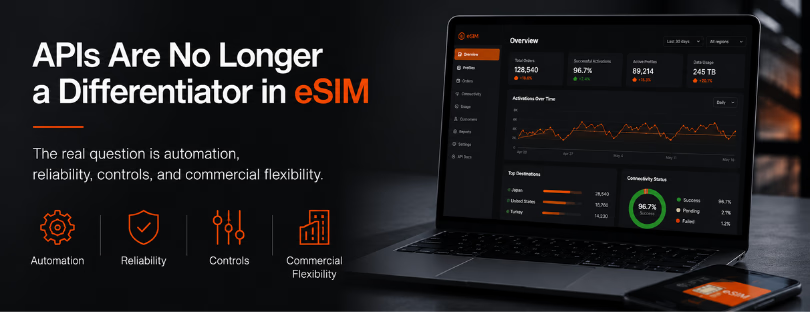
The companies that understand this are building accordingly. They treat developer relations as a distribution strategy. They think about API reliability and uptime the way carriers used to think about network coverage. They offer sandbox environments, webhooks, and usage dashboards, all the elements that make an API sticky.
And “sticky” is the keyword. Once a platform integrates your API and builds a product around it, switching costs are real. That is a moat. Not a glamorous one, but a durable one.
What Happens Next
The SIM card persisted for 30 years because it solved a hard problem elegantly: authentication and authorization at scale, in a tiny physical object. It did not disappear because someone built a better SIM. It is being displaced because the same problem can now be solved in software, at lower cost and with far more flexibility.
The API is doing to distribution what eSIM did to the card itself: dematerializing it, making it programmable, and opening it to players who were never meant to be part of this industry.
The connectivity providers who understand this early and treat their API as a product rather than an afterthought are the ones that will remain relevant as the market evolves. The ones who do not will become very good at selling something that ends up embedded inside someone else’s app, at someone else’s price point, under someone else’s brand.
The SIM card was hardware with a business model baked in. The API is software with the same ambition — just without the plastic. eSIM API distribution