Heathrow Ends Liquid Rules With Full CT Scanner Rollout
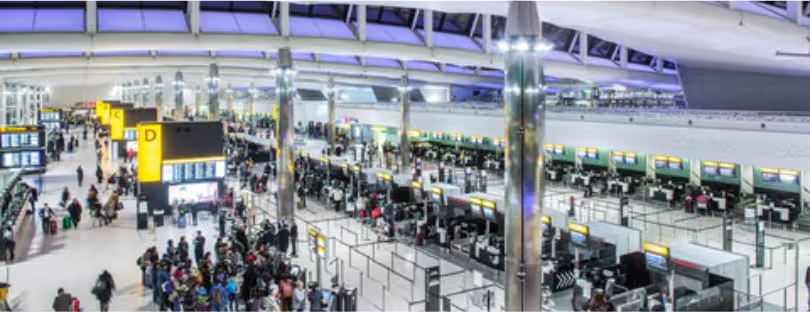
If you have flown through Heathrow Airport recently, you might have noticed something subtle but meaningful at security. No frantic repacking. No plastic bag gymnastics. No laptop tray Tetris. That is not luck. It is the result of a full-scale, billion-pound overhaul that puts Heathrow in a global first-mover position.
As a corporate partner of the FTE Digital, Innovation and Startup Hub, Heathrow has now become the largest airport in the world to fully roll out next-generation CT security scanners across all terminals. Every passenger, in every terminal, can now leave liquids and electronics inside their hand luggage.
For travellers, it is a small behavioural change with a massive psychological payoff. For the airport industry, it is a signal that security is finally catching up with modern passenger expectations.
A £1 billion bet on speed, clarity and less stress
The scale of this rollout matters. Heathrow has replaced passenger security lanes across all four terminals with advanced CT scanners capable of processing thousands of bags per hour. This is not a pilot. It is not limited to premium lanes or one terminal. It is a full operational shift.
CT scanners generate highly detailed 3D images of cabin baggage, allowing security officers to rotate, zoom and analyse contents without passengers having to unpack. The result is faster throughput, fewer manual bag checks and less pressure during peak periods.
The investment also brings tangible sustainability benefits. Heathrow estimates the change will eliminate almost 16 million single-use plastic bags per year, previously handed out for liquids. That alone makes it one of the most visible waste-reduction wins in airport security anywhere in the world.
“Every Heathrow passenger can now leave their liquids and laptops in their bags at security as we become the largest airport in the world to roll out the latest security scanning technology,” said Heathrow CEO Thomas Woldbye. “That means less time preparing for security and more time enjoying their journey – and millions fewer single-use plastic bags. This billion-pound investment means our customers can be confident they will continue to have a great experience at Heathrow.”
What this actually changes for passengers
The headline benefit is obvious, but the real impact sits deeper in the passenger journey.
Preparation time drops dramatically. Families, business travellers and infrequent flyers all move through security with fewer instructions and less anxiety. Peak-hour queues become more predictable because the process is less dependent on passenger compliance.
Last year, more than 97 percent of Heathrow passengers waited less than five minutes at security. That figure now has a technological safety net behind it rather than relying purely on staffing and operational tweaks.
Baggage performance has also improved in parallel. Heathrow reports a load rate above 98 percent in 2025, placing an additional quarter of a million bags on their intended flights compared to the previous year. For airlines, this translates into fewer disruption cascades. For passengers, it means fewer reunions with lost luggage desks.
Heathrow versus the rest of the world
Heathrow is not the first airport to experiment with CT scanners, but it is the first mega-hub to go all in.
Airports like Amsterdam Schiphol Airport and Rome Fiumicino introduced CT technology earlier, often earning praise for smoother security experiences. In the United States, terminals at JFK, Atlanta and Chicago have deployed CT scanners selectively, usually constrained by regulatory timelines and infrastructure complexity.
What sets Heathrow apart is completeness. Full rollout across all terminals removes inconsistency. Passengers do not have to guess which rules apply today or which lane still requires liquids to be unpacked. From a user experience perspective, consistency is just as important as speed.
Why this move matters beyond Heathrow
This shift reflects a broader trend in aviation: security is being reframed as a design problem, not just a compliance requirement.
Industry bodies such as IATA and ACI have long argued that smarter screening technology can improve both safety and passenger satisfaction. Manufacturers like Smiths Detection and Rapiscan have invested heavily in CT development, anticipating regulatory approval and airline demand.
Regulators are also evolving. The UK Department for Transport has gradually aligned its guidance to allow CT-enabled airports to relax liquid restrictions, paving the way for nationwide adoption over time.
Heathrow’s rollout effectively stress-tests this future at scale. If it works reliably at one of the world’s busiest international hubs, it becomes much easier for other airports to justify the investment.
The business case airports cannot ignore
Beyond passenger goodwill, CT scanners make financial sense.
Faster processing reduces the need for surge staffing. Fewer manual bag checks mean better use of security personnel. Shorter queues drive higher dwell time in retail areas, a critical revenue stream for large hubs.
There is also a brand dimension. Airports increasingly compete on experience, not just connectivity. Smooth security has become a differentiator that passengers remember, talk about and choose for future journeys.
For airlines, reliable security performance lowers missed-connection risk and improves on-time departure metrics. In an industry where margins are thin, those operational gains matter.
Conclusion: the end of security theatre, the start of quiet efficiency
Heathrow’s CT rollout feels less like a flashy innovation and more like a long-overdue correction. Security remains rigorous, but the theatre is gone. The process finally respects the fact that passengers travel with modern devices and expect systems to adapt accordingly.
Compared with peers still stuck in partial deployments or regulatory limbo, Heathrow has drawn a clear line under the old model. The airport has effectively said that friction is no longer an acceptable default.
If the data continues to support shorter waits, higher baggage accuracy and lower waste, this will not remain a Heathrow story for long. It will become the baseline expectation for major airports worldwide.
For travellers, that means one less moment of stress before a flight. For the industry, it signals a future where security works quietly in the background, doing its job without making passengers feel like part of the problem.