Global eSIM Subscriptions: A New Travel Standard
There’s a subtle change happening in the eSIM market that most travelers haven’t fully clocked yet. It’s not about better coverage or cheaper gigabytes. It’s about how connectivity itself is being packaged. global eSIM subscription
For years, the model was simple. You bought data before a trip. You used it. You ran out, or you didn’t. Then you repeated the process next time. It worked, mostly. But it also locked connectivity into a series of one-off decisions.
Now, that model is starting to feel… dated.
GlobaI eSIM subscriptions are quietly stepping in to replace it. And not in a flashy, disruptive way. More like a slow realization that maybe connectivity shouldn’t reset every time you cross a border.
From travel product to everyday infrastructure
The most interesting thing about global eSIM subscriptions is not the pricing. It’s the positioning.
This is no longer a “travel product.” It’s closer to infrastructure.
If you look at how frequent travelers actually behave, the cracks in prepaid become obvious. A consultant flying between Frankfurt and Singapore doesn’t want to think about buying a new data plan every time. A founder spending two months in Lisbon, then three weeks in New York, then back to Europe, doesn’t want to manage five different eSIM profiles.
They want continuity.
That’s where subscription logic starts to make sense. One eSIM. Persistent. Always there. Not tied to a single trip, but to the way you live and move.
Fairplay leans directly into this idea. Instead of selling disconnected data packages, it builds around a long-term relationship with the user. You’re not just buying data. You’re subscribing to a connectivity layer that follows you.
It sounds simple. But it changes the entire mental model.
The predictability problem nobody solved
Let’s be honest. One of the biggest frustrations in mobile connectivity has never been coverage. It’s uncertainty.
How much will I actually spend?
Traditional roaming failed here spectacularly. That’s well documented. Even regulators across the EU had to step in years ago to cap costs. GSMA and European Commission reports have repeatedly highlighted bill shock as one of the main consumer pain points in international roaming.
Prepaid eSIMs improved things, but only partially. Yes, you know what you pay upfront. But you don’t always know what you’ll need.
Buy too little, and you’re topping up mid-trip at higher effective rates. Buy too much, and you’re wasting data you already paid for. It’s controlled, but not optimized.
Subscriptions try to fix this differently. Instead of forcing you to predict your usage, they absorb the variability.
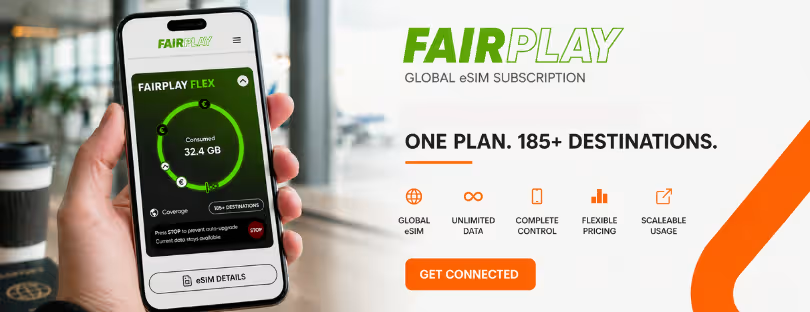
Fairplay’s structure is a good example of this logic in practice. There’s a base monthly fee that includes an initial data allowance. Then usage scales in predictable increments. Each additional block of data comes at a fixed price. And crucially, there’s a ceiling.
You don’t need to calculate edge cases. You just know that beyond a certain point, you’ve effectively reached unlimited usage. Not marketing “unlimited,” but an actual cost cap.
That predictability is what people have been asking for, even if they didn’t frame it that way.
Who does this model actually work for?
Not every traveler needs a subscription. That’s important to say upfront.
If you travel twice a year, prepaid still makes sense. It’s simple, transactional, and probably cheaper for low usage.
But there’s a growing segment that no longer fits that pattern.
Frequent cross-border travelers
People are moving between multiple countries every month. For them, friction matters more than price differences of a few euros.
Digital nomads and remote workers
This group is less about “travel” and more about temporary living. Connectivity becomes part of their daily setup, like rent or a coworking space.
Business users and teams
Especially those managing multiple devices or employees. Predictable costs and centralized control start to matter more than chasing the cheapest gigabyte.
For these users, subscriptions are not a luxury. They’re a simplification.
And that’s the real value. Not cheaper data. Fewer decisions.
The psychology of “unlimited” is finally changing
There’s another layer here that’s worth calling out.
The word “unlimited” has been abused in telecom for years. Most users have learned to distrust it. Throttling, fair usage policies, hidden restrictions… it’s all part of the package.
Subscriptions like Fairplay’s take a different route. Instead of promising infinite data from the start, they build toward it.
You start with a base. You add more as needed. And at a certain point, you hit a cap where usage no longer increases your bill.
It’s a subtle shift, but an important one. It reframes unlimited from a marketing claim into a financial boundary.
And for heavy users, that’s actually more valuable.
Because the real fear isn’t running out of data. It’s losing control over costs.
Why didn’t the industry move here sooner?
If this model makes so much sense, why hasn’t everyone already adopted it?
Part of the answer is commercial.
Prepaid is easy to sell. It’s transactional. It generates immediate revenue. And it doesn’t require long-term customer management.
Subscriptions are different. They require retention strategies, billing infrastructure, and a more complex relationship with the user.
They also expose weaknesses.
If your network quality is inconsistent, users will quickly notice in a subscription model. If your pricing isn’t well structured, heavy users will exploit it. If your margins are too thin, long-term usage becomes risky.
So historically, many providers stayed in the safer lane. Sell small packages. Optimize for acquisition. Move on.
But that’s starting to change.
As the market matures, the easy growth phase is ending. Customer acquisition costs are rising. Differentiation is getting harder. And suddenly, building long-term value starts to look more attractive.
Subscriptions are a natural response to that shift.

A glimpse of where this is going
If you zoom out, global eSIM subscriptions are part of a broader trend.
Connectivity is becoming embedded.
Not just in travel apps, but in financial services, airlines, and mobility platforms. Everywhere you look, companies are starting to integrate connectivity into their core offering.
And in that context, subscriptions make even more sense.
Because they align with how digital services are already sold. Monthly. Predictable. Ongoing.
We’ve seen this play out in media, software, even transportation. Telecom is just catching up.
Research from GSMA Intelligence has been pointing in this direction for a while, highlighting the shift from transactional connectivity toward service-based models. Juniper Research has also noted the growing importance of eSIM in enabling recurring revenue streams, particularly in travel and IoT segments.
What we’re seeing now is that theory starting to translate into actual products.
The friction nobody talks about
There is still one challenge that doesn’t get enough attention.
User behavior.
People are used to buying data when they need it. Subscriptions require a mindset shift. You’re paying even when you’re not actively traveling. That can feel counterintuitive.
The success of this model will depend on whether providers can clearly communicate the value of continuity.
Not in abstract terms, but in real-life scenarios.
No setup before a trip. No switching profiles. No last-minute purchases at the airport. No second-guessing how much data you’ll need.
Just… it works.
That’s a harder story to tell, but a more powerful one once it lands.
Conclusion about global eSIM subscriptions
The rise of global eSIM subscriptions isn’t just a new pricing model. It’s a signal that the market is maturing.
For years, the industry competed on surface-level metrics. Coverage maps. Price per gigabyte. “Unlimited” claims that are rarely held up under scrutiny.
Subscriptions shift the conversation toward something more structural: predictability, continuity, and long-term value.
Fairplay sits in an interesting position within this shift. Its model reflects a broader move toward transparency and cost control, especially for heavier users who have historically been underserved. Instead of chasing headline pricing, it builds around a clear economic framework. Base, increments, cap. No surprises.
Compared to the rest of the market, which still leans heavily on prepaid logic and promotional messaging, this feels closer to where things are heading. Not necessarily for everyone, but for a growing segment that values stability over short-term deals.
The real question is not whether subscriptions will replace prepaid. They won’t. Both will coexist.
The question is whether connectivity will continue to be treated as a travel add-on, or evolve into something more permanent.
Right now, it’s doing both. But the direction is becoming clearer.
And if GSMA and Juniper projections are anything to go by, the winners in this space won’t be the ones selling the cheapest data.
They’ll be the ones who make connectivity disappear into the background, quietly reliable, always on, and, finally, predictable.