Free Airport Transfers Make Macao Easier Than Ever to Visit
The idea of landing in Hong Kong and being in Macao less than an hour later without passing immigration sounds almost too smooth to be real. But from January 20, 2026, it very much is. free Hong Kong to Macao transfer
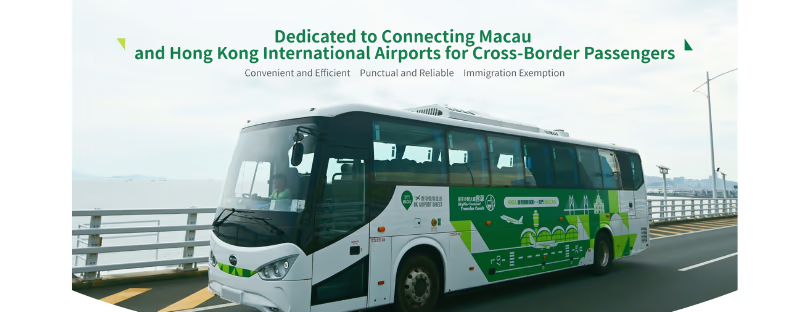
The Macao Government Tourism Office (MGTO) has officially partnered with a Hong Kong-Macau cross-border bus operator to launch free direct coach transfers for international travellers arriving at Hong Kong International Airport. The offer is aimed specifically at visitors arriving from outside the Greater China region and runs all the way until December 31, 2026.
For Macao, this is not just a transport perk. It is a strategic move in a very competitive regional tourism landscape.
A familiar strategy with a sharper focus
This is not the first time MGTO has experimented with cross-border transport incentives. Similar initiatives rolled out in 2024 and 2025 tested how much friction-free travel influences international visitor behaviour. The answer was clear. When you remove visa queues, ferry terminals, ticket confusion, and time penalties, travellers are far more willing to add Macao to their itinerary.
This latest version takes that logic further. Instead of asking travellers to exit Hong Kong, clear immigration, and then continue their journey, the transfer operates entirely within the restricted area of the airport. That means no passport control, no baggage recheck, and no city detour.
For travellers stepping off long-haul flights from Europe, North America, or the Middle East, this matters more than any discount.
How the free coach transfer works in practice
Eligible international visitors arriving at Hong Kong International Airport can head to a designated counter inside the restricted area to complete basic formalities. Once approved, they receive a free one-way coach ticket for a direct transfer from the SkyPier Terminal to Macao via the Hong Kong Zhuhai Macao Bridge.
The journey takes around 30 to 45 minutes to cover the 55-kilometre distance between Hong Kong and Macao. The service operates around the clock, aligning well with late-night and early-morning international arrivals.
Bookings are available through the operator’s official website, and within the offer period, travellers can use the free coach ticket multiple times, subject to seat availability. As expected, the promotion operates on a quota system and is governed by specific terms and conditions.
The bridge that made this possible
None of this works without the Hong Kong-Zhuhai-Macao Bridge, a piece of infrastructure that quietly reshaped regional mobility when it opened in 2018.
Built at a cost of US$18.8 billion, the bridge is both the longest sea crossing and the longest open-sea fixed link in the world. It combines three bridges, an undersea tunnel, and four artificial islands, creating a continuous 24-hour connection between Hong Kong, Zhuhai, and Macao.
What used to be a three-hour journey involving ferries or indirect road routes now takes under 45 minutes. For tourism planners, this has turned Macao into a realistic extension of any Hong Kong trip rather than a separate decision.

Why Macao still needs incentives
Macao’s global image remains heavily tied to gaming. The city’s massive casino resorts and luxury malls have earned it the nickname “Las Vegas of Asia,” but that branding can be a double-edged sword.
While casino tourism rebounded quickly post-pandemic, attracting broader international audiences has been slower. Many long-haul travellers still see Macao as optional rather than essential. Transport friction only reinforces that perception.
By removing cost and complexity at the point of arrival, MGTO is effectively reframing Macao as a natural continuation of a Hong Kong journey rather than a separate destination that requires effort to reach.
Marketing beyond the bus ticket
The free coach service is not being launched quietly. MGTO and the transport operator are rolling out coordinated online and offline promotions, working closely with airlines and travel agencies across multiple source markets.
Social media campaigns, airline partnerships, and bundled itinerary messaging are designed to position Macao as part of a twin-destination experience. This aligns with a broader trend across Asia, where destinations are collaborating rather than competing for stopover traffic.
Singapore, Seoul, and even Dubai have all leaned into stopover tourism models in recent years. Macao’s approach is different but equally pragmatic. Instead of selling nights, it is selling ease.
Alternatives still exist, but convenience wins
Travellers flying into Hong Kong still have multiple ways to reach Macao. High-speed ferries remain popular, private car transfers cater to premium travellers, and the 24-hour Golden Shuttle Bus continues to operate across the bridge.
But none of those options remove immigration friction or cost entirely. The free direct coach stands out because it turns what used to be a logistical decision into an almost automatic choice.
In a region where travellers are increasingly time-poor and experience-rich, convenience is becoming the most powerful currency.

What this says about regional tourism trends
This move places Macao firmly in line with a growing trend toward seamless, infrastructure-led tourism growth. Rather than relying solely on new attractions or hotel openings, destinations are investing in smarter access.
Japan has expanded airport rail links. Thailand is experimenting with multi-city visa-free travel. The Gulf states are building airline-led stopover ecosystems. Macao uses buses and bridges.
Different tools, same logic.
Conclusion
What makes this initiative interesting is not the free ticket itself, but what it signals. Macao is competing not just with neighbouring cities, but with global destinations that understand how critical first impressions are. When travellers land after a 12-hour flight, every additional step feels heavier than it should.
By absorbing that friction at the airport, MGTO is effectively buying goodwill at the most decisive moment of a journey. Compared to traditional tourism incentives like hotel discounts or attraction bundles, this approach is cheaper, more scalable, and arguably more impactful.
If the data from 2024 and 2025 repeats itself, other destinations connected to major aviation hubs will be watching closely. Seamless transfers are no longer a luxury. They are becoming a baseline expectation.
Reliable reporting from regional aviation authorities, infrastructure operators, and tourism boards consistently shows that convenience drives conversion. Macao’s free direct coach is a textbook example of that insight put into practice.