eSIMo Raises $10M to Scale Global Expansion
eSIMo has closed a $10 million funding round, backed by a UK investment fund that acquired shares and options in the company. On the surface, it looks like another startup capital injection in a fast-moving sector. In reality, it is something more important: a validation moment for the travel eSIM model as a scalable, global telecom layer.
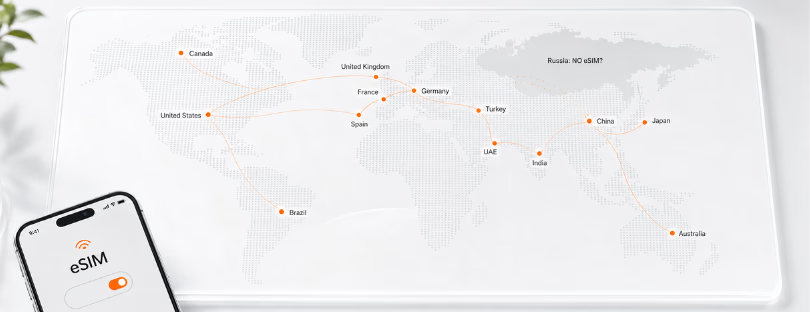
The company operates in more than 190 destinations and connects across 400-plus cellular networks. That level of coverage is no longer unusual in the eSIM world. What is unusual is the speed at which players like eSIMo are scaling revenue and customer acquisition. According to the company, it recorded approximately 400 percent revenue growth in 2025 compared to 2024 and now serves more than one million paying customers with a team of around 25 employees globally.
For an industry that, just a few years ago, was still educating users on what an embedded SIM actually is, this pace matters.
Market momentum
The global eSIM market is estimated at between 9.9 and 11.74 billion dollars in 2025, depending on the source and methodology. Analysts from firms such as Counterpoint Research and Juniper Research have consistently projected double-digit annual growth, driven by smartphones, IoT devices, connected cars and travel connectivity.
An eSIM is a programmable SIM embedded directly into a device. Instead of physically swapping plastic cards, users download a network profile digitally. That simple shift removes distribution friction, logistics costs and retail dependency. It also changes consumer behavior.
North America accounts for roughly 35 percent of the market due to early adoption by major operators and device manufacturers. But the fastest acceleration is now visible in Asia and parts of Africa, where mobile-first populations and price-sensitive travelers are driving demand for flexible, prepaid connectivity.
Funding rounds like this are not happening in a vacuum. They follow broader signals. Apple’s continued push toward eSIM-only devices in the United States. Google and Samsung are expanding eSIM compatibility across mid-range models. And travel is rebounding strongly after pandemic slowdowns, with international arrivals approaching pre 2020 levels according to UN Tourism.
When travel returns, roaming pain returns with it. And that is where companies like eSIMo position themselves.
What eSIMo actually offers
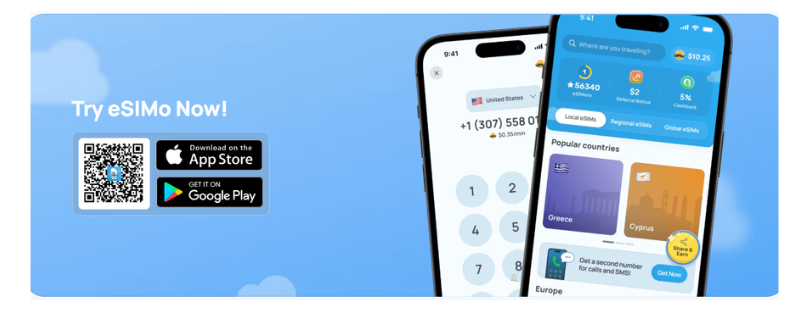
The core proposition is straightforward: affordable mobile data abroad without traditional roaming markups. But eSIMo is not limited to data.
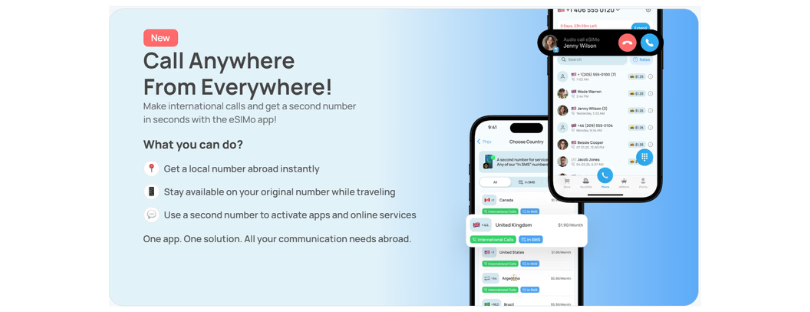
Beyond regional and global data plans, the company offers voice capabilities and local numbers in selected markets. This matters more than many realize. Data alone solves browsing and app usage. Voice and numbers solve identity and accessibility.
For frequent travelers, having a local number can increase callback rates, improve trust with clients, and simplify local service registrations. For leisure travelers, it removes the friction of constantly sharing temporary numbers. For digital nomads, it creates a semi-stable telecom identity that moves with them.
The platform claims 24/7 multilingual support, competitive pricing compared to operator roaming, and activation through a single app. The operational footprint across 400-plus networks suggests a broad set of wholesale agreements or aggregator partnerships behind the scenes.
This is not a small lifestyle app experiment. It is infrastructure assembled through global telecom relationships.
Why growth is accelerating
Roaming economics have always been controversial. Even within the European Union, where roam like at home rules apply, global roaming outside the bloc can quickly become expensive. In markets like the United States, Australia or parts of Asia, daily roaming passes often cost between 10 and 15 dollars per day.
Travel eSIM providers exploit the gap between wholesale data rates and retail roaming packages. By pre-negotiating data volumes and distributing them digitally, they can undercut traditional roaming while preserving margins.
But price is only one layer. The deeper driver is predictability. Consumers increasingly expect their connectivity to behave like streaming subscriptions. Open an app. Choose a plan. Pay transparently. Activate instantly.
eSIMo’s reported 400 percent revenue growth suggests that user education is no longer the main bottleneck. Awareness has crossed a threshold. Travelers now actively search for “eSIM for Japan” or “best eSIM for USA” before departure. The buying journey has shifted from airport kiosks to app stores and comparison platforms.
What the funding will fuel
According to the company, the $10 million will be allocated to global growth and marketing, product development, team expansion and entry into new markets. It also plans to leverage higher purchasing volumes to negotiate better wholesale rates and reduce end user prices further.
That scale play is critical. In the eSIM space, margins are directly linked to volume. Larger purchasing blocks improve bargaining power with carriers and connectivity aggregators. That, in turn, allows either sharper pricing or stronger reinvestment into brand and distribution.
CEO Liroy Tisona summarized the ambition clearly:
“We’re building a global digital communications company -one that lets people connect from anywhere in the world through one app, without contracts, without complexity, and without inflated prices. This is a big change in how people consume communications.”
The phrasing reflects a broader industry shift. Telecom is moving from national operator logic to platform logic.
Competitive landscape
eSIMo operates in a crowded field. Players like Airalo, Holafly, and Nomad have already built strong consumer recognition. Some emphasize unlimited plans. Others focus on aggressive pricing. A few build marketplace models aggregating multiple suppliers.
Where eSIMo appears to differentiate is the combination of global coverage, voice and number services, and rapid growth metrics. Many travel eSIM brands remain data only. Adding voice and number layers positions the company closer to becoming a portable telecom identity rather than a temporary travel add on.
At the same time, competition is intensifying. New white label platforms allow travel agencies, airlines and fintech apps to embed eSIM offers directly into their user journeys. Infrastructure providers are lowering entry barriers for new brands.
This means capital alone will not guarantee dominance. Brand trust, app performance, network quality and transparent pricing will determine long term winners.
Adoption beyond tourism
It is easy to frame eSIMo purely as a travel solution. That would be incomplete.
The broader eSIM wave includes enterprise mobility, IoT deployments, remote workforce enablement and connected devices. As more laptops, tablets and even wearables integrate eSIM, the addressable market expands beyond short term tourists.
Voice and number services could also support remote teams needing temporary presence in multiple regions. Small businesses testing new markets may prefer app based number activation over traditional telecom contracts.
In that context, this funding round is not just about summer travel packages. It is about positioning within a structural telecom transition.
What this means for the market
Capital inflows into mid sized eSIM players indicate investor confidence that the model is not a passing trend. Market analysts expect continued double digit growth as device penetration increases and operator resistance softens.
At the same time, regulatory environments will influence the pace. Some markets remain cautious about full eSIM onboarding without physical verification. Others actively encourage digital provisioning.
For consumers, the practical impact is simple: more choice, more competitive pricing, and increasingly integrated services. For traditional mobile operators, the pressure is mounting to rethink roaming pricing structures and digital onboarding.
A real turning point
This funding round is not the largest in the sector. It is not the first. But it represents something meaningful: a mid stage eSIM company proving that global digital connectivity can scale rapidly with a lean team and app first distribution.
Compared with established names like Airalo and Holafly, eSIMo is still building brand equity. Compared with white label infrastructure providers, it is closer to the end consumer. That hybrid positioning can be powerful if executed correctly.
The broader trend is clear. Connectivity is becoming borderless software rather than geography-bound hardware. As research from Juniper and GSMA Intelligence suggests, embedded SIM adoption will continue rising across consumer and enterprise devices throughout the decade.
In that environment, the winners will not be those who simply offer the cheapest gigabyte. They will be those who deliver stable performance, transparent pricing, and seamless activation across regions. If eSIMo uses its $10 million not just for marketing, but for strengthening network partnerships, improving app reliability, and expanding voice and number capabilities, it could move from being a travel convenience brand to becoming a recognized global telecom platform.
For the eSIM industry, this is another step away from experimentation and closer to normalization. Digital SIMs are no longer niche. They are infrastructure. And funding rounds like this confirm that investors believe the shift is permanent.