How eSIM providers differ on security
If you buy travel eSIMs often enough, you start noticing something: most providers market “coverage” and “price” like security is a solved problem. And yes, at the lowest level, eSIM is built on serious security engineering. The eUICC is a secure element, remote provisioning is standardized, crypto is everywhere.
But here’s the catch. Not every eSIM provider sits in the same part of the stack, and not everyone operates with the same controls, audits, or incentives. That is why security differences show up in the boring places: how profiles are issued, where the SM-DP+ lives, who has access, what’s logged, how support verifies you, and what happens when something goes wrong.
So instead of “Is eSIM secure?”, the more useful question is: what kind of eSIM provider are you buying from, and what security promises can they actually prove?
The eSIM stack people forget exists
When you purchase a travel eSIM, you are not just buying “data.” You are stepping into an ecosystem that typically includes:
- the eUICC (the secure chip or secure element in your device)
- Remote SIM Provisioning components (especially SM-DP+ for consumer eSIM)
- an operator profile (credentials that authenticate you to a network)
- a provider layer (the brand you paid)
- sometimes one or more aggregators or intermediaries
GSMA publishes and maintains the consumer and IoT eSIM specifications and compliance frameworks that define how this all should work, securely.
That is the foundation. What differs is how cleanly each provider implements it, and how much of it they truly control.
Certification: “secure by design” is not the same as “secure in operation”
If you want a quick filter, look for evidence in two buckets:
Bucket 1: product and component assurance
Some parts of the eSIM world can be evaluated against structured security schemes. GSMA’s eUICC Security Assurance (eSA) is a scheme focused on evaluating eUICC software security, built to create consistent assurance for the ecosystem.
Bucket 2: operational accreditation
Even if the tech is solid, security collapses if the provisioning platform is run like a hobby project. GSMA’s Security Accreditation Scheme (SAS) exists for exactly this reason: it’s designed to build trust across SIM production and subscription management suppliers, including subscription management environments used in eSIM provisioning.
READ MORE: Provisioning Is Becoming the Boring Part of eSIM
In plain terms, eSA is about “is the eUICC robust against attackers?” and SAS is about “is the environment that handles profiles run to security expectations?” Not every travel eSIM brand can credibly talk about either, because many are not the entity being evaluated.

Provider type matters more than the logo
This is where buyers get tricked by branding. Two apps can look identical and still have very different security realities.
Marketplace-style travel eSIM brands
These are often “front-ends” that sell plans sourced from multiple partners. That is not automatically bad, but it changes the risk shape:
- more parties touch provisioning and support
- more systems handle identifiers, QR codes, and activation flows
- more room for weak account recovery or sloppy customer support processes
Security research on consumer RSP has highlighted how important it is to analyze the full protocol and implementation details, because the ecosystem is complex and small weaknesses compound.
MNO-run or MNO-adjacent eSIM offers
Operators typically live deeper in the chain and have mature processes (not always, but usually). They are also directly exposed to SIM swap risk, fraud pressures, and regulatory scrutiny, which forces investment in controls.
ENISA’s work on SIM swapping is a good reminder that a lot of “eSIM security incidents” are not crypto failures. They are identity and process failures, often during swaps and customer verification.
Enterprise-focused providers
If you are managing business travel at scale, the security conversation changes again. Enterprise players tend to offer:
- admin controls and role-based access
- clearer auditability
- stronger onboarding and identity verification patterns
- tighter incident workflows
They also tend to be more honest about what matters: not just “secure provisioning,” but secure operations.
The real-world weak points where providers differ
Here’s where differences show up in practice, even when everyone uses the same standards.
Account security and identity proofing
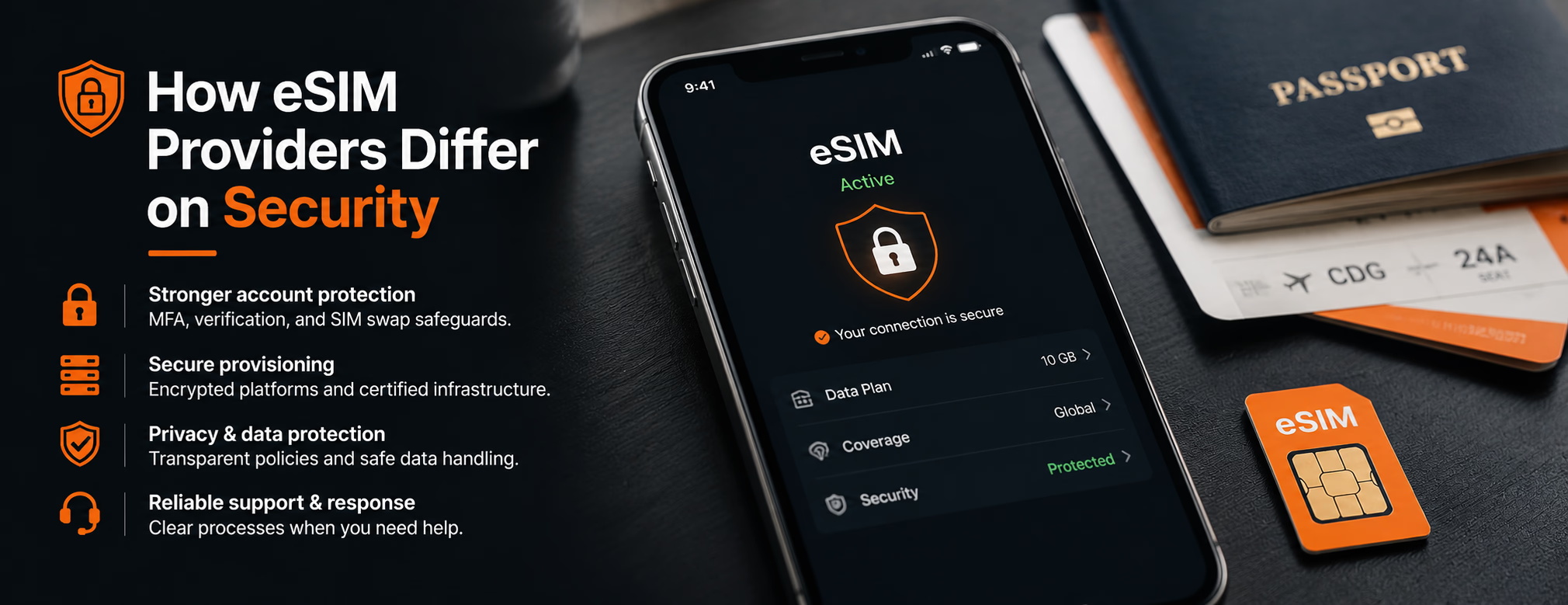
If an attacker can reset your password or convince support to reissue an eSIM, the standards do not save you. Providers vary massively on:
- MFA availability and enforcement
- support verification rigor
- swap and reissue safeguards
This is exactly why SIM swap mitigation has become such a major focus in telecom security discussions.

Provisioning platform hygiene
If a provider is operating (or outsourcing) SM-DP+ infrastructure, questions that matter include:
- key management practices (often involving HSMs)
- segmentation and access control
- logging, monitoring, and incident response maturity
Even vendor guidance aimed at eSIM ecosystems emphasizes how provisioning security relies on strong cryptographic key protection and operational controls, not just “the chip is secure.”
Privacy, routing, and jurisdiction
Security is not only about “can someone hack the eSIM.” It’s also about where your traffic and metadata travel, and who can see what.
ENISA’s eSIM ecosystem report frames security challenges and mitigation measures across the broader system, including ecosystem dependencies and risks beyond the secure element itself.
READ MORE: What is a SM-DP+ Server? Understanding the Backbone of eSIM Provisioning
In travel eSIM land, especially, the provider you pay may not be the operator actually carrying your traffic, and your “local” experience might still involve international routing. This is not inherently malicious, but it’s absolutely a security and privacy consideration if you are a business traveler.
Transparency and accountability
A simple but underrated signal: can the provider clearly explain who they are in the chain?
- Do they name their operator partners?
- Do they describe support processes for compromise and reissue?
- Do they publish security posture basics (MFA, incident response, audits)?
The more opaque the answer, the more the burden shifts to trust.
What to ask before you recommend any provider
If you’re evaluating providers for Alertify readers, or for a corporate travel program, these questions cut through the noise fast.
Security checklist
- Do you support MFA, and can it be enforced?
- What is your account recovery process, and what proofs are required?
- Who operates the SM-DP+ infrastructure behind your offers?
- Do you align with GSMA compliance frameworks for eSIM devices and subscription management systems?
- Do you have evidence of security assurance or accreditation in the relevant parts of the chain (not just vague “we take security seriously” language)?
- If a profile is compromised or a device is lost, what is the step-by-step response?
If a provider cannot answer half of that clearly, the security differences are already showing.
Conclusion about eSIM provider security differences
The eSIM market is maturing in two directions at once. On one side, standards and assurance schemes are getting stronger and more formalized, with GSMA continuing to expand and optimize how eUICC security assurance is evaluated. On the other side, the travel eSIM boom has created a long tail of brands that look polished but operate as thin layers over complex supply chains.
So the security gap between providers is rarely about “does eSIM use encryption” (it does). It’s about operational seriousness: identity proofing that resists SIM swap style attacks, provisioning infrastructure run under disciplined controls, and transparency about who is responsible when something breaks. ENISA’s reporting makes the same point in a different language: eSIM security is ecosystem security, and risks live in relationships, processes, and dependencies, not only in the chip.
The trend to watch in 2026 is that buyers, especially business travelers and corporate travel teams, are starting to reward “boringly secure” providers: those who can prove assurance, explain their chain, and treat support and swaps as security-critical workflows. The eSIM brands that win long-term will not be the loudest about security. They will be the ones who make security feel invisible, because they engineered the messy parts out of your day.