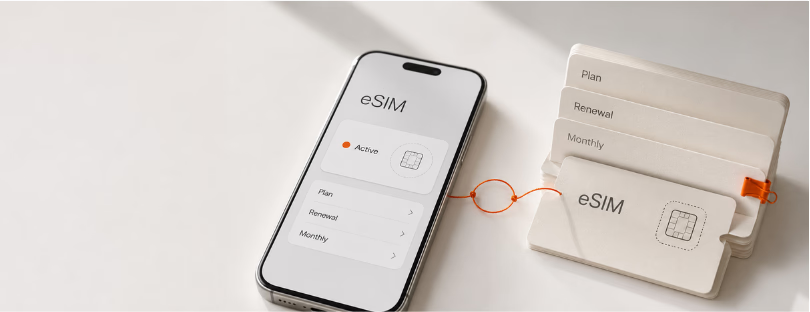
eSIM Adoption Is Exploding, but Smartphones Aren’t the Reason
New forecasts suggest that global eSIM adoption is about to hit another inflection point. According to fresh data from Juniper Research, the number of eSIM-enabled devices worldwide is expected to rise by around 30 percent in 2026, growing from 1.2 billion in 2025 to roughly 1.5 billion.
At first glance, that sounds like another smartphone-driven success story. In reality, phones are not the main engine behind this growth. The next wave of eSIM adoption is being pushed by machines, infrastructure, and enterprise systems rather than consumers upgrading their handsets.
The biggest gains are coming from connected logistics, oil and gas operations, and smart street lighting. Together, these three sectors alone are expected to add around 75 million new eSIM connections to global networks in 2026. This is not about convenience features or travel savings. It is about scale, automation, and control.
Why IoT is now leading the eSIM story
The turning point for enterprise eSIM adoption arrived with the launch of the GSMA’s SGP.32 IoT eSIM specification in 2025. Unlike earlier standards designed around consumer devices, SGP.32 was built specifically for large-scale IoT deployments.
Instead of requiring each device to individually download and activate a profile, SGP.32 enables server-driven bulk provisioning. In practical terms, this allows enterprises to activate, switch, or manage thousands of devices simultaneously from a centralized system.
That shift matters. Logistics fleets, energy infrastructure, and smart cities do not operate on consumer timelines or manual processes. They require connectivity that can be deployed remotely, updated instantly, and scaled globally without physical intervention.
Juniper’s analysts believe this standard will be the foundation for most new enterprise eSIM growth over the next several years, especially as organizations modernize legacy machine-to-machine deployments.
The provisioning model problem no one can ignore
However, Juniper’s research also flags a structural challenge that the eSIM industry is still catching up with. Historically, eSIM provisioning followed a pull model, where each device downloads its own profile when needed.
That approach works for smartphones and individual users. It breaks down when enterprises attempt to provision tens of thousands of sensors, meters, or vehicles at once.
As deployment patterns shift toward centralized IT and operations teams, eSIM platforms are being pushed into unfamiliar territory. According to Juniper, vendors must now build true push-provisioning capabilities that allow enterprises to manage connectivity at scale.
“For enterprise IoT users, it is inefficient to use a pull model to provision so many devices, and eSIM platforms must adapt,”
said Senior Research Analyst Ardit Ballhysa.
This is a key moment for eSIM platform providers. Those that remain consumer-focused risk being sidelined, while platforms that invest in enterprise-grade orchestration, automation, and API-driven provisioning stand to dominate the next phase of the market.
iSIM quietly moves into the spotlight
Alongside eSIMs, another technology is gaining momentum with far less public attention. Integrated SIM, or iSIM, removes the need for a dedicated SIM module altogether by embedding connectivity directly into a device’s main chipset.
Juniper previously forecast that iSIM connections would grow by more than 1,200 percent, rising from around 800,000 in 2024 to 10 million by 2026. That growth is being driven by the GSMA’s SGP.41 and SGP.42 specifications, which aim to standardize iSIM deployment and reduce complexity for manufacturers.
iSIMs are particularly attractive for smart energy meters, compact logistics trackers, and ultra-low-power devices where space, cost, and energy efficiency matter more than flexibility. Looking further ahead, Juniper expects the number of iSIM connections to reach 210 million by 2028.
“eSIM vendors must ensure that they provide standard-agnostic platforms that are flexible to upcoming form factors, standards and use-case demands,”
wrote report author Elisha Sudlow-Poole.
The implication is clear. Connectivity providers can no longer optimize solely for eSIM or iSIM. The winners will be those that abstract the underlying technology and offer unified management across both.
Consumer eSIM demand is still rising, just differently
While enterprise and IoT deployments are doing the heavy lifting, consumer eSIM adoption continues to grow steadily, especially in travel. Separate data from CCS Insight shows that around a quarter of UK consumers have already used an eSIM to access local mobile rates while abroad.
This aligns with what travel-focused eSIM providers have been reporting for the past two years. Convenience, instant activation, and predictable pricing remain the main drivers. At the same time, frustration with rising mobile tariffs is changing consumer behavior at home.
Nearly half of UK users now rely on SIM-only contracts and are holding onto their devices for longer, extending upgrade cycles. That trend indirectly benefits eSIM adoption, since users are becoming more comfortable managing connectivity independently rather than through bundled carrier plans.
Unlike enterprise deployments, consumer eSIMs still rely on the familiar pull model. Users scan a QR code, download a profile, and activate when needed. For now, that remains sufficient for travel and personal use.

What this means for the eSIM market
The eSIM narrative is splitting into two distinct paths. On one side, consumer eSIMs continue to expand through travel, secondary lines, and flexible data plans. On the other hand, enterprise eSIMs are becoming a core infrastructure technology for industries that depend on always-on connectivity.
Major players across the ecosystem are adjusting accordingly. Mobile operators are investing in IoT connectivity platforms. Specialized providers are focusing on logistics, automotive, and energy verticals. Hardware manufacturers are increasingly designing devices with eSIM and iSIM support baked in from day one.
At the same time, standards bodies like the GSMA are accelerating work on interoperability to prevent fragmentation as form factors multiply.
Conclusion
The most important takeaway from the latest data is not the headline growth numbers, but where that growth is coming from. eSIM adoption is no longer driven primarily by smartphones or consumer choice. It is being shaped by enterprises that view connectivity as infrastructure rather than a product.
Compared to earlier cycles dominated by consumer carriers, today’s eSIM market looks more like cloud computing did a decade ago. Centralized control, automation, and scale matter more than branding or retail distribution. Providers that fail to evolve beyond consumer provisioning models will struggle to remain relevant.
Reliable sources like Juniper Research, CCS Insight, and the GSMA all point in the same direction. The future of eSIM is quieter, more industrial, and far more strategic than most consumers realize. For the industry, that shift may prove to be its most important transformation yet.