Tap to Pay on iPhone
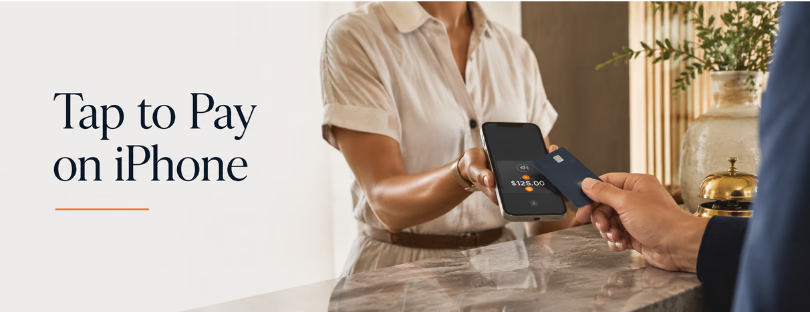
Tap to Pay on iPhone sounds almost too simple to matter. A merchant opens a supported app, enters the amount, shows the iPhone to the customer, and the customer taps a contactless card, Apple Pay, Apple Watch, or another digital wallet near the phone. No separate card reader. No terminal sitting on the counter. No small plastic device that needs charging at the worst possible moment.
But that simplicity is exactly why this matters.
Apple has been steadily expanding Tap to Pay on iPhone across Europe and beyond. Key Countries & Regions with Tap to Pay on iPhone (as of May 2026):
- Europe: Austria, Belgium, Bulgaria, Croatia, Cyprus, Czech Republic, Denmark, Estonia, Finland, France, Germany, Gibraltar, Greece, Hungary, Iceland, Ireland, Italy, Latvia, Liechtenstein, Lithuania, Luxembourg, Malta, Netherlands, Norway, Poland, Portugal, Romania, Slovakia, Slovenia, Spain, Sweden, Switzerland, UK.
- North America: United States, Canada, Mexico.
- Asia-Pacific: Australia, Japan, Malaysia, New Zealand, Singapore.
Apple’s developer documentation also makes clear that availability depends on supported countries, regions, and participating payment service providers.
For Alertify readers, this is not just a payments story. It is a travel-tech story, a small-business story, and, quietly, a platform-control story.
Why merchants care
For small merchants, the appeal is obvious. A tour guide in Split. A pop-up shop at an airport event. A hotel concierge selling last-minute add-ons. A food truck outside a festival. A freelance driver. A market vendor. These businesses do not necessarily want another piece of hardware, another contract, another setup process.
Tap to Pay on iPhone turns the phone they already carry into a payment acceptance device, as long as they use a supported payment app from providers such as Stripe, Adyen, SumUp, Square, Revolut, PayPal, Viva.com, Nexi, or other local partners depending on the market. Stripe describes the product as a way to accept in-person payments with only an iPhone through Stripe Terminal, while Adyen positions it as a way to reduce queues and support more flexible checkout setups.
READ MORE: Apple Pay App: The Quiet Power Move Inside Your iPhone
This is where the feature becomes interesting. It does not replace the serious point-of-sale systems used by supermarkets, hotel chains, or large retailers. Those businesses still need inventory, reconciliation, staff permissions, loyalty, refunds, reporting, and integration with accounting systems. But Tap to Pay removes friction at the edge of commerce.
And travel is full of edges.
Think of a kayak rental company, a boutique hotel upselling late checkout, a tourist shuttle, or a local guide collecting payment on the street after a walking tour. These are the exact moments where card acceptance used to be clumsy. Tap to Pay makes those moments feel normal.
Not Apple Pay, but Apple infrastructure
One common confusion is the difference between Apple Pay and Tap to Pay on iPhone.
Apple Pay is what the customer uses to pay. Tap to Pay on iPhone is what the merchant uses to accept the payment. The merchant’s iPhone becomes the contactless reader. The customer can pay with Apple Pay, but also with a contactless card or other digital wallets, depending on the setup and supported payment networks.
That distinction matters because Apple is not simply adding another consumer convenience. It is pushing the iPhone deeper into the merchant stack.
This is a very Apple move. The company does not need to own the whole payment relationship to influence the experience. It controls the device, the NFC capability, the security layer, the operating system experience, and the developer framework. Payment processors still process. Banks still issue cards. Networks such as Visa and Mastercard still move transactions. But the checkout surface starts to look more like software than hardware.
That is a big shift.

The regulatory shadow
There is also a European subplot here, and it is important.
In July 2024, the European Commission made Apple’s commitments legally binding under EU antitrust rules, addressing concerns around Apple’s restrictions on access to NFC technology for contactless payments on iPhones. The commitments were designed to open access to “tap and go” technology and increase competition in mobile wallets.
This does not mean Tap to Pay on iPhone and third-party NFC wallet access are the same thing. They are separate parts of the broader iPhone payments ecosystem. But they point in the same direction: the iPhone is becoming a more open, more contested, and more commercially important payment interface.
For years, Apple’s payment story was mostly consumer-facing: add your card, pay with your phone, enjoy the smooth Apple Pay moment. Now the merchant side is becoming just as strategic.
The competitors are not standing still
Apple is not alone in this space. Android has supported “softPOS” style payment acceptance for years through various payment providers and terminal apps. SumUp, Zettle, Square, Stripe, Adyen, Viva.com, Revolut, and local banks all want to own the merchant relationship, especially among SMEs and mobile-first businesses.
The difference is that Apple has enormous influence over premium small-business behavior. Many independent business owners already use iPhones. Many hospitality operators, consultants, event sellers, creators, and travel professionals live on iOS. Giving them payment acceptance inside the same device lowers the mental barrier.
READ MORE: Google Pay App Explained: Setup, Use & Travel Tips
Still, Apple is not replacing Stripe or Adyen here. It is enabling them, while also making itself harder to ignore. Stripe can embed Tap to Pay into platforms. Adyen can offer it to larger merchants looking for mobile checkout. SumUp can bring it to micro-merchants in local markets. Apple provides the device-native acceptance layer, but the real commercial battle happens around onboarding, fees, support, analytics, payouts, and business tools.
That is where payment companies will compete.
What this means for travel
Travel has always been a messy payment environment. Different currencies, temporary locations, seasonal staff, pop-up demand, cross-border visitors, and consumers who increasingly expect contactless everything.
Tap to Pay on iPhone fits that world unusually well. It is not glamorous. It will not make headlines like AI concierge tools or biometric airports. But it solves a very real problem: how do you accept money quickly, securely, and without adding operational weight?
For hotels, it could support mobile check-in desks, poolside payments, event add-ons, or concierge services. For tour operators, it can reduce cash handling. For tourism boards and event organizers, it makes temporary commerce easier. For travel retailers, it can turn staff into roaming checkout points rather than forcing customers into one queue.
The stronger point is this: commerce is becoming more mobile, and the checkout is moving closer to the customer.
Conclusion
Tap to Pay on iPhone is not revolutionary because tapping a card on a phone feels futuristic. It is powerful because it makes payment hardware feel optional.
That puts pressure on the old terminal model, but it also raises expectations for payment providers. The winners will not be the companies that simply say “you can accept cards on an iPhone.” Soon, that will be basic. The winners will be the ones that wrap Tap to Pay into a better merchant experience: fast onboarding, transparent pricing, useful reporting, easy refunds, multi-location controls, hotel and travel integrations, and support that actually works when a merchant is standing in front of a customer.
For Apple, the move strengthens the iPhone as business infrastructure. For Stripe, Adyen, SumUp, Revolut, and others, it opens another distribution layer. For travel businesses, it removes one more excuse for clunky payment moments.
The quiet trend is bigger than payments. The phone is becoming the terminal, the wallet, the travel document, the room key, the boarding pass, the eSIM manager, and the customer-service screen. Tap to Pay on iPhone is one more sign that travel technology is not moving toward more devices. It is moving toward fewer, smarter ones.