Airalo Reaches 10M Users, Launches B2B Platform
Airalo has officially crossed the 10 million users mark.
On the surface, that’s a strong growth milestone. In reality, it tells a much bigger story about where the travel eSIM market is heading and how companies like Airalo are repositioning themselves beyond simple consumer apps.
Because alongside that announcement, Airalo introduced something far more strategic: Airalo Partners, a B2B and B2B2C platform designed for resellers, travel businesses, and corporate clients.
And that’s where things get interesting.
From consumer app to distribution platform
Airalo built its reputation on a simple promise: make it easy for travelers to get data abroad without dealing with physical SIM cards or expensive roaming.
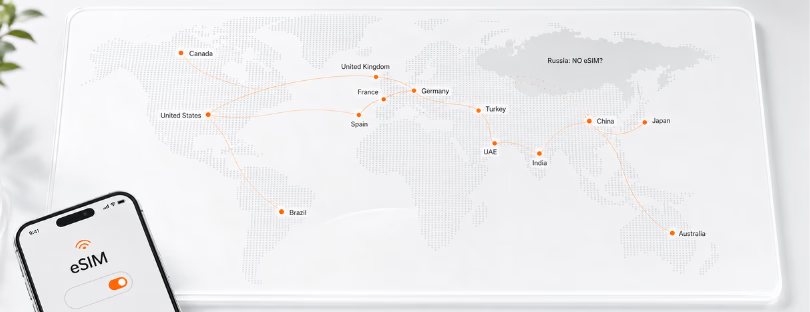
That model worked. More than 10 million users across over 230 countries and regions now rely on the platform, with support available in 50+ languages. In several markets, Airalo has even reached the top rankings in mobile app stores within the travel category.
But scale like this does something to a company. It forces a shift.
At a certain point, growth is no longer just about acquiring more users. It becomes about how efficiently you can reach them.
And in today’s eSIM market, that means one thing: distribution.
Airalo is no longer just selling eSIMs to travelers. It’s building the infrastructure to let others sell them too.
What Airalo Partners actually is
Airalo Partners is positioned as an all-in-one platform for businesses that want to integrate connectivity into their own offerings.
That includes:
- travel agencies and tour operators
- resellers and affiliate partners
- corporates managing employee connectivity
- digital platforms looking to embed eSIM into their services
Instead of sending users to the Airalo app, these partners can now buy, manage, and distribute eSIMs directly to their own customers or teams.
In practical terms, this turns connectivity into a flexible, programmable layer rather than a standalone product.
It also builds on Airalo’s existing partner ecosystem, which already includes its API and affiliate program. The difference now is consolidation. One platform, multiple routes to market.
For partners, that means less friction. For Airalo, it means tighter control over how and where its product is distributed.


Why this move matters
The consumer eSIM market is getting crowded.
New providers enter every month. Pricing pressure is constant. Unlimited plans dominate marketing. And customer acquisition costs are rising fast, especially through paid channels like Google and social media.
In that environment, relying solely on direct-to-consumer growth becomes expensive and difficult to scale efficiently.
This is why B2B is becoming central.
Airalo already works with more than 5,000 partners globally. With Airalo Partners, it is formalizing and expanding that ecosystem into something more structured and scalable.
The logic is simple.
Instead of paying to acquire every traveler individually, you integrate into platforms that already have users.
Airlines. Online travel agencies. Fintech apps. Corporate travel tools.
That’s where the next phase of growth is happening.
The broader shift: connectivity as a built-in feature
Airalo’s move reflects a larger transformation across the telecom and travel tech industries.
Connectivity is no longer being sold only as a product. It’s being embedded as a feature.
You don’t just buy data. It comes bundled with your travel booking, your bank account, or your company’s mobility solution.
This is already visible in parts of the market.
Some fintech apps now offer eSIM packages directly inside their platforms. Airlines are experimenting with bundled connectivity options. Corporate travel tools are integrating mobile data into employee workflows.
In this context, Airalo Partners is not just a new product. It is a positioning shift.
Airalo is moving from being a destination to becoming infrastructure.
What this means for Airalo’s position in the market
Airalo has long been one of the most recognized names in the travel eSIM space. Crossing 10 million users reinforces that position.
But recognition alone is not enough anymore.
The market is evolving into distinct layers.
Some players focus on consumer acquisition and brand visibility. Others push aggressive pricing or unlimited data positioning. A growing group is moving deeper into infrastructure, APIs, and enterprise solutions.
With Airalo Partners, Airalo is clearly expanding into that third layer.
It is not abandoning its consumer base. Instead, it is building a parallel growth engine that reduces reliance on direct acquisition and strengthens its role within the broader connectivity ecosystem.
This is a logical move, but it also introduces new challenges.
B2B platforms require different capabilities. Integration, support, customization, and partner management become critical. The expectations are higher, and the competition is different.
Airalo is no longer just competing with other travel eSIM apps. It is entering a space where telecom platforms, API providers, and enterprise connectivity solutions already operate.
The founders’ perspective
Co-founders Abraham Burak and Ahmet Bahadir Özdemir framed the milestone as both validation and a starting point for the next phase.
“We are happy to see that millions of travelers have been finding their needs addressed in Airalo and grateful to be writing this new chapter of travel connectivity with them. With our new platform, Airalo Partners, along with our various business-to-business offers, we will extend Airalo’s innovative and affordable solution to businesses and organizations across the globe.”
The emphasis here is important. The focus is no longer just on individual travelers. It is on extending connectivity to organizations and systems that serve those travelers.
Where this leaves the travel eSIM market
Airalo reaching 10 million users is significant, but it is also a signal of market maturity.
The first phase of travel eSIM adoption was about awareness. Convincing travelers to switch from roaming or physical SIM cards.
The second phase, which is now underway, is about integration and scale.
Who controls distribution.
Who embeds connectivity into existing user journeys.
Who reduces acquisition costs while increasing lifetime value.
Airalo Partners is a direct response to that shift.
Conclusion: growth is no longer about users, but about access
Crossing 10 million users confirms that Airalo is no longer an emerging player. It is part of the foundation of the travel eSIM category.
But the launch of Airalo Partners is the more important development.
It shows that the company understands where the market is heading.
The future of travel connectivity is not about convincing each traveler to download an app. It is about making connectivity available exactly where it is needed, often before the traveler even thinks about it.
In that future, the companies that win will not necessarily be the ones with the most users.
They will be the ones with the best access to users.
Airalo has taken a clear step in that direction. The question now is how effectively it can execute on this new layer while maintaining the simplicity that made it successful in the first place.