How AI Is Starting to Change eSIM Connectivity
For years, eSIM was sold as a convenience story: no plastic SIM, no airport kiosk, no roaming shock. Useful, yes, but too small for what is now happening.
The more interesting question in 2026 is not whether eSIM replaces the physical SIM. That shift is already moving. The real question is what happens when eSIM becomes part of a smarter connectivity layer shaped by automation, travel apps, fintech wallets, enterprise platforms and artificial intelligence.
AI is not “inside” most eSIM products in the magical way some marketing pages suggest. Your travel eSIM does not think for itself. It still depends on carrier agreements, provisioning systems, roaming routes, device settings and network quality. But AI is starting to appear around eSIM, especially in support, product development, network choice, fraud detection, enterprise mobility and travel personalization.
Where AI already fits
The first practical area is support. Anyone who has bought an eSIM late at night before an early flight knows the problem. Installation is easy until it is not. Locked phone, deleted profile, wrong APN, no QR code access, no signal on arrival. This is where AI chatbots and smarter help flows can reduce real friction, as long as they know when to hand over to a human.
Ubigi is one of the clearer examples publicly talking about AI in eSIM operations. Its parent company Transatel has described AI as part of Ubigi’s next innovation phase, including faster product development and an AI-powered chatbot handling a significant share of support queries.
READ MORE: Europe Is the Hardest Test for eSIMs — Most Quietly Fail It
The second area is network optimization. In theory, AI can help decide which available network gives a traveler the best result based on coverage, congestion, cost, latency and past performance. Airalo has described AI-powered network optimization as a future eSIM capability, where connectivity could automatically favor the best available network for speed, cost or reliability.
But this should not be oversold. In real life, it depends on how many networks the provider can access, what the roaming agreements allow, and whether the user actually feels the improvement. A reseller with one route and limited network control cannot become intelligent by adding the word AI.
 Who is using it
 Who is using it
Today, AI in eSIM is mostly visible in three places.
Infrastructure-led MVNOs and stronger global connectivity providers have more room to use AI because they control more of the stack: routing, support, pricing, product logic and performance data.
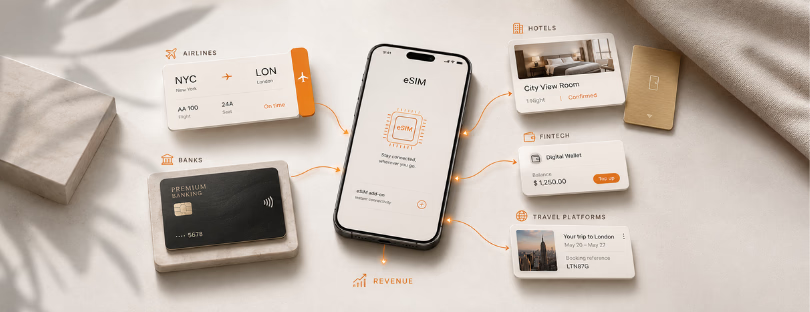
Embedded connectivity platforms are another area to watch. Gigs is a useful example of eSIM moving into fintech and lifestyle apps. Its recent PicPay launch brought a global eSIM directly into a banking app for premium users. That is not necessarily “AI eSIM” yet, but it shows where AI could become powerful: predicting travel intent, personalizing offers, and activating connectivity without making users search manually.
READ MORE: Explore eSIM Technology with a Free Trial
Enterprise and IoT may be even more interesting. Fleet devices, payment terminals, cameras, cars and industrial sensors do not care about a beautiful app. They care about uptime. AI can help identify failing connections, unusual usage, weak coverage zones or risky devices before a human notices. GSMA’s SGP.32 specification matters because it modernizes remote eSIM provisioning for IoT devices, including devices with limited screens or user interfaces.
The AI-washing risk
There is a quiet danger here: AI washing.
Some providers may start saying “AI-powered” when they really mean automated emails, a basic chatbot or a simple recommendation box. That does not make the product bad, but it does make the claim weak.
For travelers, the basics still matter more than the buzzword. Does the eSIM install easily? Is the phone unlocked? Is 5G really available? Can hotspot be used? Is unlimited actually usable, or just fair-use unlimited with vague limits?
AI can improve all of this. It cannot fix poor carrier agreements, confusing pricing or weak support.
Why GITEX AI Europe matters
This is why GITEX AI Europe in Berlin is worth watching for the connectivity industry. The 2026 edition takes place at Messe Berlin on 30 June and 1 July, after a large inaugural 2025 event that brought together exhibitors, startups, investors and public-sector technology leaders.
For eSIM, the importance is not that GITEX will become an eSIM trade show. It will not. Its value is that AI, cybersecurity, deep tech, quantum, enterprise software and digital infrastructure are being discussed together. That is exactly where eSIM now belongs.
The next phase of eSIM growth will not come only from cheaper travel data. It will come from smarter identity, secure device onboarding, embedded connectivity, enterprise control, fintech distribution, connected cars and IoT. Those are GITEX topics, even when eSIM is not named on the stage.
Conclusion about AI in eSIM connectivity
AI will not make every eSIM provider better. It may actually expose the difference between providers with real infrastructure and providers with thin branding.
Consumer-first names such as Airalo, Holafly, Yesim, Nomad eSIM, Saily and GigSky will likely use AI to improve discovery, support and personalization. Infrastructure-led players such as Ubigi, Gigs, 1GLOBAL, eSIM Go, Telna and enterprise IoT specialists have a different opportunity: using AI to improve provisioning, reliability, routing, fraud control and embedded connectivity at scale.
That is the bigger trend. eSIM is moving from “data for your trip” to “connectivity that appears inside the service you already use.” AI can make that transition feel invisible, but only if the basics are strong.
For travelers who just need 3GB for a weekend in Rome, this may be more than they need. A simple prepaid eSIM from a reliable provider is enough. For banks, airlines, hotels, enterprises and IoT platforms, AI plus eSIM is becoming a serious strategic layer.
The winners will not be the companies that put AI in the headline. They will be the ones that use it to remove decisions, reduce failure, improve trust and make connectivity feel like it was always there.