Yesim eSIM: More Than a Travel SIM
There’s a quiet confidence to how Yesim operates. No aggressive influencer campaigns, no flashy unlimited-data-for-$5 promises plastered across every travel forum. Just a product that’s been quietly growing since 2019, now sitting at over 3 million users and — perhaps most interestingly — backed by Genesis Group AG, a Swiss holding company registered in Zug. That corporate structure matters more than it sounds.
Most eSIM providers are essentially resellers operating on thin margins in a very crowded space. Yesim is positioning itself differently: as a connectivity platform with multiple revenue streams, a B2B layer, and a pricing philosophy that challenges how the rest of the market thinks about data monetization.
The Pay & Fly Model
The headline product worth examining is Pay & Fly — Yesim’s pay-as-you-go plan that works across 170+ countries on a single eSIM. You top up a Ycoins wallet, activate the plan, and get charged per MB used. Starting from $1.10 per GB, rates vary by country but the promise is consistent: no fixed packages, no expiry pressure, no leftover data you’ve paid for and never used.
This is fundamentally different from how Airalo or Holafly operate. Airalo sells bundles per destination — you pick 1GB, 3GB, 5GB and commit upfront. Holafly leans into unlimited plans with daily pricing. Both models push the user to estimate consumption before they travel, which is inherently imprecise. Yesim’s Pay & Fly sidesteps that entirely. You just use what you need.
The Ycoins balance is valid for 12 months, which removes the urgency that many providers rely on to drive repeat purchases. Auto top-up is available. For a frequent traveler making multiple short trips a year, a single funded eSIM that follows them across destinations without requiring new purchases each time is genuinely useful — not just a marketing claim.
What Else Is in the Stack
Beyond Pay & Fly, Yesim offers standard country and regional data packages (prepaid bundles for individual destinations, from about $1.52/day for Thailand to $3.04/day for the UAE), virtual phone numbers, a VPN layer baked into the app, and a loyalty program running on — again — Ycoins.
The virtual numbers product is worth flagging separately. It’s not something most travel eSIM providers bother with. Yesim offers local numbers across multiple countries, which makes this a useful territory for remote workers and digital nomads who need a verifiable local presence without a physical SIM. That’s a niche but growing segment, and it gives Yesim an additional revenue line that pure-data competitors don’t have.
On the B2B side, the OneBalance platform handles corporate eSIM management, while a Partner API lets third parties embed Yesim’s connectivity into their own products. This isn’t unique — Airalo and others have distribution APIs — but Yesim’s no-platform-fee angle on the B2B offering makes it more accessible for smaller operators and resellers.
The SwitchLess Networks feature is also worth noting: the system automatically moves users to a better network tier if one is available in their area. It’s a nice UX touch that addresses one of the most common travel eSIM frustrations — being stuck on a slow carrier because the eSIM profile is locked to one network.
The Numbers Behind the Brand
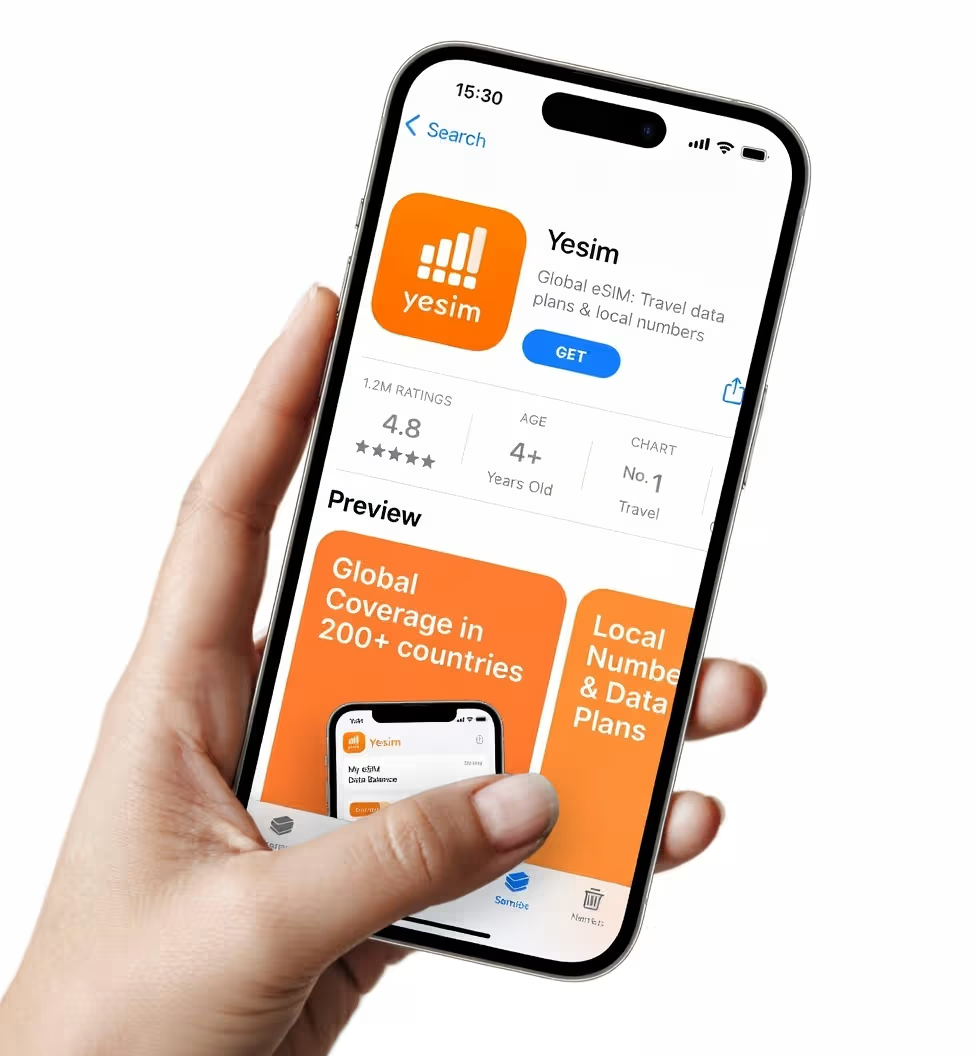
Five-plus years in the market. 3 million users. 50,000+ app ratings. A 4.5 App Store score and a 4.6 TrustScore on Trustpilot. Coverage across 200+ destinations, with partnerships across 800+ operators. These are solid figures for a company that hasn’t relied on heavy consumer advertising.
The Swiss incorporation via Genesis Group AG is not a detail to gloss over. It signals regulatory seriousness and a longer-term business horizon. When you’re handling recurring payments, wallet balances, and virtual numbers across dozens of jurisdictions, that kind of institutional backbone matters. It’s one reason Yesim doesn’t feel like a startup that could disappear in 18 months — a real concern with the wave of eSIM apps that have launched and quietly gone dark since 2020.
Where Yesim Fits
The Milwaukee Bucks‘ co-branding partnership visible on the footer is an interesting signal. It suggests Yesim is exploring white-label or co-branded distribution — the kind of move that Airalo has also been pursuing through its API channel and travel brand partnerships. It’s not a coincidence that both companies are thinking about embedded distribution at the same time. The next competitive frontier in travel eSIM isn’t who has the cheapest GB in Thailand. It’s who gets integrated into the booking flow, the travel app, the airline loyalty program.
The Bottom Line
Yesim occupies a genuinely distinct position in a market that’s starting to look dangerously commoditized. Where Airalo wins on brand recognition and catalog depth, and Holafly wins on simplicity for unlimited-data seekers, Yesim’s real differentiation is architectural: a wallet-based, usage-driven model backed by a B2B stack and virtual number capabilities. That combination makes it more platform than product.
The risk is that pay-as-you-go pricing, while rational, is harder to market than “unlimited data from $x.” Holafly’s growth proved that travelers often prefer simplicity and perceived certainty over cost optimization. But as eSIM adoption matures and users get smarter about how they actually consume data on the road, the Yesim model has real legs — especially for frequent multi-destination travelers who are done buying a new eSIM every time they cross a border.
The GSMA’s Mobile Economy reports consistently flag the MVNO/MVNE layer as one of the highest-growth segments in mobile as connectivity unbundles from traditional carriers. Yesim is building toward that layer, not away from it. That’s a longer game than most of its competitors are playing.