XPIN and Line Next Launch Web3 Global eSIM Service
The telecom industry has seen plenty of bold promises over the years. But occasionally a project appears that tries to connect two worlds that rarely meet: telecommunications infrastructure and the decentralized Web3 economy.
That is the ambition behind a new initiative from XPIN.
The decentralized connectivity project has launched a co-branded global eSIM service with Line Next, the Web3 subsidiary of the Japanese messaging giant LINE. The partnership, announced in Singapore in March 2025, allows users to purchase global mobile data packages directly through the Unifi stablecoin wallet, effectively blending blockchain payments with real-world telecom services.
At its core, the initiative aims to solve a familiar problem for travelers: how to access reliable mobile data across borders without expensive roaming or complicated SIM swaps. But the way XPIN approaches the solution introduces a much bigger idea — that connectivity itself could become part of a decentralized digital ecosystem.
A Different Approach to Global eSIM Distribution
Global eSIM services are no longer new. Over the past five years, dozens of providers have entered the market offering digital data plans for travelers.
Companies such as Airalo, Nomad, Ubigi and Yesim have popularized the concept: download an app, install a digital SIM profile, and buy a data package before landing in another country.
XPIN’s approach builds on this model but adds a different layer: blockchain-based service management and payments.
Through the partnership with Line Next, users within the LINE ecosystem can purchase XPIN’s global data packages using stablecoins stored in their Unifi wallet. Once the purchase is confirmed, the eSIM can be activated digitally, allowing the device to connect to local partner networks in the destination country.
From the user perspective, the experience is designed to feel similar to other travel eSIM services. The difference lies in the underlying infrastructure. XPIN’s platform uses blockchain-based processes to manage transactions and automate parts of the provisioning system.
In practical terms, that means payments, usage tracking, and service activation can be handled automatically through smart contract logic, reducing some of the operational complexity that traditionally exists in telecom billing systems.
For travelers and digital nomads, the promise is straightforward: quick access to global data connectivity without traditional roaming costs.
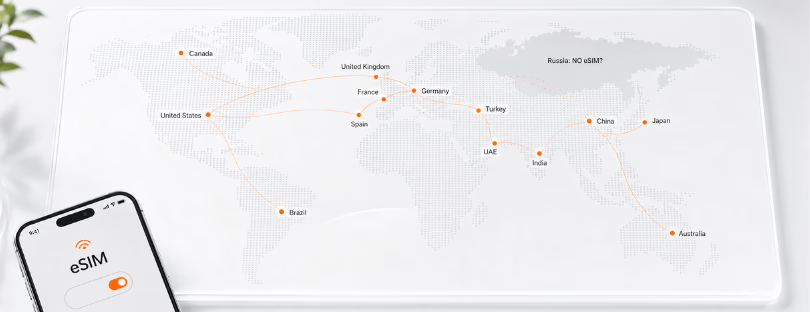
40 Countries & Regions
Travel freely across 40 countries and regions in Europe with AI auto-switching, 4G/5G local networks, zero roaming fees, and long-term use.
| 365-Day Packages | Unlimited Packages |
|---|---|
| 1 GB — $1.9 | 3 days — $7.9 |
| 10 GB — $23 | 5 days — $13.2 |
| 30 GB — $68 | 15 days — $35.2 |
| 50 GB — $90 | 30 days — $68 |
| 100 GB — $180 | — |
Package Details
| Package Data | 1 GB |
| Package Type | Data Only |
| Validity | 365 days |
| Activation Requirement | Activation is required within 365 days of purchase |
| Coverage | 40 Countries & Regions |
| Add Data | Available |
| Hotspot | Available |
| Network Generation | 4G / 5G |
| Network Switching | AI-Automatic |
Inside the XPIN Network Concept
XPIN describes its platform as an AI-driven decentralized communication network.
The concept combines several technologies that have been evolving independently over the past decade:
- eSIM-based connectivity
- decentralized blockchain infrastructure
- AI optimization for network allocation
The system uses blockchain to manage data allocation and settlement between different network partners. Meanwhile, AI components are intended to optimize network selection and traffic routing.
In theory, this approach could allow XPIN to distribute mobile data capacity dynamically across different regions and providers.
Telecommunications networks have long relied on complex inter-operator agreements for roaming. Blockchain-based settlement systems could simplify parts of that process by automating payments between parties.
It is still early for this model, but several telecom experiments are already exploring similar ideas.
Industry groups including the GSMA have previously tested blockchain for roaming settlements and identity management, while startups in the DePIN (Decentralized Physical Infrastructure Networks) sector are experimenting with distributed telecom infrastructure models.
XPIN’s launch therefore sits within a broader technological movement trying to rethink how communication networks are managed and monetized.
Why the Line Next Partnership Matters
The most important element of the launch may not be the technology itself, but the distribution channel.
Line Next is part of the LINE ecosystem, one of the most widely used messaging platforms in Asia with hundreds of millions of users.
By integrating XPIN’s eSIM services directly into the Line Next environment, the project gains something many telecom startups struggle with: immediate access to a large digital community.
Users already active in the Web3 ecosystem of Line Next can purchase connectivity services using their existing wallets. That reduces friction compared to launching a completely new telecom app.
In the travel eSIM market, distribution is often the hardest challenge.
Many providers spend heavily on marketing channels such as:
- Google Ads
- influencer campaigns
- affiliate networks
- app store advertising
Industry insiders estimate that acquiring a single travel eSIM customer can cost anywhere between €20 and €80, even though the average plan purchased might be worth only €10 to €20.
Embedding telecom services inside an existing platform is therefore an increasingly attractive strategy.
Several players are already experimenting with similar approaches, integrating connectivity into fintech apps, airline platforms, and travel super-apps.
XPIN’s partnership with Line Next follows that same logic but adds the Web3 layer on top.


What Users Actually Get
For the end user, the service is meant to remain simple despite the complex technology underneath.
The basic process works like this:
Access through the wallet
Users open their Unifi stablecoin wallet inside the Line Next ecosystem.
Choose a data plan
Global or regional data packages can be selected depending on travel needs.
Pay with stablecoins
Transactions are completed using stablecoins, avoiding the volatility associated with many cryptocurrencies.
Instant activation
Once purchased, the eSIM profile activates digitally on the device.
Key benefits promoted by the companies include:
Borderless connectivity
Travelers can access mobile data in multiple countries without swapping physical SIM cards.
Crypto-native payments
Stablecoin transactions remove the need for credit cards or currency conversion.
Transparent pricing
Blockchain-based transactions may reduce hidden fees or complicated roaming structures.
Reduced environmental impact
eSIM services eliminate plastic SIM card production and distribution.
While these benefits are not entirely unique to XPIN, combining them within a Web3 ecosystem could attract a specific audience already familiar with crypto wallets and decentralized applications.
The Broader Market Context
The timing of the launch is notable.
The global eSIM market continues to grow rapidly, driven by smartphone adoption and rising demand for flexible connectivity.
Research from firms such as Juniper Research and Counterpoint suggests the eSIM market could exceed $4 billion by 2027, with strong growth coming from travel connectivity, IoT devices and enterprise applications.
At the same time, the blockchain sector is searching for practical real-world use cases beyond decentralized finance and token speculation.
Telecommunications offers a compelling test environment because it already operates as a global network with complex billing systems and cross-border infrastructure.
Several emerging projects are exploring the idea of decentralized telecom networks, including Helium Mobile and other DePIN initiatives.
However, the majority of global connectivity today still relies on traditional telecom infrastructure controlled by large mobile operators.
This means projects like XPIN will ultimately need to integrate with existing carrier networks to deliver coverage.
How XPIN Compares With Traditional Travel eSIM Providers
The travel eSIM market already includes a wide range of providers, each approaching global connectivity differently.
Traditional telecom operators typically rely on centralized roaming agreements and billing systems.
Most travel eSIM startups operate cloud-based platforms that aggregate network access through wholesale telecom partners.
XPIN introduces a third model by combining telecom access with a decentralized transaction infrastructure.
| Model | Payment | Network Management | Coverage |
|---|---|---|---|
| Traditional telecom | Credit cards, local currency | Centralized roaming systems | Operator partner networks |
| Travel eSIM providers | Digital payments, apps | Cloud-based platforms | Global but partner-based |
| XPIN model | Stablecoin wallet | AI + blockchain infrastructure | Global partner networks |
Whether this decentralized approach will gain significant adoption remains uncertain.
Telecommunications is one of the most regulated industries in the world, and operating across jurisdictions often requires compliance with complex licensing and regulatory frameworks.
Nevertheless, the experiment itself reflects a growing trend: connectivity services are increasingly being embedded into broader digital ecosystems.
What This Means for the Future of Connectivity
If projects like XPIN succeed, the implications could extend far beyond travel connectivity.
Messaging platforms, fintech apps and digital wallets could eventually integrate mobile data services directly into their ecosystems. Instead of visiting a telecom website or downloading a separate app, users might simply activate connectivity inside platforms they already use every day.
This idea is already visible in several parts of the market. Airlines are bundling eSIM data with flight tickets. Banks and fintech apps are experimenting with travel connectivity offers. Super-apps in Asia increasingly integrate transportation, payments and communication services under one interface.
XPIN’s launch therefore reflects a broader shift in the telecom industry.
Connectivity is gradually becoming a feature of digital platforms rather than a standalone product.
The bigger picture
Whether decentralized telecom networks will become mainstream remains an open question. Large operators still control the physical infrastructure that keeps the global internet running.
However, the XPIN and Line Next collaboration shows how new players are experimenting with alternative models for how connectivity can be purchased, distributed and managed.
For travelers, the immediate benefit may simply be another option for accessing mobile data abroad.
For the telecom industry, the experiment points to a deeper transformation.
The future of connectivity may not be decided solely by network operators anymore. Increasingly, it may be shaped by platform ecosystems, digital wallets, and new infrastructure models that sit on top of traditional telecom networks.
And that is where the real story begins.