Why Travel Routers Matter Again — TP-Link’s Wi-Fi 7 Move
Anyone who has ever tried to work from a hotel room knows the pain. The Wi-Fi looks strong on paper, the signal bars are full, and yet the connection crawls. Video calls freeze. Files refuse to upload. Slack messages lag just enough to be annoying. Hotels have improved over the years, but wireless congestion remains one of the most common friction points for travelers who actually need to get things done.
What many people don’t realize is that plenty of hotels still rely on wired Ethernet behind the scenes. The problem is that modern travelers rarely carry Ethernet dongles, and even if they do, one cable only connects one device. Phones, tablets, laptops, streaming sticks, kids’ iPads — none of them benefit.
This is exactly where travel routers step in, and why they’ve quietly become one of the most underrated travel tech tools. And with Wi-Fi 7 now entering the mainstream, that category is evolving fast.
Why travel routers suddenly matter again
A travel router acts as your personal network bubble. You plug it into a hotel’s Ethernet port, connect it to public Wi-Fi, or even tether it to your phone’s 4G or 5G connection, and it rebroadcasts that connection as your own private Wi-Fi network.
That means:
- One login instead of five
- One secure network instead of trusting public hotspots
- One fast connection shared across all your devices
For families, it means kids can stream and play without fighting over bandwidth. For business travelers and digital nomads, it means stable calls, safer connections, and fewer awkward “sorry, my Wi-Fi dropped” moments.
This is the context in which TP-Link launched its latest travel router, the TP-Link TL-WR3602BE, and why it’s getting attention beyond the usual networking crowd.
Designed for digital nomads, not IT closets
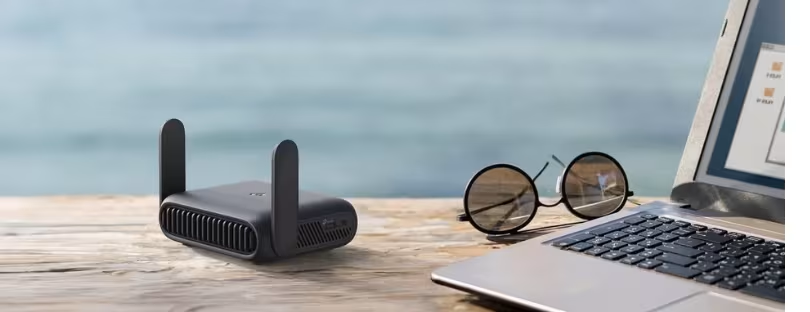
At first glance, the TL-WR3602BE doesn’t look like a typical router. It’s compact, lightweight, and small enough to slip into a jacket pocket or backpack side pouch. Think paperback book, not desk hardware.
Power is equally flexible. It runs on USB-C at 5V, which means it works with:
- Standard phone chargers
- Laptop USB-C ports
- Power banks
That alone makes it travel-friendly. No bulky power bricks. No region-specific plugs. Just plug and go.
TP-Link clearly had mobile professionals in mind here: people who work from hotel rooms, cafés, airports, coworking spaces, cruise ships, and temporary apartments where network quality is unpredictable.
Wi-Fi 7 isn’t just a buzzword here
The headline feature is Wi-Fi 7 support, with combined wireless speeds up to 3.6 Gbps. On paper, that’s massive for a travel router, and in practice, it’s less about raw speed and more about efficiency.
Wi-Fi 7 introduces technologies like Multi-Link Operation, 4K-QAM, and improved OFDMA handling. In plain language, that means:
- Better performance in crowded environments
- Lower latency for calls and cloud apps
- More stable connections when many devices are active
The TL-WR3602BE supports dual-band Wi-Fi, delivering up to 2,882 Mbps on 5GHz and 688 Mbps on 2.4GHz. It can also handle up to 90 connected devices, which sounds excessive until you remember how many gadgets a modern traveling family or small remote team actually carries.
In busy hotels or airports, this kind of efficiency matters more than headline speed numbers.
 Turning hostile public Wi-Fi into something usable
One of the most practical features is how the router handles public hotspots. In hotspot mode, you authenticate once through the captive portal, and then all your devices connect through the router instead of individually.
This does two important things:
- It saves time and frustration
- It isolates your devices from the public network
Public Wi-Fi remains one of the easiest attack surfaces for data interception. By funneling traffic through your own router, you significantly reduce exposure, especially when combined with VPN encryption.
Built-in VPN support that actually makes sense
VPN support isn’t new, but TP-Link has done something smart here. The TL-WR3602BE supports OpenVPN and WireGuard natively and works with over 35 VPN providers.
Notably, NordVPN and Surfshark are directly integrated into the router interface, which removes much of the setup friction that usually puts people off router-level VPNs.
Router-based VPNs are especially useful for travelers who:
- Want to access home-country content libraries
- Need secure access to corporate networks
- Travel through regions with tighter internet controls
Instead of installing VPN apps on every device, the router handles encryption once, for everything connected to it.
A physical switch on the device lets you toggle key features like VPN or guest mode instantly, which is a small touch that makes a big difference when you’re on the move.

Connectivity options that cover real travel scenarios
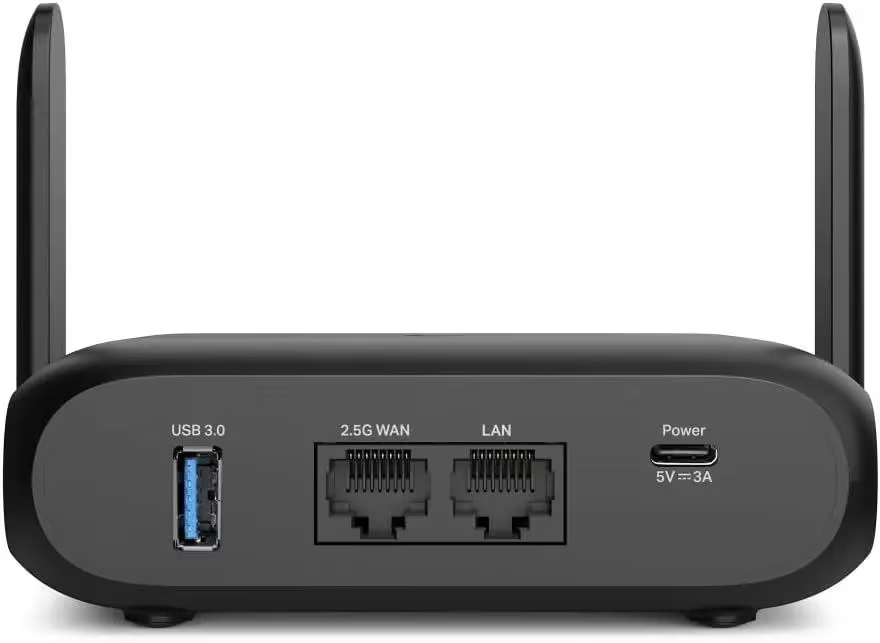
On the hardware side, the TL-WR3602BE offers:
- One 2.5Gbps WAN port
- One 1Gbps LAN port
- One USB 3.0 port
That setup allows for wired hotel connections, local device connections like NAS or printers, and even USB modem support for mobile broadband.
Seven operating modes give it flexibility across use cases, including router mode, hotspot mode, access point, range extender, client mode, USB tethering, and USB modem mode.
This means you can:
- Share hotel Ethernet across all devices
- Re-broadcast café Wi-Fi securely
- Use your smartphone as a 5G modem
- Extend weak apartment Wi-Fi
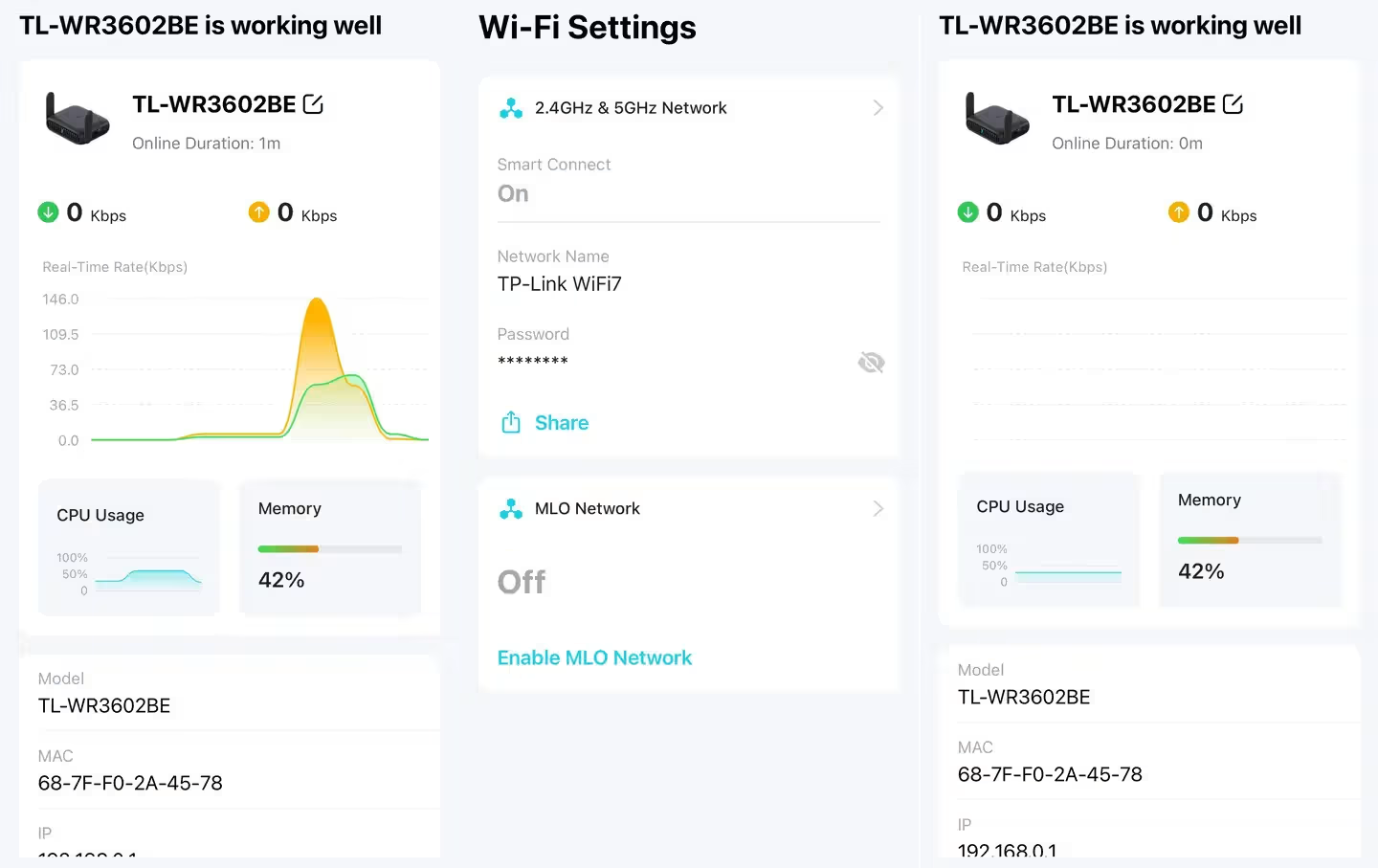
You don’t need to be a network engineer either. Setup and management are handled through the TP-Link Tether app or a browser interface, both designed for non-technical users.
Where this sits in the wider travel tech landscape
Travel routers aren’t new. Brands like GL.iNet have built loyal followings among digital nomads, and Netgear has long offered mobile hotspot-router hybrids. What’s changing now is the baseline expectation.
Wi-Fi 6 is quickly becoming the minimum standard, and Wi-Fi 7 is starting to appear in flagship laptops and smartphones from Apple, Samsung, and others. As that happens, older travel routers become bottlenecks instead of solutions.
TP-Link is clearly positioning the TL-WR3602BE as a future-proof option, priced at $99 / £119, which undercuts many enterprise-grade competitors while offering newer wireless tech.
From a trend perspective, this aligns with what we’re seeing across travel tech:
– More people working while traveling
– More devices per traveler
– Higher expectations for performance and security
According to GSMA and industry analysts tracking mobile and Wi-Fi convergence, hybrid connectivity setups — mixing wired, Wi-Fi, and cellular — are becoming the norm rather than the exception. Travel routers sit right at that intersection.
Conclusion: not just a gadget, but a connectivity strategy
The TL-WR3602BE isn’t trying to be flashy. It’s trying to solve a very real, very persistent travel problem with modern tools. Compared to older travel routers, its Wi-Fi 7 support and VPN integration feel genuinely forward-looking. Compared to mobile hotspots, it offers far more control, security, and flexibility.
For frequent travelers, remote workers, and families who value stable internet as much as a good suitcase, this category deserves more attention than it gets. TP-Link’s latest entry shows that travel routers are no longer niche accessories — they’re becoming part of a smarter, layered connectivity strategy.
As hotels, airports, and public spaces struggle to keep up with demand, owning your connection rather than borrowing it might be the most reliable upgrade you can make on the road.