CAC vs LTV in Travel eSIM: A Market Under Pressure
On the surface, the travel eSIM market looks like a clean success story. Instant activation, global coverage, no physical SIM cards, and a product that fits naturally into modern travel behavior. travel eSIM economics
But once you look at the economics, the picture becomes more complex.
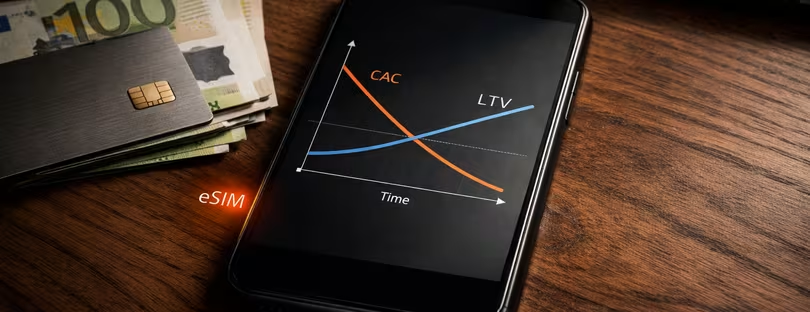
Because this market is no longer being decided by coverage or pricing alone. Increasingly, it comes down to a single equation:
Customer Acquisition Cost versus Customer Lifetime Value.
And for many providers, that equation is still under pressure.
The reality behind every eSIM purchase
A typical travel eSIM transaction is relatively small. Users purchase short-term data plans tied to specific trips, often with no long-term commitment.
On the other side of that transaction, providers rely on a mix of paid acquisition, affiliate distribution, app store visibility, and partnerships to reach those users.
Each of these channels carries a cost.
In many cases, that cost can approach or exceed the value of a single transaction, depending on the channel, geography, and level of competition.
This leads to an important structural point.
The first transaction is not always where profitability is realized.
Instead, it often represents the beginning of a potential customer relationship.
Why acquisition is becoming more complex
There is a common assumption that digital distribution becomes more efficient over time. In practice, travel eSIM is experiencing increasing competition across key acquisition channels.
Competition for high-intent users
More providers are targeting the same travelers across search, social platforms, and app ecosystems. This increases bidding pressure and reduces organic visibility.
Reliance on third-party distribution
Affiliate networks and partnerships play a key role in growth, but they also introduce revenue sharing that impacts margins.
Limited brand differentiation
For many users, an eSIM is a functional purchase. As a result, brand recall across the category can remain relatively low, which can affect repeat behavior.
Taken together, this creates a dynamic where acquisition costs are not always a one-time investment.
If users do not return, acquisition effectively needs to be repeated.

The LTV challenge in travel eSIM
This is where travel eSIM differs from traditional telecom models.
Mobile operators typically rely on long-term relationships supported by subscriptions, contracts, or bundled services. These structures create a predictable lifetime value.
Travel eSIM, by contrast, is often tied to episodic usage.
A user may purchase connectivity for a specific trip and not engage again until a future journey, if at all.
This leads to a key observation:
Customer lifetime value in travel eSIM does not accumulate automatically. It needs to be actively built.
What drives lifetime value in this market
LTV in travel eSIM is less about increasing the size of a single purchase and more about increasing frequency and continuity of usage.
In practical terms, value tends to grow when:
- users return for multiple trips
- users expand usage across regions or use cases
- the product becomes part of regular travel behavior
Without these dynamics, lifetime value remains limited to one or a small number of transactions.
A market starting to diverge
As a result, the market is beginning to show signs of divergence in strategy.
Transaction-focused models
Some providers prioritize:
- efficient user acquisition
- strong visibility across paid and affiliate channels
- competitive pricing and conversion optimization
This approach can drive rapid growth, but it remains sensitive to rising acquisition costs and user churn.
Relationship and infrastructure-oriented models
Other providers are placing greater emphasis on:
- repeat usage and account-based engagement
- subscription or balance-based approaches
- integration into broader digital ecosystems
In these models, the objective extends beyond a single transaction toward building a longer-term relationship with the user.

How different approaches are emerging
These strategic differences are visible across the market.
Providers such as Airalo and Holafly are widely associated with strong global presence and effective user acquisition strategies.
At the same time, some companies are exploring models that extend beyond one-time purchases.
Yesim, for example, has introduced approaches that position connectivity as a more continuous service experience, rather than purely trip-based usage.
On another layer, companies like Airhub are focused on enabling connectivity through APIs and partnerships, embedding eSIM capabilities into other platforms and services.
These approaches reflect different ways of addressing the same underlying economic challenge.
The role of distribution
One of the clearest shifts in the market is the growing importance of distribution strategy.
When connectivity is integrated into existing user journeys, such as:
- airline booking flows
- financial apps
- travel platforms
- enterprise mobility solutions
The cost and complexity of acquisition can be significantly reduced.
In these cases, providers are not competing for attention in crowded advertising channels. Instead, they are accessed within environments where users are already active.
This represents a shift from acquiring users externally to accessing them within existing ecosystems.
Scale and positioning
As acquisition becomes more competitive, scale can offer advantages.
Larger providers are generally better positioned to:
- distribute acquisition costs across a wider user base
- invest in product development and retention
- build stronger brand recognition
- engage more effectively with partners across the value chain
Smaller players can still compete, particularly through niche positioning or differentiated distribution, but the margin for error is narrower.
Where this leads
While the travel eSIM market continues to grow, its internal dynamics are evolving.
The key question is no longer only how many users a provider can acquire, but how effectively those users can be retained and developed over time.
Conclusion
The travel eSIM market is moving beyond its initial growth phase into a more structurally defined competitive landscape.
Coverage and pricing remain important, but they are no longer sufficient on their own.
The defining factor is increasingly the ability to build lasting user relationships and reduce reliance on repeated acquisition.
Some providers continue to operate primarily within transactional models, focusing on capturing demand at the point of need. Others are exploring ways to extend connectivity into ongoing services or embedded experiences.
This shift reflects a broader pattern already seen in other parts of telecom and digital services, where long-term value is created not at the point of acquisition, but through sustained engagement.
In that context, CAC and LTV are not just financial metrics.
They are indicators of how well a company has aligned its product, distribution, and user experience with the realities of the market.
And over time, that alignment is likely to determine which players remain competitive as the space continues to mature.