Telenor IoT and Axentia Advance IoT eSIM
Telenor IoT has announced that Axentia has become the first customer to receive and commercially deploy its standardized SGP.32 solution, including both SIM cards and remote SIM provisioning capabilities. It is a technical announcement, yes, but it matters because it shows SGP.32 moving from industry discussion into a live commercial IoT deployment.
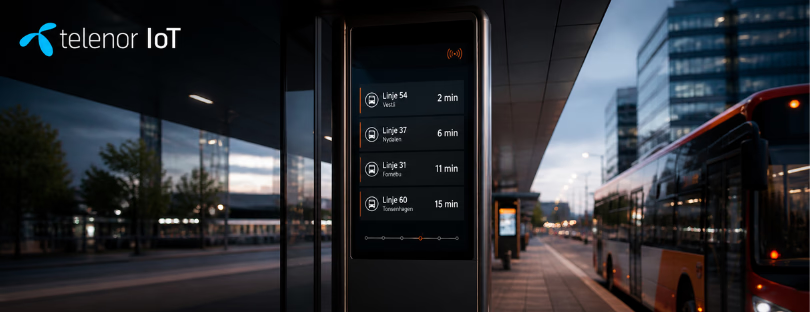
Axentia is a strong first use case. The company provides battery and solar-powered display systems for public transport, including real-time passenger information screens used at stops, stations and transport environments. These devices are often deployed across multiple markets, without external cabling, and are expected to operate reliably for years.
That makes connectivity more than a background feature. If a public transport display loses connection, passengers lose real-time information. If a device needs a physical SIM swap, operators face maintenance costs, site visits and service disruption. For IoT devices that sit in the field for long periods, connectivity has to be flexible from day one.
Why SGP.32 matters
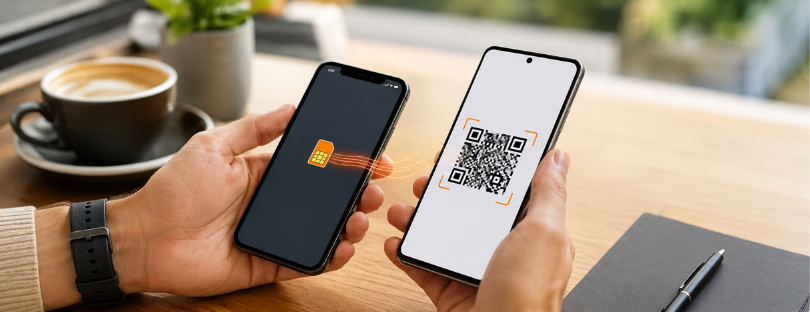
SGP.32 is the GSMA specification for remote SIM provisioning in IoT devices. Unlike consumer eSIM, which usually assumes a smartphone screen, app flow or QR code, SGP.32 is designed for connected devices that may be low-power, remotely installed or difficult to access physically.
That distinction is important. Many IoT devices do not have a user interface. Some are installed in hard-to-reach places. Others need to operate for a decade or more. In those cases, changing connectivity manually is not realistic.
With SGP.32, companies can manage SIM profiles remotely and more easily adapt connectivity over the lifetime of a device. For Axentia, this means its public transport display systems can avoid being locked into one provider or one network arrangement for their full operational life.
That flexibility is the real value. Networks change. Regulations change. Customer requirements change. Commercial agreements change. A connectivity setup that looks perfect at deployment may not be the right choice five years later.
A long-term partnership
Telenor IoT and Axentia have worked together since 2021, building a partnership around innovation, sustainability and future-ready connectivity. The deployment of SGP.32 SIM cards is now the next step in that relationship.
Axentia’s products fit the sustainability angle well. Battery and solar-powered public transport displays are designed to reduce cabling needs and support more flexible deployment. But sustainable hardware still needs sustainable connectivity. If devices require repeated manual interventions, the operational efficiency story quickly becomes weaker.
READ MORE: Telenor IoT Launches Future-Proof SGP.32 eSIM Standard
That is where remote SIM provisioning becomes important. It helps extend the useful life of connected devices by making connectivity easier to update, manage and optimize without touching the hardware.
Frithjof Qvigstad, CTO at Axentia, put it clearly:
“Axentia operates in a market where flexible and modern connectivity is no longer optional. By being an early adopter of SGP.32, Axentia is positioning itself to meet future customer demands with a standardized, scalable solution.”

Not just another SIM upgrade
It would be easy to describe this as a SIM card update. That would miss the point.
The bigger shift is about control. Traditional IoT connectivity often forced companies into long-term dependency on a single provider, especially once devices were deployed. In large fleets, switching connectivity could become slow, expensive and operationally painful.
SGP.32 gives IoT companies a more modern structure. It does not remove every challenge, because device support, ecosystem maturity and profile availability still matter. But it does create a cleaner framework for managing IoT connectivity at scale.
This is especially relevant for industries such as transport, utilities, logistics, smart cities and industrial monitoring. These sectors do not need eSIM for convenience. They need it because device fleets are becoming larger, more distributed and harder to manage manually.
A wider market signal
Telenor IoT is not the only player moving in this direction. Companies such as Kigen and other eSIM infrastructure specialists have also been positioning SGP.32 as a key enabler for scalable IoT deployments. The Trusted Connectivity Alliance has also highlighted SGP.32 as an important step for secure remote provisioning in constrained IoT environments.
READ MORE: eSIM Standards Explained: How SGP.32 Changes Travel Connectivity
That matters because the IoT eSIM market is not developing like the consumer travel eSIM market. In travel eSIM, the conversation is often about price, coverage and app experience. In IoT, the questions are more operational: Can the device stay connected for years? Can it switch profiles when needed? Can the company avoid lock-in? Can connectivity be managed without sending technicians into the field?
This is where Telenor IoT’s Axentia deployment becomes useful proof. It shows SGP.32 being applied to a real, practical use case where remote management directly affects cost, reliability and long-term service quality.
Bottom line about Telenor SGP.32 IoT eSIM
The Axentia deployment is not loud, but it is important. It shows that SGP.32 is starting to solve the kind of problem IoT companies actually care about: how to keep long-life devices connected without locking the customer into today’s network decision forever.
Compared with consumer eSIM providers, IoT connectivity players are dealing with a tougher lifecycle challenge. A travel eSIM may need to work for a week. A public transport display may need to work for years.
That is why this announcement matters. The future of IoT eSIM will not be defined only by who offers global coverage. It will be defined by who gives enterprises control, flexibility and confidence across the full life of the device.