Roamless Price: Is Pay-As-You-Go eSIM Worth It?
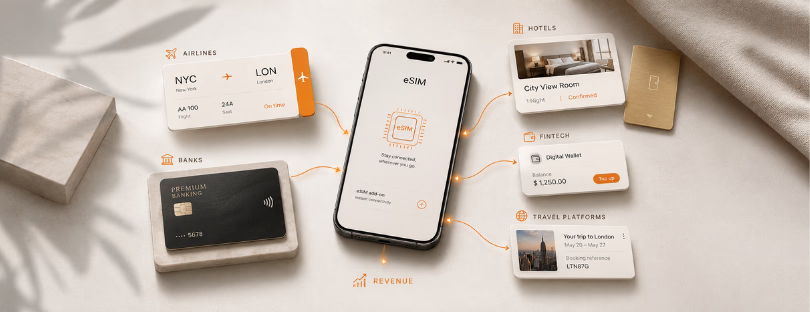
Roamless is one of those travel eSIM products where the price story is not only about “how much is 1GB?” That question still matters, of course. Travelers compare gigabytes, screenshots, promo codes and country pages. But Roamless is trying to shift the pricing conversation slightly. Instead of selling you a new country eSIM every time you travel, it sells a single global eSIM, one balance, and a pay-as-you-go model that follows you across trips.
That sounds simple. It also sounds familiar, because the travel eSIM market is full of simple promises. But the important detail with Roamless is the structure behind the price.
According to Roamless, its app combines eSIM data, phone numbers, international calls and SMS under one balance, with credits used for pay-as-you-go data, calls or SMS. The company says those credits do not expire, and its single globaI eSIM works across 200+ destinations without reinstalling a new eSIM every time.
For frequent travelers, that changes the psychology of buying connectivity.
The real pricing idea
Most travel eSIMs still work like a trip purchase. You go to France, buy France. You go to Japan, buy Japan. You go to the US, buy the US. Sometimes you buy a regional plan if the route is messy. That model is easy to understand, but it also creates waste.
You buy 5GB because 3GB feels risky. You use 2.7GB. The rest disappears after 7, 15 or 30 days. It is not a disaster, but it is annoying. Roamless is trying to remove that little irritation.
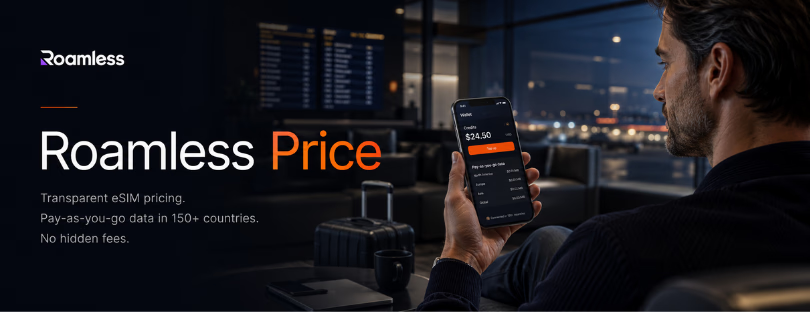
Its pay-as-you-go model means users top up credits and spend them as needed. Roamless says the most up-to-date prices are shown in the app, web app and website, covering pay-as-you-go data rates, data plan prices and in-app call rates. That matters because Roamless pricing is not a single flat global number. Rates can vary depending on destination and service type, so the app becomes the price dashboard.
READ MORE: Roamless Adds Calls, SMS and Phone Numbers — Is This the All-in-One Travel eSIM?
This is not necessarily the cheapest model for every traveler. A person going to one country for two weeks and using heavy data every day may still find a large fixed plan cheaper elsewhere. But for people who move often, use data unevenly, or hate buying a new plan for every trip, the Roamless model is genuinely practical.


Plans and credits
Roamless now has two layers: pay-as-you-go credits and data plans. Its support page explains that Roamless data plans are data-only, work on the same single globaI eSIM, can be activated within 18 months of purchase, and become valid for 30 days once activated. It also says data plans and pay-as-you-go credits can work together automatically.
That combination is more interesting than it first looks.
Imagine a business traveler flying from Zagreb to London, then Munich, then Dubai over a few months. A traditional eSIM purchase pattern would probably mean separate plans, different expiry windows, and maybe several unused balances. With Roamless, that traveler could use credits for small gaps, buy a data plan when usage is more predictable, and keep the same eSIM installed.
This is where Roamless has a stronger argument than just “cheap data.” It is selling reduced friction.
And in travel connectivity, friction has a cost. Not a dramatic one, but a real one. The cost is the ten minutes at the airport. The wrong QR code. The plan starts too early. The leftover gigabytes. The “Do I need another eSIM for the next country?” question.
Calls change the value
Another part of Roamless pricing that deserves attention is calling. Many travel eSIMs are still data-only products. That is fine for WhatsApp, Maps, Uber and email, but it is less useful when you need to call a hotel, airline, bank, restaurant or local service number.
Roamless says users can make international calls worldwide using Roamless Credits, see call rates before dialing, and be charged per minute from their credits. It also supports calling with a Roamless Number, a verified personal number as caller ID for outgoing calls, or anonymous calls from the app.
READ MORE: Roamless – Global Travel Connectivity Startup – Raises $12M to Fix Broken Roaming
This does not make Roamless a full mobile operator replacement for everyone. But it does make the price comparison more nuanced. If one provider gives you cheaper data but no practical calling option, while Roamless gives you data plus calling from the same balance, the better value depends on what kind of traveler you are.
For a weekend tourist, maybe calls do not matter. For a business traveler trying to reach a hotel reception desk, a car rental company or a customer support line abroad, they absolutely do.
Market comparison
Airalo remains one of the most recognizable players in travel eSIMs, with local, regional and globaI eSIM packages across 200+ destinations. Its globaI eSIM page positions the product around package-based global coverage, with global packages starting from the shown price. Airalo is strong when the user knows the destination and wants a familiar, catalog-style buying experience.
Holafly plays a different game. It is best known for unlimited data positioning, simple trip-based plans and strong consumer messaging around stress-free travel. Holafly also highlights 24/7 support, WhatsApp continuity, refunds in certain situations and reliable connectivity at the destination. For heavy data users who do not want to count gigabytes, Holafly can feel emotionally easier.
Roamless sits between these worlds. It is not just a country-plan marketplace. It is not mainly an unlimited-data brand either. Its strongest pricing argument is continuity: one installed eSIM, one balance, credits that do not expire, optional data plans, and calling features inside the same app.
That makes Roamless especially relevant for irregular travelers. Not the person who takes one annual holiday and uses 20GB of Instagram, but the person whose travel pattern is messy: two days here, five days there, a conference next month, a layover in between, maybe a second phone number needed for practical reasons.
What to watch
There are still questions buyers should ask. What is the exact rate in your destination? Is the fixed data plan better value than pay-as-you-go credits? Do you need calls, or only data? Are you a heavy hotspot user? Will an unlimited plan suit you better?
Roamless is transparent in one important sense: it directs users to current rates inside the app, web app and website. But travelers still need to compare by real use case, not headline price.
That is the bigger lesson for the eSIM market in 2026. Price per GB is no longer enough. The smarter comparison is price per avoided headache.
Conclusion about Roamless price
Roamless is not winning the price conversation by shouting “cheapest.” That is actually a good thing. The cheapest eSIM is often cheap because it is narrow, temporary or inconvenient. Roamless is more interesting because it prices connectivity like an ongoing travel utility rather than a disposable trip product.
Compared with Airalo, Roamless feels less like a storefront and more like a wallet. Compared with Holafly, it is less about unlimited comfort and more about controlled, reusable flexibility. Compared with traditional roaming, the appeal is obvious: no carrier bill shock, no awkward package hunting, and less waste between trips.
The trend is clear. Travel eSIMs are moving away from one-off data bundles and toward persistent connectivity accounts. Roamless is one of the sharper examples of that shift. For light and medium users who travel often, its price model may be more valuable than a cheaper single-trip plan. Not because every gigabyte is always the lowest on the market, but because the product respects how people actually travel: unevenly, repeatedly, and rarely according to perfect 30-day plan logic.