Rivian R2 Bets on SGP.32 eSIM to Build a Truly Global Connected Vehicle
The next wave of connected vehicles is not just about electric powertrains or bigger touchscreens. It is about connectivity architecture. How vehicles connect to networks, how they update software, and how they operate across global markets is becoming just as important as the drivetrain itself.
Rivian’s upcoming R2 offers an early glimpse into this shift.
The electric vehicle manufacturer has confirmed that the R2 will launch with support for the GSMA SGP.32 eSIM standard, supported by connectivity from AT&T and infrastructure from Giesecke+Devrient (G+D). The partnership aims to deliver a scalable connectivity platform capable of operating across multiple markets without forcing Rivian to redesign hardware for each region.
That might sound technical, but the implications are significant. In simple terms, Rivian is building a vehicle that can adapt its connectivity layer over time rather than locking it in at the factory.
For an industry that is increasingly defined by software updates and digital services, that flexibility is becoming essential.
What SGP.32 Changes in Automotive Connectivity
The GSMA developed SGP.32 specifically for IoT and automotive deployments, where devices often remain in service for many years and operate across multiple regions.
Earlier eSIM standards were originally designed around consumer devices like smartphones. Automotive deployments required additional layers of integration, and in many cases vehicles were still tied to predefined operator relationships.
SGP.32 changes that model.
The standard allows remote provisioning and switching of operator profiles throughout the lifecycle of the device. Instead of committing to one mobile network partner at the manufacturing stage, companies can dynamically add or change connectivity providers later.
For automakers, this introduces an entirely different approach to global connectivity.
A vehicle can leave the factory with one connectivity profile but switch to a different operator as it enters a new country or market. The process happens remotely through secure provisioning systems rather than through hardware modifications.
That is why many in the industry see SGP.32 as a key enabler for large-scale connected vehicle deployments.

Single-SKU Global Vehicles
One of the biggest operational advantages of SGP.32 is something automakers care deeply about: simplifying production.
Traditionally, vehicles intended for different regions often required separate connectivity configurations. Telecom standards, roaming rules, and operator agreements vary widely between markets. As a result, manufacturers sometimes had to produce multiple hardware variants of the same model.
This increases supply chain complexity and adds cost.
SGP.32 allows manufacturers to build a single global hardware SKU and configure connectivity later through software.
For Rivian, this means the R2 platform can potentially be deployed across multiple markets without redesigning its connectivity hardware.
For a growing EV manufacturer trying to scale production efficiently, that kind of simplification can be extremely valuable.
G+D’s Role in the Connectivity Stack
Rivian’s connectivity architecture relies heavily on infrastructure provided by Giesecke+Devrient.
The company supplies both the automotive-grade eSIM hardware embedded in the vehicle and the eSIM IoT Remote Manager (eIM) platform used to control connectivity profiles remotely.
Together, these systems form a secure management layer that allows Rivian to manage connectivity across the entire vehicle fleet.
The remote manager enables operators to download new profiles, switch network partners, and update connectivity settings as conditions change. This is particularly important for connected vehicles, which may remain operational for more than a decade.
During that time, networks evolve, regulations shift, and operator partnerships change.
Having the ability to manage connectivity remotely ensures the vehicle can adapt to those changes without requiring hardware replacement.
G+D’s BeekGek Lim, Global Head of Business Line Digital Offerings, said the SGP.32 collaboration allows Rivian to deploy a single global hardware SKU while retaining full flexibility to manage connectivity remotely and securely throughout the vehicle lifecycle.
AT&T Delivers the Initial 5G Connectivity
At launch, AT&T will provide the primary connectivity layer for the Rivian R2 in the United States.
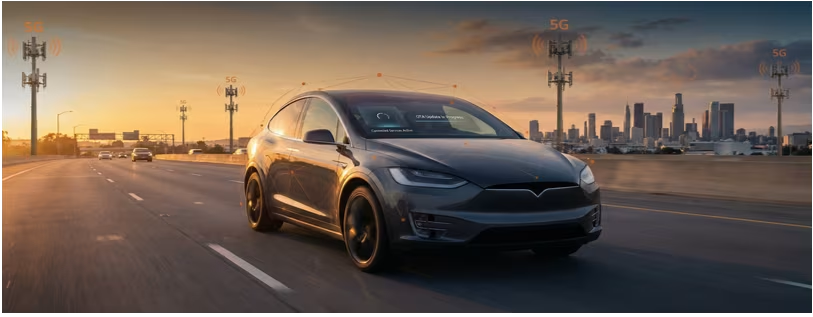
The operator’s 5G network will support a range of connected vehicle services, including over-the-air software updates, diagnostics, and digital features integrated into the vehicle experience.
For modern vehicles, connectivity plays a central role in how the product evolves after purchase.
Software updates can introduce new functionality, improve vehicle performance, or fix issues remotely. Navigation systems rely on real-time data, and connected services increasingly form part of the broader user experience.
That means the reliability and scalability of the connectivity layer are becoming critical design considerations for automakers.
Rivian’s Brandon Blumber, Global Director of Business Development, noted that the connectivity architecture is designed for performance today while scaling into new markets over time.
The Broader Industry Shift
Rivian’s announcement reflects a wider trend across the automotive sector.
As vehicles become more software-driven, automakers are starting to treat connectivity as infrastructure rather than as a bundled telecom feature. Instead of locking themselves into a single operator relationship, they are building systems capable of integrating multiple network partners over time.
This mirrors developments already seen across the IoT industry.
According to GSMA Intelligence, the number of connected vehicles globally is expected to surpass 400 million by 2030. Managing connectivity for such a massive device base requires flexible provisioning systems capable of adapting across markets and networks.
This is precisely the problem that SGP.32 was designed to solve.
A Showcase at MWC Barcelona
The Rivian connectivity architecture is being showcased during MWC Barcelona, where G+D and Rivian are presenting the implementation as part of the “IoT Summit: Simplifying the Future of Connected Innovation.”
MWC has increasingly become a meeting point between telecom infrastructure providers, device manufacturers, and automotive companies exploring new connectivity models.
As vehicles evolve into software platforms with continuous updates and digital services, these collaborations are becoming more common.
Connectivity is no longer just an accessory for vehicles. It is becoming part of the core architecture.
Conclusion about SGP.32 eSIM automotive connectivity
Rivian’s decision to launch the R2 with SGP.32 support highlights a broader shift in how the automotive industry approaches connectivity.
Earlier generations of connected vehicles relied heavily on fixed operator relationships and region-specific hardware configurations. While those systems enabled basic connected services, they lacked the flexibility needed for truly global deployments.
The SGP.32 model moves the industry closer to a software-defined connectivity architecture. Vehicles can be manufactured once and adapted to different markets through remote profile management and operator switching.
Other players in the industry are moving in a similar direction. Companies such as BMW, Stellantis, and Volkswagen have been expanding their use of embedded connectivity platforms, while infrastructure providers like Thales, Kigen, and G+D are building remote provisioning systems designed for large-scale IoT and automotive deployments.
What Rivian’s R2 demonstrates is how these technologies are starting to converge into a cohesive architecture.
The connected vehicle is no longer just a car with a modem inside. It is becoming a networked device designed to evolve throughout its lifecycle. SGP.32 eSIM automotive connectivity
And standards like SGP.32 may ultimately determine how flexible that evolution can be.