PayPal QR code payments are not new, but they suddenly feel much more relevant again. For years, QR codes sat in that slightly awkward corner of digital life. Useful, yes. Elegant, not always. Then travel reopened, cafés went cash-light, small merchants started selling everywhere from pop-up markets to airport corridors, and consumers became more comfortable scanning a code to pay, order, check in, board, unlock, verify or download. The QR code became less of a novelty and more of a practical shortcut.
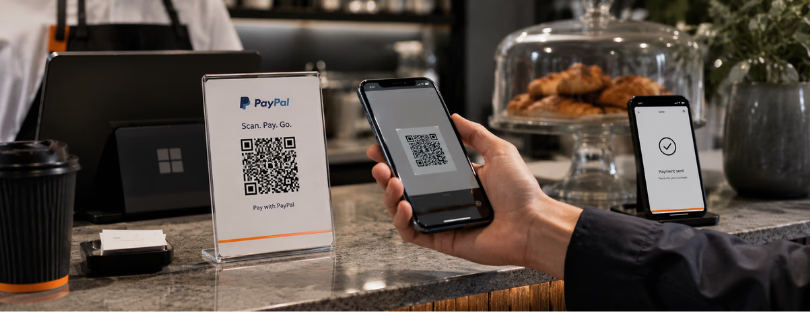
PayPal’s QR code fits neatly into that shift. The idea is simple: a merchant displays a PayPal QR code, the customer scans it with a smartphone or through the PayPal app, enters or confirms the amount, and pays without exchanging cash, sharing bank details or using a physical terminal. PayPal describes it as a way for businesses to accept in-person payments by displaying a code customers can scan using the PayPal app. The QR code does not expire, and one code can be used repeatedly for different transactions.
That simplicity is the point. And for the travel economy, simplicity matters more than most payment companies like to admit.
Why it matters for travellers
Think about the places where travel payments still feel messy: a local food stand, a luggage storage desk, a small tour operator, a beach rental kiosk, a hotel shuttle, a festival booth, a tiny souvenir shop that does not want to invest in full payment infrastructure.
Cards work beautifully in many markets, but not everywhere. Cash still works, but travellers increasingly carry less of it. Bank transfers are too slow and too local. Downloading a new local wallet for one purchase is annoying. A PayPal QR code sits somewhere between all of these options. It is not perfect, but it is easy to understand.
For travellers, the value is not just “contactless.” It is familiarity. Many people already know PayPal from online shopping, subscriptions or marketplace payments. When they see a PayPal QR code abroad, the payment flow feels closer to an online checkout than a local banking experience. That makes a difference when someone is tired, in a queue, low on cash, or unsure whether a small merchant’s card terminal will accept their foreign card.
PayPal itself has been pushing this wider wallet logic, arguing that in-person transactions are becoming a mix of Tap to Pay, QR codes and wallet authentication. That is a useful way to see the market. QR is not replacing cards. It is becoming one more bridge between physical commerce and digital wallets.
The merchant angle
For small merchants, the appeal is even clearer. A QR code can be printed, displayed on a counter, added to packaging, placed on a table tent or shown on a phone. There is no need to hand over a device. There is no need to manually type an email address. For mobile sellers and seasonal businesses, that flexibility is valuable.
The fee structure also matters. In the United States, PayPal lists QR code transactions at 2.29% plus a fixed fee, while QR code transactions through a third-party integrator are listed at 2.29% plus $0.09. Standard PayPal Checkout and guest checkout are listed at higher rates. Fees vary by market, so merchants still need to check their local PayPal pricing, but the positioning is obvious: QR payments are designed to be a lighter in-person acceptance method, not just another online checkout button.
This is where PayPal becomes interesting for travel sellers. A local guide in Lisbon, a pop-up coffee stand near a train station, or a hostel selling last-minute experiences does not always need a sophisticated POS setup. Sometimes they need a payment option that works now, looks recognizable, and does not require a customer to carry local cash.
There is also a subtle trust layer here. A printed QR code from a known payment brand can feel more credible than a random bank transfer request or an unfamiliar local payment app. That matters in tourism, where the customer and merchant may never meet again.
QR codes are not magic
Still, we should not romanticize the square.
QR payments depend on the customer having a smartphone, battery, internet access and the right app or wallet flow. That is not always guaranteed while travelling. Anyone who has arrived at an airport with 3% battery and no local data knows the problem. For Alertify readers, this connects directly to a wider point: digital payments and travel connectivity are now linked. A payment experience is only as smooth as the mobile connection underneath it.
There is also the issue of QR code fraud. Static QR codes can be replaced or tampered with, especially in public locations. Merchants need to protect displayed codes, check them regularly, and avoid sloppy setups. Customers should also slow down before paying. Does the merchant name look right? Is the amount correct? Is the payment screen actually PayPal? These are small checks, but they matter.
QR also has strong regional differences. In parts of Asia, QR payments are deeply embedded in everyday commerce. In Europe and North America, cards, Apple Pay, Google Pay and contactless terminals remain dominant in many environments. According to the European Central Bank, card payments represented 57% of the total number of non-cash transactions in the euro area in the first half of 2025, while e-money payments accounted for 6%. That tells us something important: QR may be growing, but cards still own the mainstream payment habit in Europe.
PayPal versus the wallet crowd
PayPal’s QR code does not compete in isolation. It sits in a crowded payments landscape with Apple Pay, Google Pay, Samsung Wallet, Venmo, Revolut, local bank apps, card networks, account-to-account payment systems and emerging public payment initiatives.
Apple Pay and Google Pay win on speed at NFC terminals. Venmo has social payment strength in the US and also supports QR payments in stores and partner apps. Revolut is strong for frequent travellers who want multi-currency spending and card control. Local QR systems can be powerful when they become part of national payment habits. Meanwhile, Europe continues to explore deeper payment sovereignty through projects such as the digital euro, which the ECB frames as a response to declining cash use and the need for public money in digital form.
PayPal’s advantage is different. It is not the most invisible payment method, and it is not always the cheapest. Its strength is recognition, cross-border familiarity and ease of deployment for small merchants. That combination is useful in travel because travel commerce is fragmented. Not every transaction happens inside a polished retail chain with modern terminals and perfect infrastructure.
Conclusion
The PayPal QR code is not the future of payments by itself. That would be too simple. The future is messier: cards, wallets, QR codes, bank payments, super apps, digital identity and eventually central bank digital money all overlapping in different markets.
But PayPal QR codes solve a very real problem in that messy middle. They give small businesses a recognizable way to accept digital payments without overbuilding their checkout stack. They give travellers one more familiar option when cash feels outdated and local payment systems feel unfamiliar. And they show where commerce is heading: not toward one universal payment method, but toward flexible payment layers that adapt to the situation.
For travel brands, hotels, tour operators and mobility providers, the lesson is bigger than PayPal. The checkout moment is now part of the customer experience. If payment feels local, confusing or fragile, the brand feels fragile too. If it feels fast, familiar and safe, the sale becomes easier. PayPal’s QR code is a small square, but it points to a much larger trend: travel commerce is becoming more mobile, more wallet-driven and much less patient with friction.
Driven by wanderlust and a passion for tech, Sandra is the creative force behind Alertify. Love for exploration and discovery is what sparked the idea for Alertify, a product that likely combines Sandra’s technological expertise with the desire to simplify or enhance travel experiences in some way.


 QR codes are not magic