Mobile Phone Accessories Market Is Quietly Exploding
The global mobile phone accessories market is quietly having its biggest identity shift in a decade. What used to be a world of cheap cables, plastic cases, and impulse buys at airport kiosks has turned into a high-margin, design-driven, and deeply strategic ecosystem that now sits at the center of how people experience their smartphones.
According to the latest outlook from Future Market Insights, the market is valued at USD 119.2 billion in 2026 and is projected to almost double to USD 230.1 billion by 2036. A 6.8 percent CAGR does not happen by accident. It reflects a structural change in how consumers treat accessories. These products are no longer optional extras. They are performance upgrades, protection policies, and lifestyle statements rolled into one.
For travelers, remote workers, gamers, and everyday power users, the accessory has become just as important as the phone itself.
Accessories are no longer secondary
The shift is visible everywhere. Smartphones are thinner, more expensive, and more powerful than ever. At the same time, manufacturers are removing ports, shrinking batteries, and pushing users deeper into closed hardware ecosystems. Accessories have stepped in to fill the gaps.
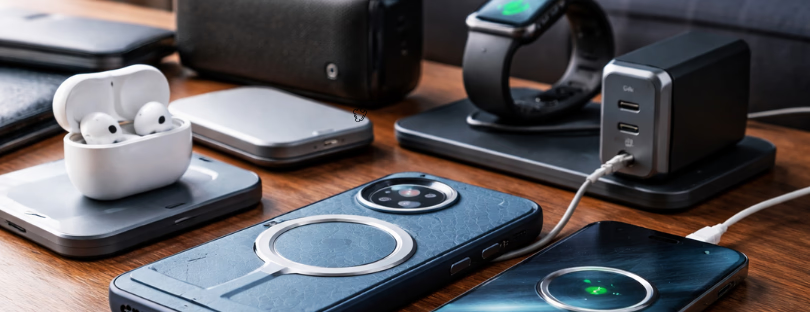
Fast charging bricks compensate for smaller batteries. Wireless earbuds replace headphone jacks. Rugged and thermal-managed cases protect devices that now cost more than many laptops. The accessory is no longer a nice-to-have. It is part of the core mobile experience.
Future Market Insights connects this growth directly to three forces: the global rollout of 5G, the explosion of wearable and wireless audio, and a growing consumer focus on extending device lifespan rather than upgrading every year.
In other words, people are keeping phones longer but investing more in what surrounds them.
From plastic to performance materials
One of the most important changes is happening behind the scenes in manufacturing. The industry is moving away from low-cost plastics toward premium, sustainable, and technically advanced materials. This is pushing production costs up, but it is also enabling higher margins and stronger brand differentiation.
Cases now integrate thermal management for gaming and sustained 5G performance. Chargers use AI-driven power delivery to protect battery health. Cables are reinforced for longevity rather than built to be replaced every six months.
“We are entering an era of ‘Margin Concentration’,” notes an industry lead analyst. “Market leaders with established, resilient supply chains are leveraging economies of scale to exert greater control over pricing. Success in 2026 and beyond is defined by the ability to justify premium price points through genuine product differentiation and brand loyalty, rather than mere volume sales.”
That statement captures the new reality. The winners are not the cheapest brands. They are the ones who can convincingly explain why their accessory makes the phone better, safer, or longer-lasting.
E-commerce is now the front door
Distribution has changed just as radically as product design. E-commerce now accounts for roughly 45 percent of all accessory sales globally, officially overtaking physical retail.
This matters for several reasons. Online platforms give consumers instant price comparisons, real-world reviews, and access to global brands that would never appear in local stores. For manufacturers, it removes layers of retail overhead and allows direct-to-consumer strategies at scale.
For travel-focused buyers in particular, online channels have become essential. Accessories are often purchased right before trips, after a cracked screen scare, or when a new device arrives. Speed, availability, and trust matter more than shelf placement.
This digital-first reality also explains why branding, packaging, and online storytelling have become as important as technical specifications.
Protection and power still dominate
While innovation is happening across categories, two segments continue to anchor the market.
Protective cases and covers
Protective accessories account for around 34 percent of total market share, making them the single largest segment. With flagship smartphones regularly crossing the USD 1,500 mark, protection is no longer cosmetic. It is financial risk management.
Consumers are willing to pay for rugged materials, antimicrobial coatings, MagSafe compatibility, and designs that do not compromise aesthetics. This segment has also benefited from sustainability trends, with recycled and biodegradable cases gaining traction.
Wireless charging and audio
The steady removal of physical ports has accelerated demand for wireless chargers, Bluetooth earbuds, and portable speakers. Adoption is particularly strong among Gen Z and Millennials, who prioritize convenience and ecosystem compatibility.
Wireless audio is no longer just about sound. It is about call quality, battery life, device switching, and seamless integration with laptops, tablets, and wearables.
Asia drives volume and velocity
North America and Europe remain high-value markets, but the fastest growth is clearly happening in Asia.
India
With an expected CAGR of 8.2 percent, India is the fastest-growing market globally. A young population, rising smartphone penetration, and government-backed manufacturing initiatives are creating ideal conditions for both local and international accessory brands.
China
China continues to sit at the center of the ecosystem with a projected CAGR of 7.2 percent. It is simultaneously the world’s largest production hub and one of its most sophisticated consumer markets. Innovation in 5G-enabled accessories, smart wearables, and integrated charging solutions often appears here first.
United States
The U.S. market grows at a solid 6.6 percent CAGR but with a different dynamic. Demand is heavily skewed toward ecosystem accessories that integrate seamlessly with specific hardware platforms. Consumers expect accessories to feel native, not generic.
Sustainability and standards reshape the next decade
Looking toward 2036, two trends stand out as structurally transformative.
Eco-friendly innovation is no longer a niche positioning. Regulatory pressure and consumer awareness are forcing brands to rethink materials, packaging, and product lifecycles. Accessories that reduce waste or extend device longevity are increasingly favored.
At the same time, technological interoperability is simplifying the market. Standards like USB-C and Qi wireless charging reduce fragmentation and allow brands to focus on quality and design rather than compatibility chaos. Universal accessories are becoming commercially viable without sacrificing performance.
Smaller brands are also carving out space by targeting hyper-specific use cases. Modular gaming cases, athlete-focused audio gear, and travel-optimized charging kits are gaining loyal followings even as giants dominate mainstream categories.
A crowded but strategic competitive landscape
Competition remains intense. Tier-one manufacturers increasingly bundle accessories with flagship devices to lock in early loyalty. Established audio and peripheral specialists continue to defend their position through engineering excellence and cross-platform support.
Key players shaping the market include Samsung Electronics, Apple, Sony, Logitech, Harman International, and GN Group. Their strategies differ, but the goal is the same: become indispensable to the user’s daily digital routine.
Conclusion
The mobile phone accessories market is no longer about volume alone. It is about relevance. Compared to adjacent consumer tech segments like wearables or smart home devices, accessories benefit from a unique advantage: they attach directly to a product people already depend on every day.
What we are seeing now mirrors earlier shifts in industries like laptops and cameras, where peripherals evolved from generic add-ons into specialized performance tools. Brands that succeed over the next decade will be those that understand context. Travel, work, gaming, sustainability, and ecosystem lock-in are not trends in isolation. They intersect in how people use their phones.
Future Market Insights, alongside ongoing reporting from outlets such as Statista and Counterpoint Research, consistently points to the same conclusion. Accessories are no longer riding the smartphone wave. They are shaping it.
For readers watching this space, the message is clear. The most interesting innovation in mobile is no longer always inside the phone. Increasingly, it is wrapped around it.
Baey, a tech enthusiast and avid traveler, blends a passion for iGaming with a love for exploration, bringing the latest in gaming technology to every corner of the globe. Whether delving into new virtual realms or discovering hidden travel gems, Baey ensures a thrilling journey for tech-savvy adventurers.