Luxury Escapes Adds Hubby eSIM to Travel Membership
Most travel memberships still focus on traditional benefits such as lounge access, upgrades, or priority services. These can add value, but they are not always relevant at the exact moment a traveler needs them.
This move by Luxury Escapes takes a more functional approach.
Through a partnership with Hubby eSIM, mobile connectivity is now embedded directly into Société, the company’s flagship membership program. It is not positioned as an add-on or optional extra, but as a built-in component of the product.
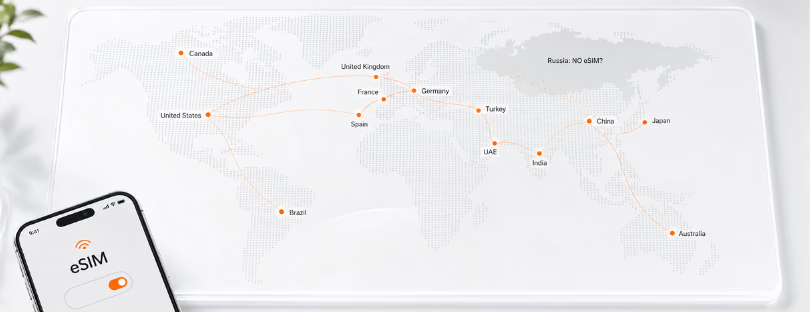
Each membership tier includes a preloaded eSIM. Bronze members receive 1GB per cycle, Silver 3GB, Gold 5GB, and Platinum 10GB. The eSIM can be installed before departure and activates automatically upon arrival across more than 200 destinations.
The concept is straightforward, but it addresses a specific and often overlooked issue in travel.
The first hour after arrival
The initial period after landing is one of the most operationally dependent moments in a trip.
Travelers rely on mobile data for transport, accommodation access, communication, and itinerary management. At the same time, this is when connectivity is least reliable if not pre-arranged.
In practice, most travelers solve this through one of three options:
- Roaming is often avoided due to cost uncertainty
- Public Wi-Fi, which is inconsistent and sometimes insecure
- Purchasing an eSIM or SIM on arrival, which requires time and decision-making
By integrating an eSIM into the membership, Luxury Escapes removes this step entirely. Connectivity is available immediately, without requiring user action at the point of arrival.
This is not an improvement in connectivity quality itself, but in how and when connectivity is delivered.
Integration into the product layer
What stands out is not the eSIM itself, but its position within the product.
Previously, connectivity sat outside the travel booking flow. Users would arrange it separately, either before or during the trip.
With this model, connectivity becomes part of the core experience:
- Booking, travel, and arrival remain within a single ecosystem
- There is no need to switch platforms to solve connectivity
- The user journey becomes more continuous
This reflects a broader shift in how travel platforms are structured. Services that were previously external are being integrated to reduce friction and retain user engagement.

The role of white-label infrastructure
Hubby eSIM operates as an enabler rather than a consumer-facing brand.
White-label eSIM providers allow companies to offer connectivity under their own brand without managing telecom infrastructure directly. This includes network access, provisioning, and global coverage agreements.
For travel companies, this removes the operational complexity typically associated with telecom services. The result is a plug-in model where connectivity can be embedded without changing the core business.
This approach is increasingly common across travel and fintech, where infrastructure is abstracted and delivered through APIs or partnerships.
Interpreting the data tiers
The included data volumes, ranging from 1GB to 10GB depending on tier, are relatively modest when compared to standalone eSIM plans.
However, the structure suggests a specific use case.
The allocation is sufficient for:
- Initial navigation
- Messaging and basic communication
- Accessing bookings and travel information
It is not designed to cover full-trip usage, particularly for data-intensive activities.
This indicates that the primary objective is to ensure immediate connectivity upon arrival, rather than to replace all other data consumption during the trip.
After the initial period, users are likely to:
- Purchase additional data
- Switch to another plan
- Use Wi-Fi where available
The included eSIM acts as a baseline layer, not a complete solution.

Positioning relative to existing eSIM providers
Direct-to-consumer providers such as Airalo and Holafly operate on a different model.
They focus on:
- Plan selection
- Pricing comparison
- Destination-specific optimization
This approach assumes active user involvement in choosing a connectivity solution.
In contrast, the Luxury Escapes model removes that decision from the user. Connectivity is pre-assigned and activated automatically.
The difference is not in the product itself, but in the user’s role in accessing it.
Distribution and visibility
Embedding connectivity changes how it is distributed.
Standalone eSIM providers rely on:
- User awareness
- Search and comparison
- Conversion at the point of need
When connectivity is bundled:
- It is delivered without a separate decision
- It is used without prior comparison
- It becomes part of the default experience
This reduces friction, but also shifts visibility away from the connectivity provider and toward the platform delivering it.
Similar patterns can be observed in other sectors, such as payments, where infrastructure is embedded and largely invisible to the end user.
Broader market direction
Data from the GSMA indicates continued growth in eSIM adoption, driven by device compatibility and operator support.
As adoption increases, the competitive focus is shifting from access to integration.
This includes:
- Travel platforms embedding connectivity into booking flows
- Financial services bundling data for international usage
- Enterprise solutions incorporating connectivity into mobility management
The common theme is that connectivity is moving closer to the product layer, rather than remaining a standalone purchase.
Conclusion
The partnership between Luxury Escapes and Hubby eSIM does not introduce new technology, but it reflects a change in how existing technology is positioned.
Compared to providers like Airalo and Holafly, which rely on user choice and active selection, this model embeds connectivity into the travel experience itself.
The key difference is not in the data offering, but in the removal of a separate decision point.
As eSIM adoption continues to grow, the distinction between standalone connectivity products and embedded solutions is likely to become more significant.
The focus is shifting from who provides connectivity to how and when it is delivered.