Telit Cinterion Brings IoT eSIM to Fleet Video AI
Telit Cinterion has announced that its NExT™ IoT eSIM solutions are powering FleetSafe.ai’s AI video telematics deployment in the 2026 British Truck Racing Championship. On paper, that sounds like a motorsport story. In practice, it is more interesting than that.
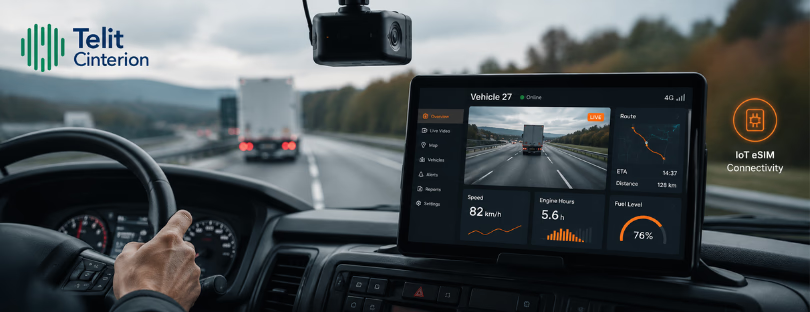
A racing truck is a harsh place to test connectivity. Vehicles move fast, vibration is constant, conditions change, and the data load is not light. FleetSafe.ai is using AI-powered in-cab and external cameras to monitor driver behaviour and fatigue, support live video streaming, and feed analytics back into the platform. Telit Cinterion’s role is the less visible but necessary layer: keeping that video and telemetry data moving when network conditions are not predictable.
That is the part fleet operators should watch. Video telematics is moving from “record it and review later” to real-time safety intelligence. And real-time safety intelligence is only useful if the connection survives the messy parts of the journey.
Why eSIM matters here
FleetSafe.ai selected Telit Cinterion for a next-generation platform that needs continuous, high-bandwidth data transmission across changing network conditions. NExT IoT eSIM supports multiprofile technology, allowing eSIMs to switch between operator profiles based on location, predefined rules, and cost.
This is not the same connectivity problem as a basic GPS tracker. A location ping can tolerate delay. Live video, driver-fatigue alerts, incident evidence, and session diagnostics are far less forgiving. When the camera becomes part of the safety workflow, connectivity stops being a commodity line item.
READ MORE: Telit Cinterion at MWC 2026: Scaling Global IoT & Advanced eSIM Innovation
Telit Cinterion’s wider NExT proposition fits the direction of enterprise IoT. Its connectivity management platform gives customers centralized visibility and control, including activation, data usage, connection status, diagnostics, provisioning parameters, and automated triggers. Telit also positions NExT as a global IoT network supporting cellular LPWA through high-bandwidth applications, with access to more than 600 networks in over 200 countries.
The standards backdrop matters too. GSMA’s SGP.32 specification is designed for remote provisioning and management of eUICC in network-constrained or user-interface-constrained IoT devices. For fleets, the practical question is simple: can you manage deployed connectivity without touching every vehicle?

The hidden control plane
FleetSafe.ai manages the deployment through Telit Cinterion’s NExT connectivity management platform. According to the announcement, the platform gives FleetSafe.ai a centralized control plane covering per-device usage analytics, session-level diagnostics, SIM lifecycle status, remote activation, and alerts for anomalous data consumption.
This is where the story becomes less flashy, but more commercially useful. Cameras sell the safety story. AI sells the intelligence story. The connectivity control plane decides whether the deployment remains manageable at scale.
By using a single commercial and technical framework, FleetSafe.ai reduces the need to manage multiple SIM vendors, APNs, and regional contracts. For commercial fleets, it could mean fewer procurement headaches, faster expansion, and better cost governance.
“Video telematics is central to improving safety and performance across modern fleets, but it requires reliable, high-throughput connectivity to deliver value,” said Dean Leonard, president of technical operations at FleetSafe.ai. “With Telit Cinterion, we can stream video in real time, monitor driver fatigue and behavior, and operate with the confidence that our connectivity will scale and perform wherever our customers need it.”
A crowded market, but a different angle
The video telematics market is already busy. Berg Insight estimates that North America had almost 7.6 million active video telematics systems in 2025 and expects the installed base to reach more than 17.3 million by 2030. Europe is smaller, but growing too, with more than two million systems estimated in 2025 and 4.3 million expected by 2030.
Players such as Samsara, Lytx, Geotab, Streamax, Motive, and Netradyne are pushing hard on AI cameras, driver coaching, incident evidence, and integrated fleet platforms. Samsara promotes AI detections and real-time alerts for driver and road risk. Lytx positions itself around AI-powered insights for safety, efficiency, and compliance. Geotab describes video telematics as the combination of dash camera footage, vehicle data, and AI analysis.
READ MORE: Telit Cinterion Partners With Thales to Enhance Its IoT eSIM Provisioning Services
Telit Cinterion is not trying to be the fleet safety dashboard in that same way. The cleaner reading is that Telit is competing for the enabling layer underneath increasingly data-hungry fleet applications. That layer is not glamorous, but it is becoming strategic.
“Fleet operators are increasingly relying on AI-driven video to enhance safety and streamline operations,” said Martin Krona, president of services and solutions at Telit Cinterion. “This deployment demonstrates how our integrated connectivity, eSIM and platform capabilities ensure uptime and support the most demanding, high-data IoT applications at global scale.”
Conclusion
This partnership is not really about racing trucks. Racing simply makes the weakness easier to see: if a fleet application depends on real-time video, edge AI, alerts, and remote diagnostics, connectivity cannot be treated as an afterthought.
For very small fleets, low-data tracking deployments, or companies already locked deeply into one all-in-one telematics provider, a sophisticated multiprofile eSIM and centralized connectivity layer may be more than they need. There is also room for clearer public benchmarking around uptime, latency, failover behaviour, and video performance under poor network conditions.
Still, the direction is obvious. AI video telematics is becoming more real-time, more bandwidth-heavy, and more operationally critical. Telit Cinterion and FleetSafe.ai are showing that the next phase of fleet safety will not be decided by cameras alone. It will also be decided by who controls the connectivity layer when the vehicle leaves the easy part of the network.