Enterprise eSIM: The Buyer’s Guide to Global Workforce Connectivity
Enterprise eSIM is not replacing roaming. It is replacing the way companies buy, control, and manage roaming.
That distinction matters because international connectivity used to be treated as a traveller problem. Someone flew abroad, activated a roaming bundle, claimed an expense, searched for airport Wi-Fi, or bought a travel eSIM before departure. It was annoying, but manageable because it happened one person at a time.
That model breaks when the user is no longer one traveller, but a global workforce.
A company with travelling executives, consultants, engineers, sales teams, project staff, contractors, and remote employees does not simply need data. It needs control. It needs visibility. It needs predictable spend. It needs support that does not turn IT into an airport helpdesk. It needs a procurement model that can be tested before it becomes another long telecom contract.
That is why enterprise eSIM is becoming its own category.
Travel eSIM providers changed the market first. Airalo, Holafly, Ubigi, GigSky, Nomad eSIM, Yesim, Saily, and others showed travellers that international data could be digital, fast, app-based, and often cheaper than traditional roaming. They made eSIM normal for millions of users.
But what works for a weekend in Barcelona does not automatically work for 500 employees moving across 40 countries.
A traveller wants data.
A company needs a managed connectivity system.
Enterprise eSIM is not a SIM-card story anymore. It is a control story.
Why travel eSIM is not an enterprise eSIM
Travel eSIM products are very good at individual access.
Choose a destination. Pick a plan. Install the eSIM. Use the data. Move on.
For holidays, solo business trips, digital nomads, freelancers, and small teams, this can be exactly right. It is simple, quick, and usually much easier than traditional roaming.
Business versions of travel-first products have also improved. Airalo for Business offers centralised eSIM management, reporting, budget controls, and visibility from one platform. Holafly for Business offers a dedicated B2B division for companies, with Holafly Business Center serving as its management platform for centralised employee eSIM administration, usage visibility, and budget control.
These are useful products. They should not be dismissed.
The issue appears when travel connectivity becomes operational infrastructure.
At scale, companies need to know who has an eSIM profile, how much data is being used, which countries are driving cost, whether thresholds can be applied, who supports the employee, whether usage can be pooled, and whether finance can understand the bill before the month ends.
That is a different problem from buying a plan before a trip.
Once a business crosses into regular international travel, 100+ mobile users, multi-country operations, procurement-led buying, and IT ownership, the question changes.
It is no longer “Which eSIM is cheapest?”
It becomes “Which provider can help us manage mobile connectivity properly?”
The three market lanes
The enterprise eSIM market is splitting into three main lanes.
The first lane is travel-first eSIM. These providers are strongest when the buyer needs fast international data for individuals, freelancers, small teams, or occasional business travellers. Airalo for Business, Holafly for Business, GigSky Business, and Nomad eSIM can all be relevant here, depending on destination coverage, user experience, dashboard needs, and team size.
The second lane is traditional enterprise telecom. Vodafone Business, Orange Business, 1GLOBAL, and other established telecom or mobility players bring infrastructure, scale, account management, voice and SMS options, security services, IoT capability, mobile fleet experience, and enterprise procurement maturity.
The third lane is managed enterprise eSIM. This is the most interesting space right now because it sits between the two. It borrows the speed and digital delivery of travel eSIM, but adds the things companies actually need: central control, managed support, visibility, spend management, reporting, procurement-friendly trials, and a commercial model that does not depend on employees buying data one trip at a time.
SureSIM is one of the clearer examples of this third model.
Its proposition is not “cheap travel data.” It is managed enterprise connectivity for global workforces. That difference matters. SureSIM focuses on multi-network access, usage visibility, central dashboards, managed support, commercial clarity, and a pilot pathway before wider deployment.
Not every company needs the same type of eSIM solution. The market is splitting into three very different buying lanes.
The important question is not “who sells eSIM?”
It is which lane matches the company’s real problem: simple access, telecom consolidation, or controlled workforce connectivity.
This is not the right level of structure for everyone.
A travel-first business eSIM may better serve a small company with occasional travel. A huge multinational already committed to Vodafone or Orange may prefer supplier consolidation. A company needing deeper telecom infrastructure and advanced remote SIM provisioning may look closely at 1GLOBAL.
But for mid-market and enterprise organisations with travelling workforces, procurement scrutiny, finance pressure, and IT ownership, the managed enterprise eSIM model is becoming very attractive.
It is not just about buying data.
It is about removing chaos from international connectivity.
The enterprise connectivity spectrum
Not every company needs the same level of eSIM maturity. This is where many comparisons go wrong. They put consumer travel eSIMs, business travel dashboards, managed workforce platforms, telecom operators, and infrastructure providers into the same basket.
That creates confusion.
A better way to look at the market is through the enterprise connectivity spectrum.
This spectrum is important because the buyer’s problem defines the right provider.
If the problem is “our employees need a simple data plan abroad,” a business travel eSIM may be enough.
If the problem is “we have no visibility, no control, unpredictable costs, too many manual claims, and IT is constantly supporting travellers,” then the company is no longer buying travel data.
It is buying workforce connectivity management.
That is a different category.
Enterprise operators still matter
It would be easy to say traditional telcos are outdated.
That would also be wrong.
Vodafone Business and Orange Business remain highly relevant in enterprise mobility. They bring scale, mature telecom infrastructure, account management, mobile fleet experience, security services, IoT capability, private networks, device management, and wider enterprise communications portfolios.
For large organisations already buying multiple services from Vodafone or Orange, consolidation can make sense. One supplier. One relationship. One broader enterprise framework. In complex procurement environments, that can be attractive.
1GLOBAL also deserves serious attention. It is one of the strongest enterprise eSIM and global mobile connectivity names in the market, with business mobile plans, eSIM deployment options, zero-touch provisioning, compliance services, voice, SMS, data, and global coverage.
For companies that want telecom depth and advanced remote SIM provisioning, 1GLOBAL is a credible benchmark.
The trade-off with operator-led models is not capability. It is buying fit.
For some companies, the operator model is exactly right: scale, account management, security, private networks, IoT, device management, and broader managed services.
For others, especially when the immediate need is focused workforce eSIM, spend visibility, and faster testing, a specialist managed enterprise eSIM platform may be easier to compare, pilot, and scale.
The Alertify enterprise eSIM evaluation model
The biggest mistake in enterprise eSIM comparison is starting with the lowest price per gigabyte.
That number matters, but it rarely tells the full story.
A cheap plan can become expensive if employees buy separate packages, unused data expires, finance reconciles dozens of claims, IT has no usage visibility, or support requests multiply. A large telco contract can look safe until out-of-zone usage, long lock-ins, and unclear billing rules create a different kind of risk.
A serious enterprise eSIM comparison should measure the operating model, not only the rate card.
This framework separates a business eSIM from an enterprise eSIM.
Travel-first business products usually perform well on speed and ease of access. Incumbent telcos perform well on scale, account structure, and wider enterprise credibility. Managed enterprise eSIM platforms perform best when the buyer needs control, visibility, support, commercial clarity, and operational flexibility without the weight of a traditional roaming contract.
Recognition is useful here, but it should be treated carefully.
Some awards are directly tied to enterprise eSIM. Some recognition is broader, such as private mobile networks, WAN services, funding, market reports, or connectivity benchmarks. All can help buyers assess credibility, but they are not interchangeable.
The key question is simple: Does the proof support the exact problem the company is trying to solve?
 Provider comparison
 Provider comparison
No provider is best for every company. That would be too neat and not very useful.
The right choice depends on what the company is trying to solve.
The right comparison is no longer “who has an eSIM?” Most serious providers now do.
The better question is: who has the operating model that matches how this company actually works?
Where each provider fits
Enterprise eSIM Provider Positioning
The trade-off with operator-led models is not capability. It is buying fit.
For some companies, the operator model is exactly right: scale, account management, security, private networks, IoT, device management, and broader managed services.
For others, especially when the immediate need is focused workforce eSIM, spend visibility, and faster testing, a specialist managed enterprise eSIM platform may be easier to compare, pilot, and scale.
It is not necessarily the best option for very small teams, consumer travellers, or companies already committed to a large telco consolidation strategy. But for mid-market and enterprise buyers managing regular international workforce movement, it is one of the more credible specialist options.
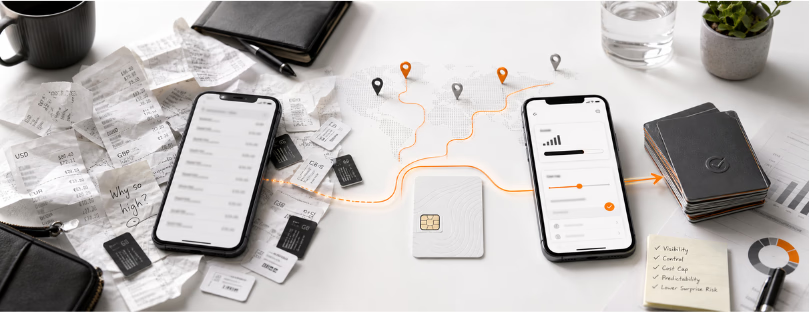
Pricing is not just a rate card
Enterprise eSIM pricing should be scored on structure, not only price.
A provider may look cheap at plan level and expensive operationally. Another may look more expensive per gigabyte but reduce support workload, invoice complexity, and uncontrolled roaming exposure.
For enterprise buyers, the real pricing questions are practical.
Is pricing published or hidden?
Is data pooled or purchased per trip?
Are high-cost destinations clearly identified?
Is support included?
Are thresholds automated?
Can usage be reported by user, team, department, country, or device?
Is there a pilot before commitment?
Can the buyer exit if the model does not work?
This is where enterprise eSIM overlaps with telecom expense management and mobile spend management. Corporate telecom expenses are no longer just a monthly invoice problem. They are an operational visibility problem.
A company cannot control what it cannot see.
That is why business roaming cost control is becoming such an important part of the enterprise eSIM conversation. It is not only about lowering the data price. It is about reducing uncertainty before it turns into financial friction, employee frustration, or IT workload.
The best enterprise eSIM model does not only reduce cost.
It reduces surprise.
The procurement test
Enterprise mobility buyers are under pressure from several sides.
IT wants a simple deployment. Finance wants predictability. Procurement wants competition and exit rights. Employees want something that works. Security wants fewer unmanaged workarounds, especially public Wi-Fi dependency. Travel managers want fewer complaints. Operations teams want people reachable when it matters.
That is why the procurement pathway matters almost as much as the product.
A stronger enterprise eSIM model should allow buyers to test with a controlled user group, measure real-world usage across actual destinations, set KPIs around cost, activation, reliability, and support, review reporting before committing, scale gradually if the business case is proven, and exit if the model does not fit.
This is where the SaaS-style approach is stronger than the old “sign first, learn later” telecom model.
SureSIM’s trial and POC approach is particularly relevant here. It gives buyers a practical way to de-risk adoption before full production. That does not make every competitor weaker, but it does make the comparison more realistic.
Enterprise buyers do not want marketing promises.
They want proof under their own conditions.
The buyer checklist
Before selecting an enterprise eSIM provider, companies should ask a few uncomfortable questions.
Questions That Reveal the Real Fit
Before selecting a provider, buyers should test the offer against strategy, operations, commercial clarity, proof, and user experience.
If a provider cannot answer these questions clearly, it may not be enterprise-ready.
What could improve across the market?
 What could improve across the market?
The enterprise eSIM market is still young, and the language is messy.
Too many providers say the same things: global, seamless, flexible, secure, scalable.
Those words are not wrong. They are just not enough.
Buyers need to know what is actually managed, what is self-serve, what is pooled, what is capped, what is supported, what is reported, and what happens when a traveller lands somewhere expensive.
The second issue is pricing clarity. Some providers still make it difficult to understand the real commercial model before sales engagement. Enterprise buyers do not expect everything to be cheap. They do expect it to be explainable.
The third issue is category confusion. eSIM Go, BICS, Eseye, Soracom, Gigs, and similar players are important names in the wider connectivity ecosystem. But infrastructure, IoT connectivity, embedded telecom APIs, and enterprise workforce mobility are not identical buying decisions.
A good comparison starts with honest scope.
A company buying connectivity for employees is not always buying the same thing as a platform embedding mobile data into an app, vehicle, payment terminal, or IoT device.
The fourth issue is proof quality.
Awards, analyst recognition, funding rounds, rankings, and market reports can all be useful. But buyers should not treat them as equals. A private network award does not prove the same thing as an enterprise eSIM deployment award. A consumer growth milestone does not prove the same thing as procurement-grade control. A latency ranking does not automatically answer questions about billing, support, or governance.
Recognition helps.
Relevance matters more.
The market direction
The next phase of enterprise eSIM will not be decided by who says “global” most often.
It will be decided by control.
Business travel remains a major corporate cost category. Hybrid work is normal. Field teams are more connected. Devices are multiplying. Employees expect mobile data to work across borders. Finance teams want predictability. IT teams want fewer tickets. Security teams want fewer unmanaged Wi-Fi workarounds.
That creates a perfect opening for enterprise eSIM.
But the winners will not only sell data.
They will sell visibility, resilience, governance, and simplicity.
That is why managed enterprise eSIM matters. It recognises that companies do not just want another mobile plan. They want fewer unknowns.
Fewer unknown costs.
Fewer disconnected employees.
Fewer emergency support requests.
Fewer local SIM workarounds.
Fewer unmanaged roaming decisions.
The best enterprise eSIM provider is not necessarily the cheapest one. It is the one that makes global connectivity boring in the best possible way.
Predictable. Visible. Controlled. Supported.
The market is not moving toward one perfect enterprise eSIM model. It is moving toward a better fit. Some buyers will choose operators. Some will choose travel-first business eSIMs. Some will need infrastructure-led connectivity. Others will need specialist managed workforce control. The winning provider is the one that matches the buyer’s operational reality, not the one with the longest feature list.
Final thoughts
Enterprise eSIM is not replacing roaming because roaming disappeared.
It is replacing roaming because the old model no longer matches how companies move.
Travel eSIM providers proved that digital connectivity could be easier. Traditional telcos proved that enterprise mobility still needs scale and structure. Managed enterprise eSIM providers are now trying to prove something more specific: that global workforce connectivity can be controlled without becoming another slow, opaque telecom contract.
That is the space to watch.
For small teams, travel-first business eSIMs may be enough. For very large organisations, Vodafone Business, Orange Business, or 1GLOBAL may remain the natural route, especially where enterprise mobility is part of a wider telecom, security, IoT, private network, or managed services strategy. For companies focused on distributed devices, laptops, vehicles, and broader connected use cases, Ubigi for Business may deserve close attention. For practical business travel data distribution, Airalo for Business, Holafly for Business, and GigSky Business have clear roles.
But for companies sitting between those worlds, large enough to need governance and agile enough to avoid overly complex roaming structures, platforms like SureSIM are becoming highly relevant. Its recent Mobile News Awards recognition strengthens that positioning, not because awards should decide procurement, but because the category matters. Enterprise eSIM deployment, innovation, and managed connectivity are exactly the areas buyers should be evaluating.
The buying decision should not start with: “Which provider has the most countries?”
It should start with: “Where are we losing control?”
Because that is the real enterprise mobility problem now.
Not coverage.
Visibility.
And once a company sees that clearly, enterprise eSIM stops looking like a travel perk.
It starts looking like infrastructure.
 Sources and references
Counterpoint Research, Global eSIM Orchestration Landscape Report 2026: https://counterpointresearch.com/en/reports/global-esim-orchestration-landscape-report-202
1GLOBAL, 1GLOBAL recognised as a Leader in Counterpoint Research’s 2026 eSIM Orchestration report: https://www.1global.com/blog/announcements/1global-recognized-as-leader-2026-counterpoint-research-esim-orchestration
Gartner, Magic Quadrant for 4G and 5G Private Mobile Network Services, published 5 March 2026: https://www.gartner.com/en/documents/7544245
Vodafone Business, Vodafone named a Leader in Gartner Magic Quadrant for 4G and 5G Private Mobile Network Services: https://www.vodafone.com/business/news-and-insights/analyst-views/vodafone-named-a-leader-in-gartner-magic-quadrant-for-4g-and-5g-private-mobile-network-services-for-the-second-year-in-a-row
Orange Business, Gartner Magic Quadrant for 4G and 5G Private Mobile Network Services: https://www.orange-business.com/en/about-us/analysts/gartner
Transatel / Ubigi, Ubigi recognised as the most reliable eSIM for mobile professionals according to the 2025 Latency Report: https://www.transatel.com/news-and-insights/press-releases/ubigi-recognised-as-the-most-reliable-esim-for-mobile-professionals-according-to-the-2025-latency-report/
Holafly, Holafly Global eSIM Index 2026: https://esim.holafly.com/inside/media-hub/holafly-global-esim-index-2026/
SureSIM, SureSIM wins Best eSIM Deployment & Innovation at the Mobile News Awards 2026: https://suresim.io/resources/news/suresim-wins-mobile-news-awards-2026/
Mobile News Awards 2026, winners and category news: https://mobilenewsawards.co.uk/