Skylo and Simetric Redefine IoT Connectivity Control
There’s a quiet but important shift happening in the connectivity space right now. While most of the conversation still revolves around eSIM adoption, pricing wars, and “unlimited” data claims, the real transformation is happening one layer deeper. It’s about control, orchestration, and how enterprises actually manage millions of connected devices across fragmented networks.
That’s exactly where the newly announced partnership between Skylo Technologies and Simetric comes in.
On the surface, it looks like another strategic collaboration. But underneath, it signals something much bigger: the emergence of a unified control plane for hybrid connectivity. One that spans terrestrial networks, satellite infrastructure, and increasingly complex IoT environments.
The real problem isn’t connectivity. It’s control
Enterprises today are not struggling to connect devices. That problem, for the most part, has been solved.
What they’re struggling with is everything that comes after.
As IoT deployments scale into the billions, companies are dealing with a messy reality: devices operating across multiple countries, different carriers, various connectivity platforms, and now, increasingly, non-terrestrial networks. Each layer adds complexity. Each network introduces its own rules, interfaces, and limitations.
Managing all of that in a coherent way has become one of the biggest operational bottlenecks in modern connectivity.
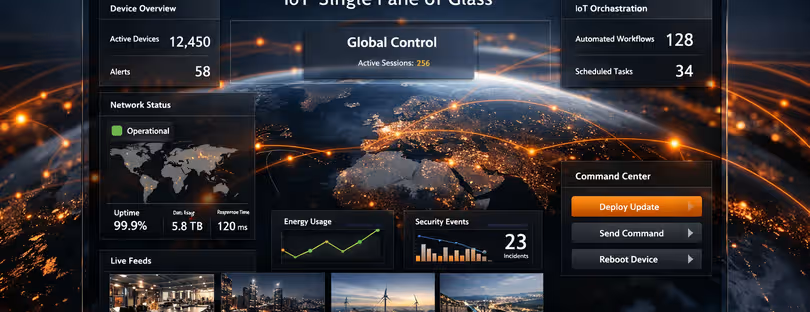
This is where Simetric positions itself. Not as another connectivity provider, but as a control layer. A “Single Pane of Glass” platform that aggregates and normalizes connectivity data across more than 300 mobile and satellite networks worldwide.
In simple terms, it gives enterprises one place to see everything. And more importantly, to control everything.
Why this partnership matters now
Skylo’s role in this partnership brings a critical piece of the puzzle: non-terrestrial connectivity.
If you look at where IoT is expanding, it’s no longer just urban or well-covered areas. It’s remote infrastructure, logistics corridors, maritime routes, agriculture, mining, and energy. Places where traditional cellular coverage simply doesn’t exist or isn’t reliable enough.
Skylo has built its position by integrating satellite connectivity directly into cellular standards, making it possible for devices to stay connected even outside terrestrial coverage zones.
Now, by integrating into Simetric’s platform, that connectivity becomes part of a broader, unified system.
Instead of treating satellite as a fallback or a separate layer, enterprises can now orchestrate terrestrial and non-terrestrial connectivity as part of the same operational workflow.
That shift is subtle, but it changes how networks are used entirely.

From connectivity provider to connectivity orchestration
One of the most interesting aspects of this collaboration is how it reframes the role of connectivity providers.
Skylo is no longer just offering coverage. It’s becoming part of a programmable, orchestrated environment where connectivity is dynamically selected, optimized, and managed based on real-time conditions.
As Karthik Ranjan, IoT Partnerships Leader at Skylo, explains:
“Enterprises today need the flexibility to choose the right network for every deployment, no matter where their devices operate. With the ability to choose multiple carriers on demand, organizations can optimize performance, reduce costs, and ensure consistent connectivity across diverse environments,” said Karthik Ranjan, IoT Partnerships Leader at Skylo. “Whether devices are operating in areas with variable terrestrial coverage or require non-terrestrial connectivity, this level of control is transformative.”
That’s the key idea here. Not just connectivity, but choice and control at scale.
Where eSIM fits into this story
You can’t talk about this shift without mentioning eSIM. And not just from a consumer travel perspective, but from an enterprise IoT standpoint.
As deployments become more global and dynamic, physical SIM logistics simply don’t scale. Enterprises need remote provisioning, lifecycle management, and the ability to switch networks without touching the device.
This is where Simetric strengthens the equation.
Through its integrations with leading eSIM and eIM providers, the platform enables full orchestration of eSIM profiles across both terrestrial and non-terrestrial networks. That means provisioning, policy enforcement, and lifecycle management can all be handled centrally.
For enterprises, this removes one of the biggest friction points in IoT scaling.
It also aligns with a broader industry trend: connectivity is becoming software-defined.
The ServiceNow angle changes everything
One detail in this announcement that shouldn’t be overlooked is the integration with ServiceNow.
At first glance, it sounds like a standard enterprise feature. In reality, it’s a major step toward aligning connectivity with core business operations.
By integrating connectivity workflows directly into ServiceNow, Skylo and Simetric are effectively embedding network management into IT service management processes. That includes ticketing, incident response, and asset tracking.
This matters because connectivity is no longer a standalone function. It’s part of the broader operational stack.
When something goes wrong with a device in the field, it’s not just a network issue. It’s a business issue. And resolving it requires coordination across multiple teams.
This integration brings connectivity into that loop.
AI is becoming the invisible layer
Another layer in this partnership is the use of agentic AI within Simetric’s platform.
Now, AI is often overused in telecom announcements. But in this context, it actually makes sense.
When you’re managing devices across hundreds of networks, in different regions, with varying performance conditions, manual optimization simply doesn’t scale.
AI can identify anomalies, predict failures, and optimize connectivity decisions in real time.
It turns a reactive system into a proactive one.
That’s particularly important for mission-critical IoT deployments, where downtime isn’t just inconvenient, but costly or even dangerous.
A network that never really disconnects
From a coverage perspective, this partnership extends Skylo’s reach significantly.
Through Simetric’s platform, enterprises can now access Skylo’s non-terrestrial network across 36 countries and more than 70 million square kilometers.
But the more important shift is conceptual.
Connectivity is no longer defined by geography alone. It’s defined by availability and orchestration.
If one network fails, another can take over. If terrestrial coverage drops, satellite fills the gap. All managed through a single interface.
That’s the idea behind the phrase:
Never Lose Coverage – Never Lose Control
The bigger picture: where the market is heading
If you zoom out, this partnership fits into a broader transformation happening across the connectivity industry.
We’re moving from:
- Static network selection → dynamic network orchestration
- Single-provider dependency → multi-network ecosystems
- Hardware-based connectivity → software-defined connectivity
- Reactive management → AI-driven optimization
And most importantly:
- Connectivity as a product → connectivity as a platform
You can see similar moves from players like 1GLOBAL, Gigs, and Eseye, all of whom are pushing toward programmable, API-driven connectivity models.
But what differentiates this Skylo–Simetric collaboration is the strong focus on hybrid networks. Not just cellular, not just satellite, but both, managed as one.
That’s still a relatively underdeveloped space, and one that’s likely to grow fast.
Conclusion: this is where control becomes the real product
The most important takeaway from this announcement isn’t about coverage, or even about satellite connectivity.
It’s about control.
For years, connectivity has been sold as access. Coverage maps, gigabytes, speeds. But as networks become more complex, access alone is no longer enough.
Enterprises don’t just need connectivity. They need visibility, governance, and the ability to orchestrate everything in real time.
That’s what this partnership is really about.
And it reflects a broader shift across the industry. According to the GSMA, IoT connections are expected to surpass 30 billion globally by the end of the decade. At that scale, manual management simply isn’t viable.
Platforms like Simetric, combined with hybrid connectivity providers like Skylo, are positioning themselves as the infrastructure layer that makes that scale manageable.
The interesting question now is who owns that control layer.
Because in the next phase of the connectivity market, it won’t be the providers with the most coverage that win.
It will be the ones who make that coverage usable.