Free eSIM Explained: Trials, Data, and Real Value
Let’s be honest. The idea of a “free eSIM” sounds almost too good to be true.
And in many cases, it kind of is.
But that doesn’t mean it’s fake. It just means you need to understand what “free” actually means in the world of travel connectivity. Because once you do, there are some genuinely useful ways to get started with eSIM without paying up front.
So let’s break it down properly, without the usual marketing fluff.
What people really mean by “free eSIM”
When you see “free eSIM” online, it can mean a few different things. And this is where most confusion starts.
Sometimes, it literally means the eSIM itself is free, but the data plan is not.
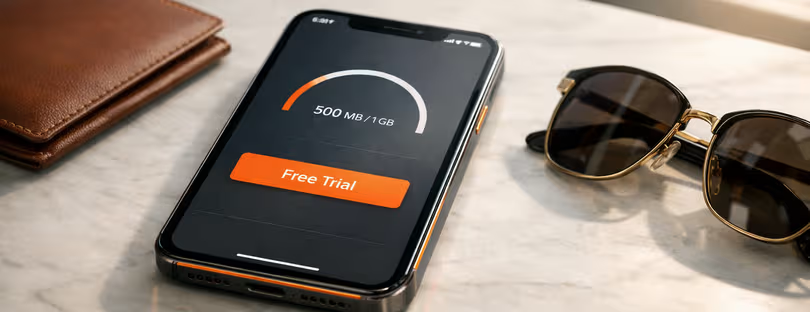
Other times, it means you get a small amount of free data as a trial.
And in some cases, it’s a promo offer or referral bonus that gives you credit to use.
The key thing to understand is this:
The eSIM as a technology is just a digital SIM profile. It doesn’t have value on its own without a data plan attached.
So when providers say “free eSIM,” they’re usually talking about one of these:
- Free installation (no SIM card cost)
- Free trial data (like 100MB to 1GB)
- Free credits through promotions
- Cashback-style offers
Once you look at it that way, it starts to make a lot more sense.
Why do providers even offer free eSIMs?
This is not charity. It’s a strategy.
The eSIM market is extremely competitive right now. There are over 100 providers globally, and most of them are fighting for the same traveler.
Offering a free trial is one of the easiest ways to remove friction.
Think about it from their perspective:
- You download their app
- You install their eSIM
- You test the connection
- You get comfortable with the experience
Once you’ve done that, you’re much more likely to actually buy a larger plan.
It’s the same logic as free trials in SaaS or streaming platforms.
And honestly, it works.

Where you can actually get a free eSIM (and what to expect)
Now let’s get practical.
There are a few types of offers you’ll typically see in the market.
Free trial data offers
Some providers give you a small amount of data just to test things.
This might look like:
- 100MB for free
- 500MB for free
- Occasionally 1GB
It’s not enough for a full trip, but it’s perfect for:
- Testing speeds
- Checking coverage
- Sending messages when you land
This is especially useful if you’re landing in a new country and just need quick connectivity before deciding on a bigger plan.
App-based promotions
Some apps offer free data in exchange for actions like:
- Signing up
- Verifying your email
- Referring a friend
This is more common than people think.
You might not get a lot, but it’s still real value, especially if you combine multiple offers.
Travel platform bundles
Sometimes airlines, hotels, or travel apps include free eSIM data as part of a bundle.
For example:
- Booking a flight and getting 1GB free
- Hotel loyalty programs offering connectivity perks
- Fintech apps bundling eSIM credits
This is where things get interesting, because eSIM is increasingly becoming part of the broader travel experience.
Not just a standalone product.
|
AIRHUB ESIM
Try before you buy
200 MB free · no credit card required
|
GIGSKY ESIM
Test real connectivity
100 MB free · no credit card required
|
Compare before you commit
500 MB free · no credit card required
|
ESKIMO GLOBAL ESIM
1 GB, long-term value
80+ countries · valid 2 years · code ALERTIFY
|
The “no credit card” angle
A lot of people specifically search for “free eSIM no credit card”.
And that makes sense.
Nobody wants to accidentally get charged or locked into something.
The good news is that many free trial offers do not require payment details.
But not all.
Some providers still ask for a card even if the first data package is free. That’s usually because they’re trying to convert you into a paying user later.
So if avoiding that is important to you, always check:
- Do you need to add a payment method?
- Is auto-renewal enabled by default?
- What happens after the free data is used?
A quick check upfront can save you from surprises later.
Is a free eSIM actually useful when traveling?
Short answer: yes, but with limits.
Free eSIM data works best as a backup or starter connection, not your main plan.
Here’s where it really shines:
- When you land and need instant internet
- As a fallback if your main SIM stops working
- For light usage like maps, messages, ride apps
Where it doesn’t work:
- Streaming
- Heavy browsing
- Long-term use
So think of it like airport WiFi in your pocket. Helpful, but not enough for everything.

The biggest misconception about “free”
Here’s something most people don’t realize.
Sometimes, chasing “free” can actually cost you more.
Why?
Because:
- Free plans often have higher upgrade prices
- You might end up buying multiple small packages
- Coverage or speeds may be limited
In many cases, a well-priced paid eSIM (like a 5GB or 10GB plan) ends up being more efficient.
This is especially true for frequent travelers.
So the smarter approach is not just asking:
“Is it free?”
But rather:
“Is it worth it for how I travel?”
That’s a much better filter.
How to use free eSIM offers strategically
If you want to get real value out of free eSIMs, you need to be a bit strategic.
Here’s how experienced travelers usually approach it:
- Use free data for arrival and setup
- Compare speeds before committing
- Combine multiple free offers if possible
- Keep one as a backup profile
And one underrated trick:
Install your eSIM before your trip while you still have stable WiFi.
A lot of people forget this, and then struggle at the airport trying to set things up with poor connectivity.
What this says about the future of connectivity
The fact that “free eSIM” is even a thing tells you something bigger about where the industry is going.
Connectivity is becoming:
- More flexible
- More software-driven
- More integrated into travel platforms
We’re moving away from the old model of buying a SIM card in a store.
Instead, connectivity is becoming something you activate instantly, sometimes even automatically.
And free trials are just the entry point into that ecosystem.
So, should you look for a free eSIM?
Yes, but with the right expectations.
A free eSIM is not a full solution. It’s a starting point.
If you treat it that way, it can actually be very useful.
You get to:
- Test providers without risk
- Stay connected in critical moments
- Explore how eSIM works without commitment
But for real travel usage, you’ll almost always need a proper data plan.
And that’s completely fine.
Because the real value of eSIM is not that it’s free.
It’s that it’s simple, instant, and built for how we travel today.