BICS and the Infrastructure Behind Global eSIM
BICS is one of those companies that becomes much more interesting once you stop looking at eSIM only through the consumer travel lens.
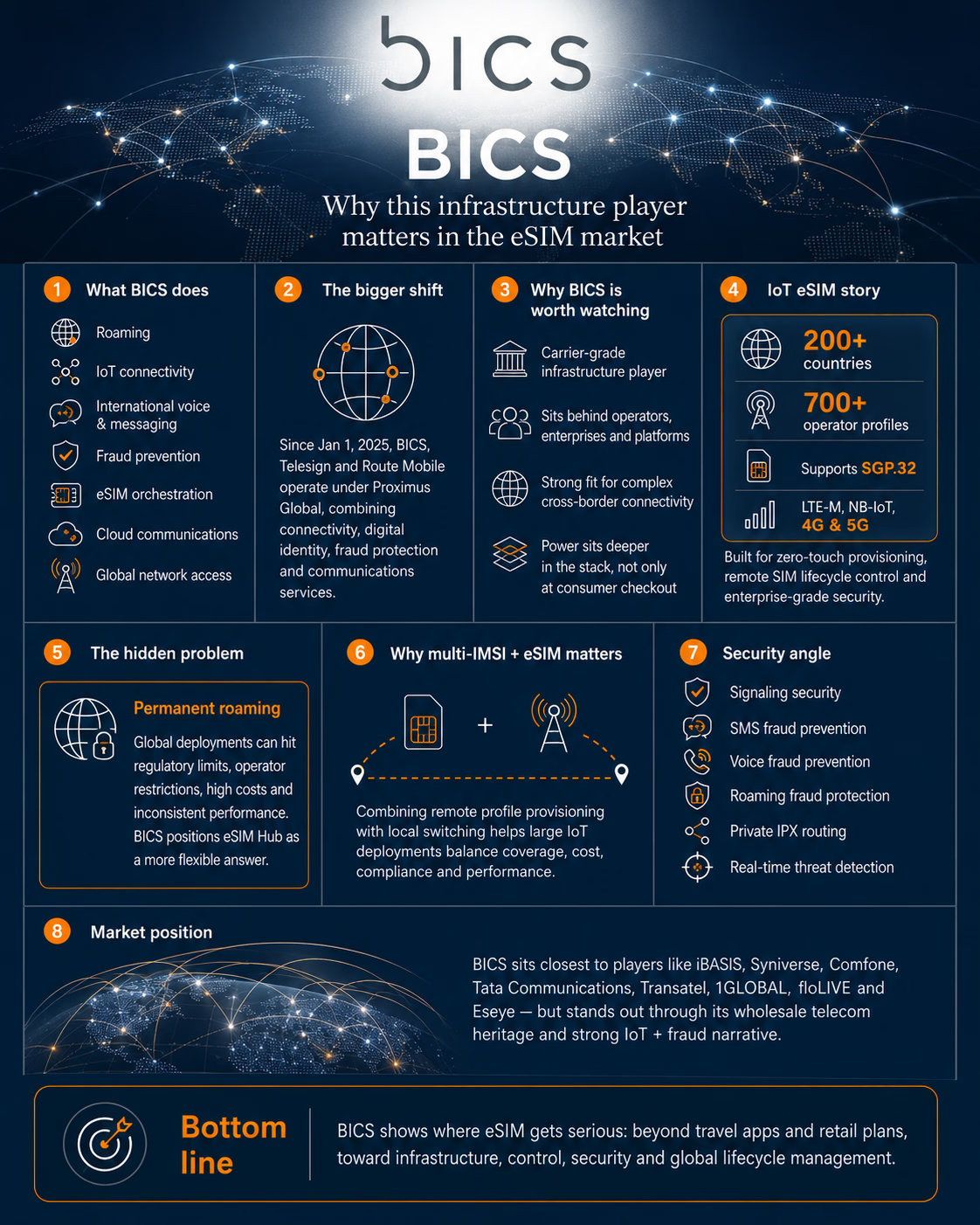
It is not really competing for the traveller who opens Google and searches for “best eSIM for Italy.” That market matters, of course. But BICS is playing deeper in the stack: roaming, IoT connectivity, international voice, messaging, fraud prevention, eSIM orchestration, cloud communications and global network access.
On its own site, BICS describes its role as connecting people, applications and devices worldwide, with solutions across enterprise communication, mobile connectivity, IoT, fraud prevention and global digital transformation. That sounds broad, but in BICS’ case the breadth is the point. This is not a small retail eSIM brand with a pretty app. It is a carrier-grade infrastructure player sitting behind operators, enterprises, platforms and connected-device deployments.
For Alertify readers, this is exactly the type of company worth watching. The visible eSIM market may be crowded, but the infrastructure layer is where the real power often sits.
The Proximus Global shift
The bigger corporate story is also important.
Since January 1, 2025, BICS, Telesign and Route Mobile have been united under the Proximus Global brand. The idea is to combine global connectivity, digital identity, fraud protection and communications services into one wider business. Proximus Global positions itself around enabling, securing and personalizing digital experiences across the customer lifecycle.
That matters because telecom is no longer just about moving traffic from one network to another. The market is converging. Connectivity, messaging, identity, verification, fraud prevention and customer engagement are starting to overlap.
READ MORE: BICS and Google Redefine Enterprise Voice in the Cloud
A bank does not only need SMS delivery. It needs fraud signals, identity checks, SIM swap detection and secure customer communication. An IoT company does not only need a SIM. It needs lifecycle control, roaming intelligence, security and cloud routing. A travel platform does not only need an eSIM product. It needs onboarding, compatibility checks, customer education and reliable connectivity after purchase.
BICS now sits inside a broader group built around that convergence. That gives it a different strategic profile from older wholesale-carrier businesses.
IoT eSIM is the serious story
The most interesting BICS angle today is probably IoT eSIM.
BICS says its enterprise-grade IoT eSIM offering gives brands access to more than 200 countries and 700+ operator profiles, with support for SGP.32, LTE-M, NB-IoT, 4G and 5G networks. It also highlights zero-touch provisioning, remote SIM lifecycle control, API integration and enterprise-grade security.
That may sound technical, but the business problem is simple.
IoT devices do not behave like tourists. A traveller can delete an eSIM, buy another plan, restart the phone or complain to support. A connected vehicle, medical device, payment terminal, logistics tracker or industrial sensor cannot manage connectivity like that. Once devices are deployed, mistakes become expensive.
READ MORE: Why BICS’s OSS Upgrade Matters for Global Connectivity
This is why BICS’ eSIM Hub matters. The company describes it as the engine behind its IoT connectivity solutions, combining multi-IMSI profiles, over-the-air management and regulatory compliance in one platform. The goal is a single global eSIM SKU that can adapt across markets while keeping devices connected reliably and in line with local roaming rules.
That is not a nice-to-have feature. For large IoT deployments, it is the difference between a scalable product and a support nightmare.
Permanent roaming is the hidden problem
One of the smartest things BICS talks about is permanent roaming.
Many IoT deployments start with a simple idea: put one global SIM in every device and let it roam everywhere. It sounds clean. It is also where things can become messy.
Permanent roaming can run into regulatory limits, operator restrictions, high costs and inconsistent performance. BICS’ material on the permanent roaming puzzle frames eSIM Hub as a way to combine roaming and local SIM approaches, making global deployments more flexible for OEMs, asset-management companies and connected-vehicle providers.
This is the kind of issue consumer eSIM marketing almost never touches, but industrial buyers care about deeply. If you are shipping hardware across multiple regions, connectivity cannot be improvised after the product is already in the field.
BICS’ answer is not just “more coverage.” It is profile flexibility, local switching, lifecycle management and compliance-aware connectivity.
Your customers will buy connectivity. The question is: from you, or from someone else?
We help airlines, banks, and travel platforms turn that demand into a built-in product — not a missed opportunity.
Multi-IMSI plus eSIM
BICS also makes a strong case for combining multi-IMSI technology with eSIM.
In a 2025 guide, BICS explains that a multi-IMSI eSIM can combine instant local switching with remote profile provisioning. The company positions this as especially valuable for large-scale IoT deployments under GSMA SGP.31/32 standards, in countries with permanent roaming restrictions, or for industries that need global reach with flexible cost and compliance models.
This is a useful distinction.
A basic eSIM lets you download or switch profiles remotely. Multi-IMSI logic can help a device behave more locally across networks. Put them together, and the result is more flexible than either approach alone.
For consumer travel, that may feel invisible. For enterprise IoT, it can be the core architecture.
Security is part of the product
BICS also has a strong fraud and security story.
Its fraud-prevention portfolio includes signaling security, SMS fraud prevention, voice fraud prevention and roaming fraud protection. The company says its firewall blocks malformed messages, non-roaming transactions, illegitimate home-network activity, signaling storms and malicious nodes before they reach mobile networks.
This is important because global connectivity is not only about access. It is also about exposure.
READ MORE: BICS and Valid Partner to Simplify Global IoT eSIM Connectivity
The more devices, apps, APIs and roaming relationships you connect, the more attack surfaces appear. BICS’ IoT security messaging also emphasizes private IPX routing, SIM-based authentication, real-time threat detection, cloud integration and keeping IoT traffic away from the public internet where needed.
That gives BICS a stronger enterprise story than providers focused only on selling connectivity volume.
Where BICS fits
The closest comparisons are companies such as iBASIS, Syniverse, Comfone, Tata Communications, Transatel, 1GLOBAL, floLIVE, Eseye, G+D, Kigen and Workz.
Compared with iBASIS, BICS is very similar in wholesale telecom DNA, roaming, mobile data, signaling and operator relationships. Compared with Syniverse and Comfone, it overlaps strongly around roaming, signaling and international interconnection. Compared with Transatel, BICS feels less consumer-visible but very strong in IoT eSIM, roaming and fraud protection. Compared with 1GLOBAL, it is less focused on fintech-style embedded consumer eSIM, but stronger in traditional carrier-grade infrastructure. Compared with floLIVE and Eseye, BICS has deeper global wholesale and operator heritage.
And compared with consumer eSIM brands like Airalo, Holafly or Nomad, the difference is obvious. Those companies own the traveller relationship. BICS helps make the machinery underneath work.
Conclusion
BICS matters because it shows where the eSIM market is becoming more serious.
The first wave of eSIM was about convenience: no plastic SIM, instant activation, and easier travel data. The next wave is about control. Who manages profiles? Who handles roaming restrictions? Who prevents fraud? Who supports IoT devices for years after deployment? Who can combine cellular, messaging, identity and security into one operating layer?
That is where BICS has a real story.
It may not be the brand a tourist sees at checkout, but it is the kind of company that operators, enterprises, OEMs and platforms depend on when connectivity has to work across borders, technologies and regulatory conditions. In a market obsessed with apps and prices, BICS is a reminder that the hardest part of eSIM is not always the sale.
It is everything that happens after the device connects.