Ooredoo Extends Apple Watch eSIM Offer in Maldives
Ooredoo Maldives is making a subtle but important move in the local connectivity market. Its ongoing Apple Watch eSIM promotion might look like a simple retail offer on the surface, but it signals something bigger: wearable connectivity is starting to matter, even in smaller and more remote telecom markets.
In partnership with Ell Mobile, the operator is offering customers six months of free eSIM connectivity when they purchase eligible Apple Watch models through the Apple Mono Store. After that, the service continues at MVR 199 per month.
At first glance, it is a straightforward bundle. But when you look closer, it is part of a broader shift in how connectivity is being distributed across devices.
Why this matters more than it looks
The real story here is not the discount. It is the device.
For years, telecom operators have focused almost entirely on smartphones as the center of connectivity. Wearables were treated as accessories, dependent on the phone for most functions. eSIM changes that equation.
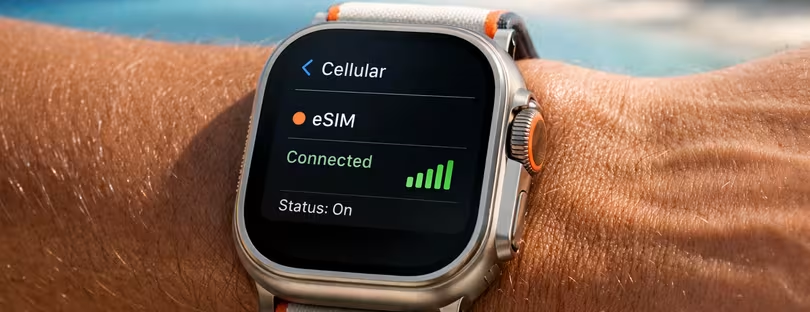
With standalone connectivity, an Apple Watch becomes a fully independent device. You can take calls, reply to messages, stream music, and receive real-time notifications without your phone nearby. For users, that means less friction in everyday moments like workouts, quick errands, or even travel scenarios where carrying a phone is inconvenient.
This is exactly the use case Ooredoo is leaning into. The company is positioning the Apple Watch not just as a companion device, but as a connected endpoint in its own right.
And importantly, it remains the only operator in the Maldives currently offering dedicated Apple wearable connectivity. That exclusivity still matters in a market where telecom differentiation is limited.
The timing is not random
Globally, wearable eSIM adoption has been slower than many expected. Not because the technology is lacking, but because the ecosystem has been fragmented.
In markets like the US, UK, and parts of Europe, operators such as Verizon, Vodafone, and Deutsche Telekom have been offering Apple Watch cellular plans for years. But even there, adoption has been gradual.
Why? Because the value proposition is subtle. This is not about saving money or getting more data. It is about convenience and lifestyle. And that takes longer to scale.
What Ooredoo is doing now mirrors what larger operators did earlier: reduce friction at the point of entry. By bundling six months of free connectivity, they remove the psychological barrier of “another subscription” and let users experience the product first.
That trial period is critical. Once users get used to leaving their phone behind and still being connected, the perceived value becomes much clearer.

A small market, but a relevant signal
It would be easy to dismiss this as a niche promotion in a small island market. That would be a mistake.
The Maldives is a high-travel, high-mobility environment. Tourists, hospitality workers, and frequent movers create a unique connectivity profile. In that context, wearable connectivity actually makes more sense than in some larger, more static markets.
It also aligns with a broader industry trend: connectivity is becoming ambient. It is no longer tied to a single device or a single plan. Instead, it is spreading across multiple devices, each with its own role.
Smartphones remain the core. But wearables, tablets, cars, and even IoT devices are becoming part of the same connectivity layer.
From that perspective, this promotion is less about selling Apple Watches and more about expanding the footprint of eSIM across device categories.
What this says about Ooredoo’s positioning
Ooredoo has consistently positioned itself as a technology-first operator in the region. Being the only provider of Apple wearable connectivity reinforces that narrative.
But more importantly, it shows a willingness to invest in use cases that are not yet mass-market.
That is where many operators hesitate. They wait for demand to become obvious before committing resources. Ooredoo is taking the opposite approach: create the experience first, let demand follow.
This is a familiar pattern in telecom innovation. Early moves often look small. But they shape user expectations over time.
What happens next
The real question is not whether this promotion will drive immediate revenue. It probably will not.
The question is whether it accelerates behavioral change.
If enough users adopt wearable connectivity and see its value, it opens the door for broader multi-device plans, bundled connectivity across ecosystems, and eventually more advanced use cases tied to health, safety, and real-time data.
And that is where things get interesting.
Conclusion: a glimpse into the multi-device future
Most of the eSIM conversation today still revolves around travel and smartphones. That is where the volume is. That is where the competition is.
But the long-term play is different.
Operators like Vodafone and Deutsche Telekom have already shown that wearable connectivity can become a steady, if modest, revenue stream. Research from firms like GSMA and Counterpoint Research consistently points to multi-device ecosystems as the next phase of telecom growth.
Ooredoo’s move fits directly into that trajectory.
It is not trying to reinvent the market. It is quietly aligning with where the industry is going: beyond the phone, beyond single-device plans, toward a distributed connectivity model.
For users, it means more flexibility. For operators, it means new layers of monetization.
And for the industry as a whole, it is another reminder that the real eSIM story is still unfolding.