Airtel Uganda partners with Transtel to provide eSIM services
Uganda’s telecom market just took another step into the digital SIM era. Airtel Uganda has partnered with Transtel Uganda to make eSIM-enabled smartphones more accessible through hire-purchase financing. The move is designed to lower the barrier to entry for consumers who want to switch to the latest generation of mobile connectivity but may not want to pay the full cost of a flagship device upfront.
Transtel, the official distributor of Samsung and Apple smartphones in Uganda, will provide eligible devices while Airtel enables the connectivity layer. For customers, the proposition is straightforward: get an eSIM-capable phone and pay for it in installments while accessing Airtel’s mobile services.
The announcement also comes shortly after Airtel Uganda launched the first commercial eSIM service in the country, marking an important milestone for a telecom market that is increasingly embracing digital infrastructure.
What eSIM Means for Users
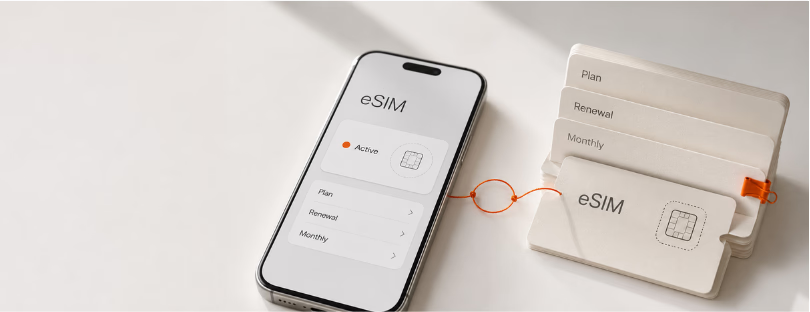
The eSIM is an electronic or embedded SIM that allows a customer to use telecom services of voice, data, sms and financial services without having to install a physical SIM card.
In practical terms, that small change represents a significant shift in how mobile connectivity works. Instead of inserting a plastic card into a device, users simply activate their mobile profile digitally. The operator provisions the connection remotely, allowing customers to switch networks, add data plans, or activate services without touching the hardware.
This technology is already standard in many high-end smartphones globally, including Apple’s iPhone lineup and Samsung’s Galaxy series. As manufacturers continue to move away from physical SIM trays, markets that adopt eSIM early often see benefits such as easier device setup, faster network activation, and greater flexibility for users who travel or manage multiple numbers.
For Airtel Uganda, introducing eSIM services is part of a broader digital strategy.
“For more than 15 years, Airtel Uganda, on its 100% 4G network, has supported the digital transformation journey in Uganda by being 5G ready, and eSIM service is the latest addition to this journey supporting device manufacturers that have transformed from physical SIM cards to digital eSIM.”
The technology also opens the door to new use cases, from managing multiple mobile profiles on one phone to enabling seamless switching between personal and business connectivity.
Making eSIM Devices More Accessible
While the technology itself is digital, the main barrier for many consumers remains the cost of compatible smartphones. That’s where the Airtel–Transtel partnership becomes interesting.
Under the agreement, Transtel will offer eSIM-capable smartphones through hire-purchase financing. Instead of paying the full retail price, customers can spread the cost over installments.
The devices included in the program are some of the most popular eSIM-compatible models on the market today:
Supported devices
- Samsung Galaxy S23
- Samsung Galaxy S23 Ultra
- iPhone 14
- iPhone 14 Plus
- iPhone 14 Pro
- iPhone 14 Pro Max
Corporate customers can also participate. Companies can contact Transtel to arrange device financing packages for employees, effectively equipping staff with eSIM-enabled smartphones that support both personal and business connectivity.
For a growing number of organizations that rely on mobile-first communication, this could simplify device management while enabling employees to handle multiple numbers or data profiles on a single phone.

Where Customers Can Get Airtel Uganda eSIM
The activation process remains relatively straightforward. Customers can obtain eSIM services directly from Airtel shops across Uganda.
Currently, eSIMs are available at all Airtel shops in Uganda and customers can access them with their valid national IDs.
That requirement aligns with standard telecom regulatory procedures across many African markets, where identity verification is mandatory for SIM registration.
Once activated, users can download their digital SIM profile to a compatible device and begin using voice, data, SMS, and mobile financial services immediately.
Why This Matters for the African Telecom Market
The partnership between Airtel Uganda and Transtel is part of a larger global shift toward embedded connectivity. Around the world, operators are experimenting with ways to accelerate eSIM adoption while addressing the biggest friction point: device access.
In markets such as Europe and North America, eSIM has already become a core feature of flagship smartphones. Apple’s latest U.S. models, for example, ship without a physical SIM tray entirely. According to industry analysis from Counterpoint Research and GSMA Intelligence, the number of eSIM-capable devices globally is expected to surpass several billion within the next few years.
African markets are now beginning to move in the same direction, although adoption tends to happen in stages. Network readiness, device availability, and consumer education all play a role.
Programs like the Airtel–Transtel financing model address two of those challenges at once. By bundling device access with connectivity services, operators can accelerate adoption while making premium smartphones more attainable.
Similar strategies have been used by telecom operators in other regions. In India, for example, operators such as Airtel and Jio have promoted eSIM activation through flagship smartphone partnerships. In Europe, operators increasingly bundle eSIM-enabled devices with travel or IoT services.
Conclusion: A Small Announcement With Bigger Implications
At first glance, the Airtel Uganda and Transtel partnership might look like a simple device financing program. But it actually signals something bigger.
Telecom operators are slowly shifting from selling SIM cards to selling digital connectivity platforms. eSIM is one of the technologies enabling that transition.
When devices, networks, and services all become programmable, the relationship between operators and customers changes. Activation becomes instant. Switching becomes easier. And mobile connectivity starts to behave more like software than hardware.
Uganda’s telecom market is still at an early stage of this transition, but the direction is clear. As more operators introduce eSIM services and more devices support embedded connectivity, physical SIM cards will gradually fade into the background.
For consumers, that means greater flexibility. For operators, it means new business models built around digital services rather than plastic cards.
And for the broader telecom industry, it reinforces a trend that analysts from organizations such as GSMA Intelligence and Juniper Research have been highlighting for years: the future of connectivity is embedded, software-driven, and increasingly global.