
Smart Ticketing: The New Front Door to Mobility
Smart ticketing used to sound like a small upgrade. A plastic card instead of a paper ticket. A QR code instead of a printed boarding pass. Tap-in, tap-out, done.
But that description now feels too small.
Across public transport, airports, events, rail networks and mobility apps, smart ticketing is becoming part of a much bigger shift: travel access is moving from a ticket you hold to an account, identity, device or payment credential that proves you are allowed to move.
That sounds technical. In real life, it is very simple.
You arrive in a city. You do not understand the local fare zones. You do not know whether you need a day pass, a tourist card, a rail ticket, a transport app or a local wallet. You just tap your phone or card, and the system works out the rest.
That is the promise. And when it works, it feels almost invisible.
From cards to accounts
The first generation of smart ticketing was mostly about replacing paper. Transport operators introduced smart cards, validators, contactless passes and stored-value cards. It made boarding faster and reduced cash handling. Useful, but still quite local.
The newer model is more ambitious. Account-based ticketing, often called ABT, moves the logic away from the card itself and into the back office. The passenger uses a card, phone, wearable, QR code or mobility account as an identifier, while the system calculates the correct fare behind the scenes.
That matters because it allows fare capping, multi-device travel, easier refunds, lost-card protection, concession management and better integration across different modes of transport. UITP describes account-based and mobile ticketing as a major part of the evolution of fare management, not just a user-interface improvement.
The Smart Ticketing Alliance makes a similar point, framing ABT as the next stage in ticketing because it supports a single account across multiple transport modes and improves interoperability, especially in Europe.
For the passenger, the best version of this is boring in the nicest possible way. No queue. No paper. No confusing machine. No wrong ticket. Just access.
Contactless changed expectations
London is still one of the strongest examples of what happens when ticketing becomes payment-led. Transport for London’s Oyster card was once the model. Then contactless bank cards and mobile wallets changed the benchmark again. For many visitors, London became the city where you could land, enter the Underground and not think too much about local transport rules.
That model is now spreading beyond big-city metros. In the UK, pay-as-you-go contactless has been expanded to additional National Rail stations in South East England, allowing passengers to tap a card or device instead of buying a ticket before travel. Transport for Wales also reported that its tap-on, tap-off pay-as-you-go rail system passed two million journeys roughly a year after launch, describing it as its fastest-growing ticketing product.
This is the real behavioural change. Once travellers get used to tap-and-go in one market, old ticketing systems feel broken elsewhere.
A tourist who can pay for a coffee, unlock a hotel room, board a plane and use an eSIM from their phone will not understand why a regional train still requires a paper receipt, a local app, or a ticket machine with six fare types and no clear explanation.
Smart ticketing is not just a transport upgrade. It is a customer-experience expectation.
The phone becomes the travel layer
For Alertify readers, this is where smart ticketing becomes especially interesting. The smartphone is no longer just where the ticket sits. It is becoming the control layer for the entire journey.
Mobile wallets already hold boarding passes, payment cards, hotel keys, event tickets and loyalty credentials. eSIMs handle connectivity. Travel apps manage itinerary changes. Digital identity is now moving into the same space.
IATA’s One ID initiative is designed around a contactless airport journey, where passengers can share required information in advance and move through parts of the airport using biometric-enabled identity rather than repeatedly showing documents. In April 2026, IATA also said industry proofs-of-concept showed that a single digital identity could be reused across the journey and that interoperability across airlines, airports and governments is possible.
That does not mean the airport of tomorrow will be completely frictionless. Anyone who has watched passengers struggle with bag drops, boarding groups or app check-ins knows better. But the direction is clear: ticketing, identity, payment and connectivity are starting to merge.
This creates a new competitive field. Transport operators, airlines, airports, fintech apps, mobile wallets, ticketing platforms and telecom providers are all trying to own a small but valuable part of the same moment: the traveller needing access.
The hidden business story
Smart ticketing is often sold as convenience. That is true, but not complete.
For operators, the business case is also about data, efficiency and revenue protection. Digital ticketing can reduce fare evasion, improve demand forecasting, support dynamic pricing, and give operators a clearer view of passenger flows. In public transport, that data can help plan capacity. In events, it helps control fraud and resale. In aviation, it reduces document checks and bottlenecks.
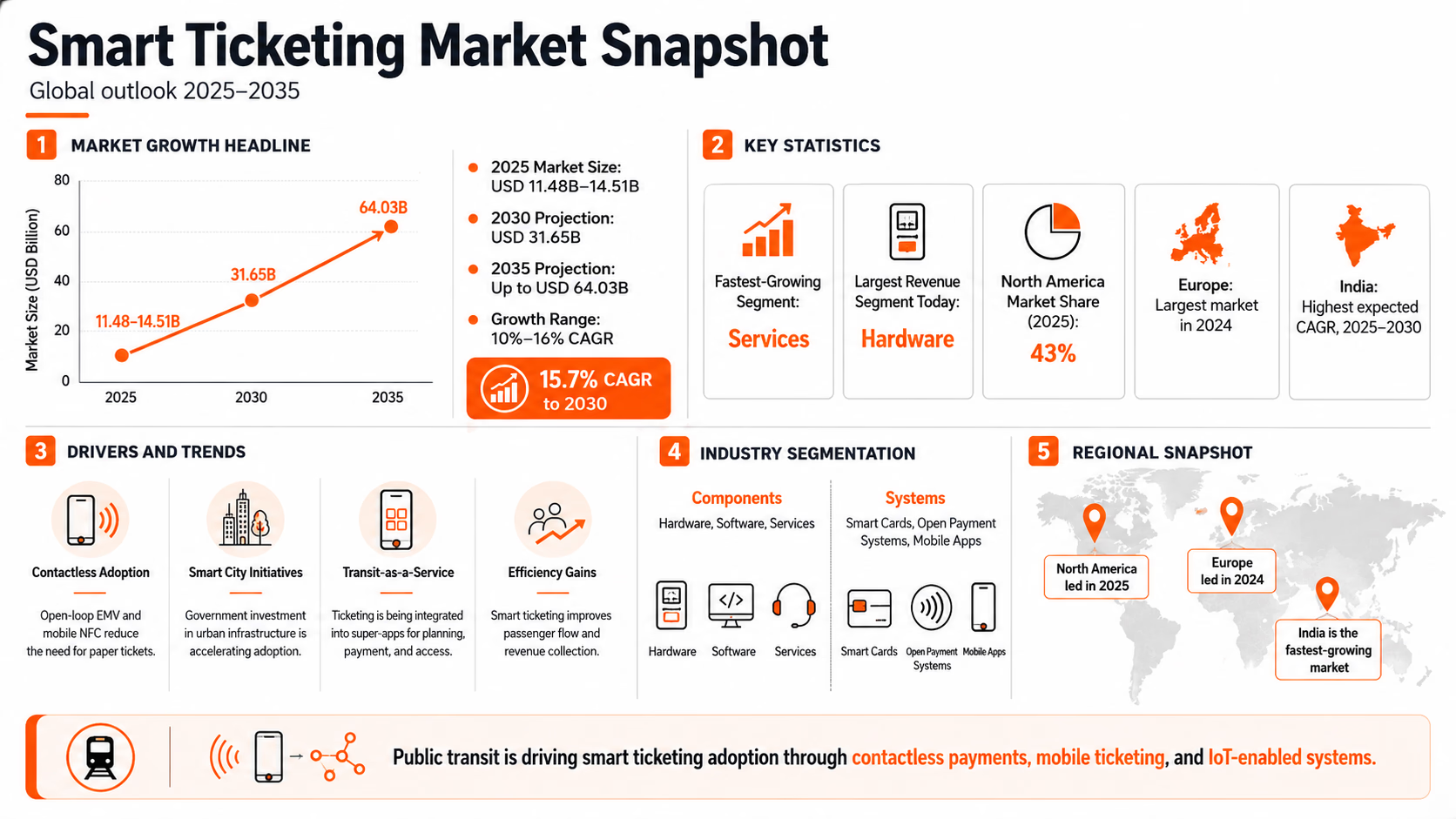
Market analysts see this as a fast-growing category. Global Market Insights valued the global smart ticketing market at $11.7 billion in 2025 and projected it to reach $39.6 billion by 2035. Mordor Intelligence, using a more conservative forecast, estimated the market at $11.48 billion in 2025 and projected growth to $18.5 billion by 2031, pointing to contactless EMV payments, tokenized fares and cloud-native ticketing platforms as key drivers.
The exact numbers vary, as market reports always do. But the direction does not. Ticketing is moving into software, payments and identity infrastructure.
And that is where many transport brands still underestimate the shift. They think they are upgrading fare collection. In reality, they are redesigning the front door to be more accessible.

Not everything should become invisible
There is one caution worth making.
Smart ticketing works best when it removes unnecessary friction. It works badly when it hides too much. Fare rules, refunds, data use, failed taps, card clashes and concession eligibility all need to be understandable.
Anyone who has been charged the wrong fare after tapping with one card and exiting with another knows that “seamless” can quickly become annoying. The more invisible the system becomes, the more trust it needs.
This is especially important for tourists, older passengers, families, people without bank cards, and travellers arriving from markets where contactless adoption is lower. A smart system cannot only be smart for the most digitally fluent passenger.
That is why the best operators will not simply remove ticket offices, machines and support channels overnight. They will use smart ticketing to simplify the main journey while keeping human help available for the edge cases.
The real conclusion
Smart ticketing is becoming the mobility version of what eSIM has become in connectivity: a quiet infrastructure shift that looks simple to the user but changes who controls the customer relationship.
The old ticket belonged to the operator. The new ticket may belong to a wallet, a phone, a payment network, a MaaS app, an airline, a city account, or a digital identity system. That is a major power shift.
Compared with earlier smart-card systems like Oyster, today’s market is more open, more cloud-based and more fragmented. Compared with airline boarding passes, public transport ticketing is moving closer to payments. Compared with event ticketing, mobility has a harder challenge because pricing is more regulated, journeys are repeated, and inclusion matters more.
The winners will not be the players who simply digitize paper tickets. That phase is already old.
The winners will be the ones who make access feel natural across the whole trip: airport, train, metro, hotel, venue, connectivity and payment. Not one app for everything, because that promise has been overused. More likely, a set of interoperable systems that quietly recognize the traveller at the right moment.
Smart ticketing is not really about the ticket anymore.
It is about who gets to open the gate.