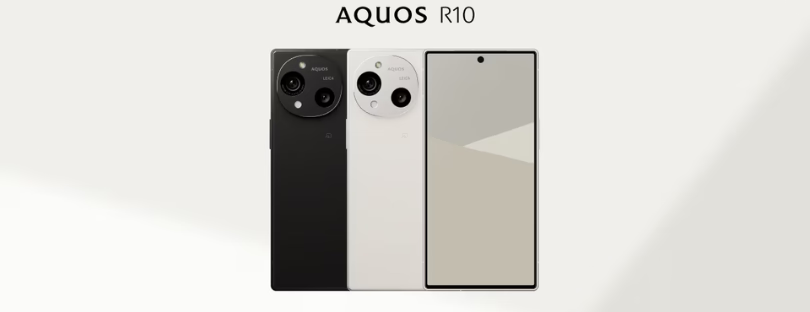
Rakuten Mobile Launches AQUOS R10: Price, Specs & Verdict
Rakuten Mobile has officially added Sharp’s new AQUOS R10 to its smartphone lineup, with sales starting in Japan on January 23, 2026. The device arrives as a firmly mid-premium Android option, priced at 109,990 JPY, which translates to roughly €594 (109,990 JPY) at current exchange rates.
This is not a headline-grabbing foldable or an ultra-flagship designed to compete with €1,000+ devices. Instead, the AQUOS R10 is very deliberately positioned in the segment that matters most right now: users who want a premium experience without paying flagship prices, and who actually care about everyday usability rather than benchmark scores.
Rakuten’s decision to push this model through its own channels also speaks volumes. This is about ecosystem value, not just hardware.
What the AQUOS R10 brings to the table
At first glance, the AQUOS R10 reads like a checklist of what a modern 2026 smartphone “should” offer.
It is a 5G-capable handset, supporting both 4G and 5G services, with 5G limited to Sub-6 frequencies and availability dependent on Rakuten Mobile’s network coverage area. That alone places it squarely in line with most mid-range and upper-mid devices sold today.
The display is one of Sharp’s strongest talking points. The phone features a 6.5-inch Pro IGZO OLED display with a Full HD+ resolution and variable refresh rate, reaching up to 240Hz in supported scenarios. Peak brightness is rated at 3,000 nits, a number clearly aimed at users who consume a lot of video and mobile content outdoors.
Under the hood, the AQUOS R10 runs on Qualcomm’s Snapdragon 7+ Gen 3, paired with 12GB of RAM and 256GB of internal storage. This is not a flagship chip, but it is more than capable for multitasking, media consumption, and AI-driven features, which is exactly where most mid-range phones now focus.
The battery capacity is 5,000 mAh, and the device comes with solid durability credentials, including water- and dust-resistance ratings that are still rare at this price point.
Cameras, Leica branding, and expectations
One of the more prominent marketing elements around the AQUOS R10 is its camera system, which is supervised by Leica Camera AG. The setup includes a dual rear camera with two roughly 50-megapixel sensors, plus a high-resolution front camera.
At this point, Leica branding on smartphones is no longer a novelty. We’ve seen it play a central role in Xiaomi’s flagship positioning, and Sharp is clearly tapping into the same idea: using a trusted photography name to shortcut consumer confidence.
This does not automatically mean “best camera in class,” but it does signal a focus on color science, image processing, and consistency rather than pure megapixel marketing. For most users, that matters more than experimental zoom ranges they rarely use.
eSIM support quietly makes this phone more relevant
For Alertify readers, one of the most relevant details is also one of the least flashy: dual SIM support via nanoSIM and eSIM.
Sharp and Rakuten explicitly list this configuration, which makes the AQUOS R10 a practical option for frequent travelers, business users, and anyone juggling personal and work numbers. In a market where some brands still treat eSIM as an afterthought, this is a meaningful advantage.
It also aligns perfectly with Rakuten Mobile’s broader strategy, where digital onboarding, online management, and flexible plans are core selling points rather than extras.
Pricing, points, and the Rakuten ecosystem play
The official price of 109,990 JPY (≈ €594) places the AQUOS R10 right in the heart of the competitive mid-premium segment.
Rakuten Mobile is also promoting an “effective” lower price through its points program. Eligible customers who switch via mobile number portability and subscribe to specific plans can receive up to 16,000 Rakuten Points, bringing the effective cost down to 93,990 JPY, or roughly €508 (93,990 JPY).
As always, points come with conditions, but this is where Rakuten’s ecosystem strength becomes clear. The company is not just selling a phone. It is reinforcing a loop of subscriptions, services, and rewards that keep users inside its platform.
How the AQUOS R10 fits into the wider market
At around €600, the AQUOS R10 faces intense competition. Devices like Google’s Pixel “a” series, Samsung’s upper Galaxy A models, and newer challengers from brands like Nothing have raised expectations significantly.
What Sharp is betting on here is balance rather than dominance in one category. The AQUOS R10 does not try to win on raw performance. It tries to feel premium where users notice it most: display quality, camera reliability, battery life, and day-to-day smoothness.
This reflects a broader market trend. Mid-range smartphones are no longer “cheap flagships.” They are becoming their own category, designed around realistic usage patterns instead of aspirational specs.
Conclusion
The AQUOS R10 launch is a good example of how the smartphone market is quietly maturing. Instead of chasing extremes, Sharp and Rakuten Mobile are focusing on polish, practicality, and ecosystem value.
At roughly €594 (109,990 JPY), the AQUOS R10 is not trying to undercut the market. It is trying to justify its price by delivering a premium-feeling experience where it counts: a bright and smooth display, a camera system backed by a trusted name, and connectivity features like eSIM that reflect how people actually use their phones today.
For Rakuten Mobile, this device also reinforces a familiar strategy: combine solid hardware with services, incentives, and long-term customer engagement. In a segment where competition is fierce and differentiation is difficult, that may be the smarter play.
The real question is not whether the AQUOS R10 has enough features. It clearly does. The question is whether more consumers will start valuing balanced, well-rounded devices over headline-grabbing specs. If that trend continues, phones like the AQUOS R10 could end up being exactly what the market needs.
Driven by wanderlust and a passion for tech, Sandra is the creative force behind Alertify. Love for exploration and discovery is what sparked the idea for Alertify, a product that likely combines Sandra’s technological expertise with the desire to simplify or enhance travel experiences in some way.