The Real Story Behind Nomad eSIM (Hint: It’s LotusFlare)
There’s a certain type of eSIM brand that doesn’t shout. No celebrity endorsements, no viral TikTok campaigns, no aggressive affiliate army flooding travel blogs. Nomad eSIM is that brand — and yet, since its launch in 2021, it has quietly grown into one of the more recognized names in travel connectivity, now serving users across 200+ destinations worldwide.
So what’s actually going on under the hood?
Not Just an App — A LotusFlare Play
Most people downloading the Nomad app have no idea they’re interacting with a Silicon Valley telco infrastructure company. Nomad was founded by Jason Chen and Nidhi Singh and operates as a business unit of LotusFlare, Inc., a company specializing in digital commerce platforms. That distinction matters more than it might seem.
LotusFlare isn’t just a parent company that cashes Nomad’s revenue checks. It’s an MVNE (Mobile Virtual Network Enabler) that builds eSIM wholesale infrastructure — and Nomad is, in part, its consumer-facing proof of concept. LotusFlare’s wholesale platform partners with travel eSIM apps like Nomad, travel agencies, hotels, airlines, and other connectivity distributors, which means Nomad has a natural advantage in terms of wholesale data access and network partnerships. This is structural. When a pure-play retail eSIM brand negotiates data rates, they’re buying access. When Nomad does it, they’re partly negotiating with their own stack.
That said, Nomad’s consumer product still stands on its own — and it’s worth examining what it actually delivers.
What the Product Looks Like in Practice
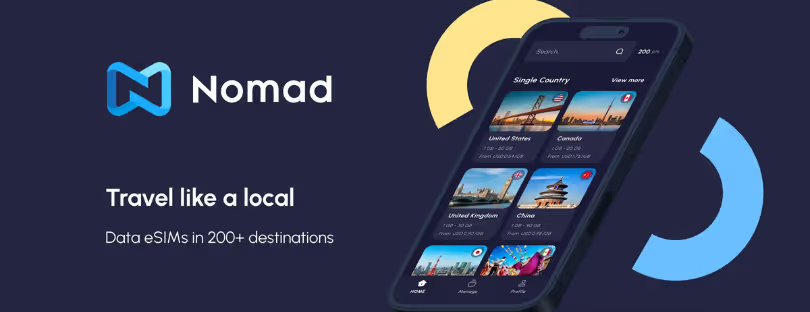
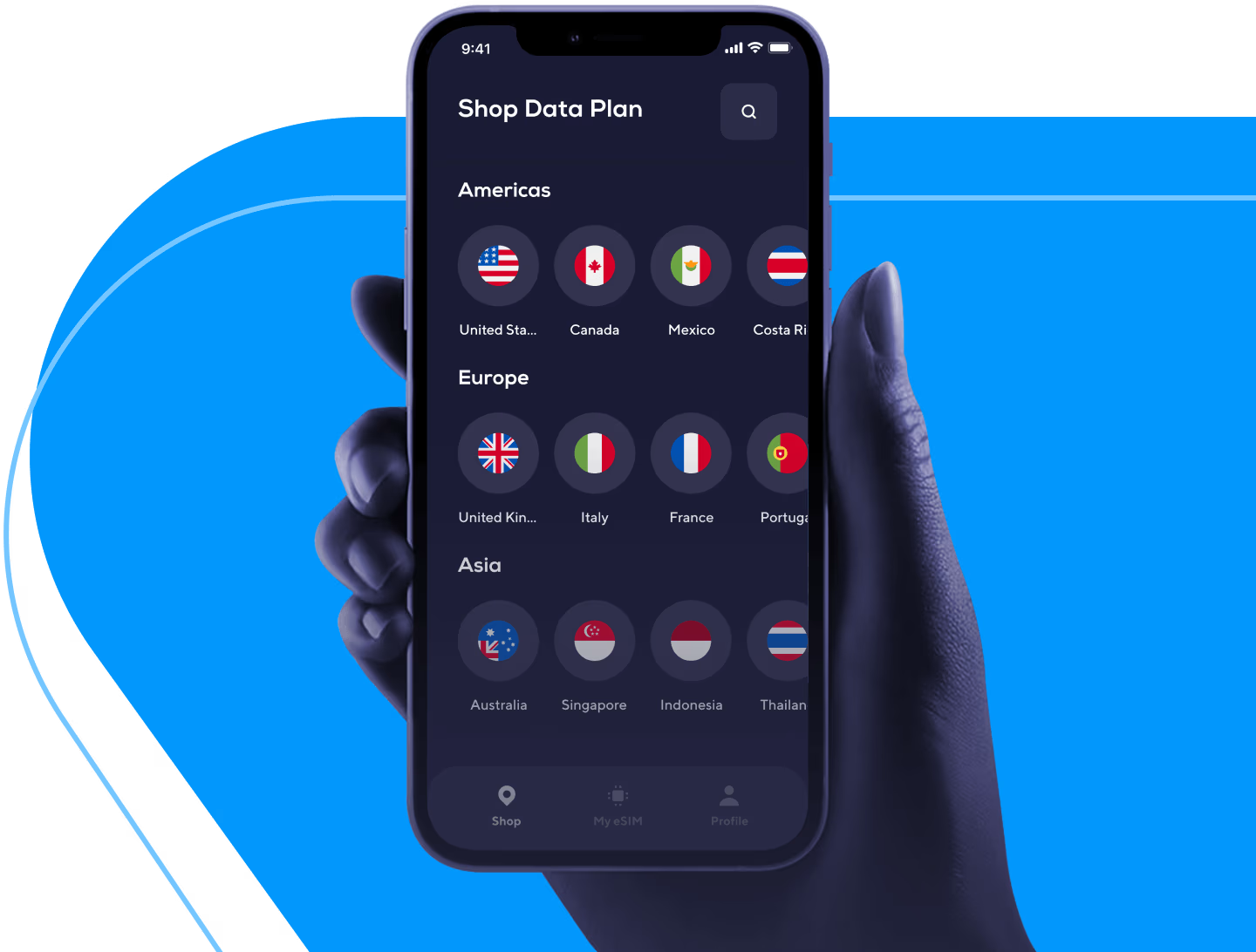
Nomad offers data-only mobile plans for more than 200 destinations. Customers can choose between local, regional, and global plans, with data provided by local carriers. The app is clean and functional — install is straightforward, QR code or in-app, and the experience is largely frictionless.
5G access is now available in over 40 popular destinations, including the US, Japan, and most of Western Europe, with average download speeds typically ranging between 75 Mbps and 100 Mbps in those regions. For everyday travel use — navigation, messaging, video calls — that’s more than enough.
One product that deserves more attention is the Global-EX plan. The Global-EX is currently the only long-term option for extended travelers, offering plans from 30 to 365 days, working in 54 to 82 countries depending on the tier chosen. In a market dominated by short-term plans and repeat purchases, a 365-day plan is a meaningful signal that Nomad is thinking beyond the casual traveler. Annual eSIM plans are still relatively rare, and this positions Nomad interestingly against competitors that haven’t moved into that territory yet.
The Friction Points Worth Knowing
No honest review skips the limitations. A few things stand out.
Nomad’s unlimited data plans come with a daily high-speed cap. After roughly 1–2GB per day, speeds drop to 512kbps. That’s technically unlimited — but it isn’t really unlimited for anyone working remotely or streaming regularly. The label is doing more work than the product.
There are no automatic renewals. When a plan expires, users need to buy a completely new one, going through a separate purchase process each time. For a brand targeting digital nomads, that’s a user experience gap. Airalo and others have moved toward more seamless top-up flows.
Customer support is functional but not fast. Live chat exists, though response times during peak periods have drawn consistent criticism across Trustpilot reviews. Support, though clearly eager to help, can take a while to find a solution to certain issues.
 The Enterprise Pivot
Nomad launched its Enterprise eSIM portal in 2024, providing businesses with a centralized solution to manage, assign, and monitor connectivity for their employees — with adoption coming from financial services, manufacturing, travel, and pharma sectors.
This is the more interesting strategic story. The consumer eSIM market is getting crowded fast — margin compression is real, affiliate costs are rising, and brand differentiation is becoming harder to sustain on price alone. Enterprise is a logical escape hatch. B2B connectivity management has higher contract values, stickier retention, and a clearer ROI story for procurement teams than “save on roaming” does for leisure travelers. If Nomad can convert its LotusFlare infrastructure advantage into serious enterprise deals, it has a durability play that most travel eSIM brands simply don’t.
Where Nomad Sits in the Competitive Stack
The Market Reality
The travel eSIM market has effectively sorted itself into a few distinct archetypes. Airalo dominates on volume and breadth — with over 20 million users and coverage in over 200 countries, it operates as a marketplace more than a brand. Holafly owns the unlimited positioning — simpler messaging, premium pricing, and a loyal customer base that doesn’t want to think about gigabytes. Yesim competes on flexibility and single-plan global access. Saily is pushing a clean, modern challenger brand. And then there’s Nomad — sitting in the middle ground, competing on reliability and infrastructure depth rather than a single standout feature.
Holafly is the only one of the major players offering unlimited data with all plans, Airalo focuses solely on fixed-data plans, while Nomad offers both — but with a strict speed cap on the unlimited plans after 1GB of use daily. That hybrid positioning sounds appealing in theory, but in practice, it satisfies neither the budget-first traveler (Airalo is often cheaper) nor the power user (Holafly’s unlimited is less restricted for casual heavy use). Nomad’s strongest differentiation is arguably its long-duration plans and the enterprise offering — not its pricing or its unlimited tier.
The Bigger Picture
The eSIM market is entering a maturation phase. According to GSMA projections cited by LotusFlare’s own research, by 2028, half of all smartphone connections will use eSIM. That’s not a niche anymore — that’s infrastructure.
In that context, being a LotusFlare-backed product with MVNE capabilities isn’t just a nice-to-have. It’s a structural advantage when wholesale pricing wars eventually hit. The brands that survive the next phase of eSIM consolidation won’t be the ones with the best affiliate programs. They’ll be the ones with the lowest cost basis, the stickiest B2B contracts, and real infrastructure ownership.
Verdict
Nomad is a well-built product that occupies a genuinely tricky market position. It’s not the cheapest. It’s not the most unlimited. But it’s among the most structurally sound. The LotusFlare backend, the Global-EX annual plans, and the 2026 enterprise push suggest a company thinking in years rather than quarters — a rarity in a market where most players are optimizing for the next affiliate click. The unlimited data labeling problem needs fixing, and the renewal UX needs work. But as the eSIM market consolidates, Nomad may end up looking more interesting in hindsight than it does in the moment.