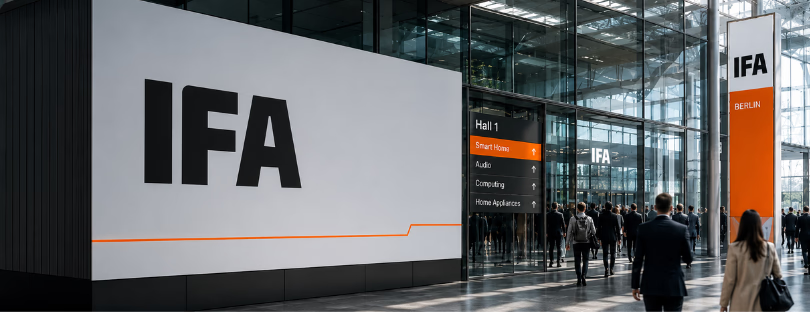
IFA Berlin is not just another tech fair where brands place shiny devices behind glass and hope journalists take photos. It is one of the few events where consumer technology, home appliances, retail, media, creators, buyers, start-ups and global hardware brands all sit inside the same commercial ecosystem.
CES in Las Vegas is where the tech world likes to talk about the future. MWC Barcelona is where connectivity, mobile networks, devices and telecom infrastructure dominate the conversation. IFA Berlin sits in a more practical middle ground. It shows what technology looks like when it is ready to move from keynote language into homes, shops, kitchens, living rooms, wrists, cars and daily routines.
For Alertify readers, that matters because travel tech, eSIM, connected devices, AI assistants, wearables, smart home systems and mobile-first services are no longer separate categories. They are beginning to overlap. A connected suitcase, an AI translation device, a smartwatch with roaming, a smart hotel room, a Wi-Fi 7 router, a foldable phone, a health wearable and a travel eSIM are all part of the same story: technology is becoming more ambient, more personal and more dependent on always-on connectivity.
IFA Berlin is one of the best places to watch that story unfold.
A century-old event with a modern role
IFA Berlin traces its roots back to 1924, which gives it something most tech events do not have: historical weight. It began in the age of radio and broadcasting, long before smartphones, streaming, AI appliances or eSIM-enabled wearables existed. Today, the event presents itself as “Innovation For All” and positions its 2026 edition as the world’s largest home and consumer tech event, taking place in Berlin from 4 to 8 September 2026. The official IFA site describes the show as a meeting point for global innovators, thought leaders, professionals and consumers across consumer electronics, home appliances and technology.
That last part is important: consumers are still part of IFA’s identity. This is not a closed telecom infrastructure event or a pure procurement summit. It has a public-facing energy. People go there to touch the devices, test the screens, see the appliances, compare the gadgets and understand what might actually enter their lives in the next year.
But IFA is also very much a business event. The official site highlights attendees from 140 countries, exhibitors from 49 countries, international retail buyers and decision-makers among trade visitors. It also promotes IFA Global Markets as a sourcing hub for OEM and ODM business, which shows how much of the event sits behind the visible product launches.
That is the part casual visitors often miss. The big TV wall is the theatre. The real business often happens in sourcing meetings, retail conversations, distribution deals and quiet product roadmap discussions.
What you actually see at IFA
IFA is especially strong in categories where technology becomes physical and domestic. Think smart home, computing, gaming, audio, mobility, fitness, digital health, AI and sustainable technology. These are listed among IFA’s current show areas, alongside IFA Next, which gives start-ups and emerging players a route into the wider event.
This mix gives IFA a useful edge. It is not only about the next smartphone, although phones and connected devices are clearly part of the picture. It is about how technology behaves when it becomes part of a household, a trip, a hotel room, an office desk or a mobility routine.
That is why IFA is increasingly relevant for the travel technology and connectivity market. A traveller now moves through a stack of connected experiences: booking platforms, airline apps, airport Wi-Fi, eSIM activation, smart luggage, mobile payments, digital identity, hotel check-in, streaming, translation, navigation and wearable health data. None of that works well without connectivity.
IFA does not always shout about telecom in the same way MWC does. But its products quietly depend on telecom. The more consumer devices become smart, portable, cloud-connected and AI-assisted, the more connectivity becomes invisible infrastructure.
That is the Alertify angle.
IFA versus CES and MWC
The easiest mistake is to compare IFA, CES and MWC as if they are three versions of the same event. They are not.
CES calls itself the global stage for innovation and says it showcases the entire tech landscape at one event. It is big, media-heavy and trend-setting, especially around AI, mobility, robotics, health tech and consumer electronics.
MWC Barcelona, hosted by GSMA, is much more directly tied to the mobile and connectivity ecosystem. Its official site describes it as the largest and most influential connectivity event in the world, with MWC26 reporting more than 105,000 attendees, over 2,900 exhibitors, sponsors and partners, and representation from 207 countries and territories.
IFA Berlin plays a different game. It is closer to the consumer adoption layer. It shows not only what technology can do, but how it is packaged, sold, explained and placed into real life. For brands, that can be more valuable than hype. A product that impresses engineers is one thing. A product that retailers understand, consumers want and media can explain is another.
This is why IFA remains important for companies building around connected living, smart travel, home tech, digital health, mobility and AI-powered devices.
Why Alertify should watch IFA
For Alertify, IFA Berlin is not just a gadget event. It is a signal market.
If eSIM is moving from a travel add-on into a default connectivity layer, IFA is one of the places where that shift becomes visible. Connected wearables, tablets, mobile routers, laptops, smart mobility devices and travel accessories all create new use cases for embedded connectivity. Some will use Wi-Fi. Some will use Bluetooth. Some will need cellular. Some will quietly push consumers toward eSIM without ever making eSIM the headline.
That is the real story.
The consumer may not wake up thinking, “I need better provisioning architecture.” They think: “Why does my watch work abroad?” “Why does my child’s tracker lose signal?” “Why does my laptop need a hotspot?” “Why does my travel device need a QR code?” IFA is where these everyday frustrations meet product design.
Conclusion
IFA Berlin matters because it shows where technology becomes normal.
CES often sells the dream. MWC explains the network. IFA shows the product shelf, the living room, the hotel room, the luggage compartment and the connected lifestyle that consumers actually recognise. For the eSIM and travel tech world, that makes it more important than it may first appear.
The next phase of connectivity will not only be won by the provider with the cheapest data plan. It will be won by the companies that understand where connectivity fits into devices, retail channels, travel habits and consumer expectations. IFA Berlin is one of the few events where all of those layers meet in public. That is why Alertify should treat it not as a side event, but as a serious window into the future of connected living.
Driven by wanderlust and a passion for tech, Sandra is the creative force behind Alertify. Love for exploration and discovery is what sparked the idea for Alertify, a product that likely combines Sandra’s technological expertise with the desire to simplify or enhance travel experiences in some way.