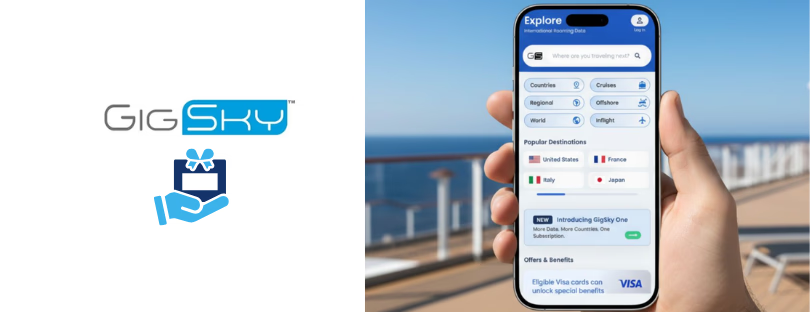
GigSky Expands Free eSIM Trial to Cruises
Cruise Wi-Fi has always had a reputation. Expensive. Slow. Unpredictable. Necessary.
Now there is a new twist in the story.
GigSky, a global provider of mobile data solutions, has expanded its $0 eSIM trial to include cruise connectivity. That may sound like a small product update. It is not. For frequent travelers, digital nomads at sea, and even first-time cruisers who simply want WhatsApp to work, this is a meaningful shift in how maritime connectivity is being positioned.
For the first time, travelers can test mobile data on select cruise routes without paying upfront and without being locked into an automatic renewal. No hidden traps. No forced subscription. Just 100MB of data to see how things actually perform at sea.
That is a smart move in a category where trust has always been fragile.
Why Cruise Connectivity Is Different
Let’s start with the obvious. Connectivity at sea is not the same as connectivity on land.
Cruise ships rely on maritime satellite networks. Latency is higher. Bandwidth is shared among thousands of passengers. Weather conditions matter. Coverage zones matter. And even when ships dock, network switching can create inconsistencies.
This is precisely why GigSky’s move is interesting. Instead of selling the promise of seamless connectivity, they are offering a live demo.
The 100MB trial data can be used for any online activity. Browsing, checking social media, sending messages, and reading email. It works both at sea and in port. Once the data is used up, travelers can purchase additional data directly in the GigSky app.
And here is a subtle but important detail: the app remains accessible even without an active data plan. That removes a major friction point that many travelers experience when their data runs out and they suddenly lose access to the very tool they need to top up.
Coverage Across the Maritime Giants
GigSky says its cruise service is available on more than 290 cruise ships across the Caribbean, North America, Europe, Asia-Pacific, the Middle East, and World cruise routes.
More importantly, the company claims to be the only eSIM provider offering service across the two major maritime satellite networks used by commercial cruise ships, representing connectivity for over 99 percent of global ocean cruise travelers.
That is not a minor claim. The maritime satellite space is largely dominated by providers like Starlink and Inmarsat, alongside other established satellite infrastructure players. Access to both major cruise satellite ecosystems means broader compatibility and fewer blind spots.
Travelers can verify ship availability directly in the app before departure. GigSky also recommends installing the eSIM before boarding and only turning on mobile data when needed. Once installed, the eSIM connects automatically to the strongest available network.
And it does not disappear after one trip. You install it once and reuse it for future cruises or international travel.
That long-term usability matters. It shifts the model from one-off travel purchase to persistent travel infrastructure.


A Trial That Reduces Psychological Risk
Let’s be honest. Cruise connectivity comes with skepticism.
Passengers have heard the stories. Slow speeds. Premium pricing. Data caps. Confusion about what works at sea versus in port.
GigSky is addressing that skepticism directly.
According to Sam King, CEO of GigSky:
“Connectivity at sea is different from land, and people want to see how it performs in real conditions,” said Sam King, CEO of GigSky. “This trial lets them test it with clear limits and no strings attached.”
That framing is deliberate. Clear limits. No strings attached.
The paid cruise plans start at $19.99, but the free trial acts as a confidence bridge. Instead of selling on abstract promises, GigSky is betting that real-world performance will convert users.
From a product psychology perspective, this is powerful. Trials in telecom are rare, especially in niche segments like maritime connectivity. And genuinely free trials, with no automatic billing, are even rarer.
How GigSky Positions Itself Differently
GigSky operates as a mobile virtual network operator, or MVNO. Unlike pure resellers that sit on top of aggregators, GigSky manages direct relationships with local mobile networks worldwide.
The company argues that by controlling these network partnerships directly, it maintains greater oversight of service quality and can respond faster to connectivity issues.
GigSky was also invited by Apple to help shape the eSIM standard and was integrated into the ecosystem at the launch of the first eSIM-enabled iPhone, the iPhone XS. That early involvement positioned it as one of the foundational eSIM players rather than a late-stage marketplace entrant.
There is also a strategic partnership with Visa, which offers eligible cardholders complimentary data allowances and discounted GigSky plans.
This ecosystem positioning matters because cruise connectivity is not just about selling megabytes. It is about trust signals. Apple validation. Visa partnerships. Direct network relationships. Maritime coverage claims.
All of that feeds into perceived reliability.
The Bigger Trend: eSIM Moves Offshore
What we are witnessing here is part of a broader evolution in travel connectivity.
eSIM started as a land-based roaming alternative. Then it expanded into regional bundles. Then global plans. Then aviation partnerships for in-flight connectivity experiments.
Now maritime is becoming a serious vertical.
Satellite infrastructure has improved significantly over the past five years. Companies like Starlink have pushed bandwidth expectations higher. Cruise operators themselves are upgrading onboard systems to meet passenger demand for streaming, remote work, and always-on communication.
According to industry data from the Cruise Lines International Association, global cruise passenger numbers are projected to exceed pre-pandemic levels, with tens of millions of travelers annually. More passengers mean more devices. More devices mean more demand for alternative connectivity models.
GigSky’s cruise trial fits neatly into this macro trend. It is not just about giving away 100MB. It is about positioning eSIM as a default connectivity layer across land, sea, and potentially air.
 Where Does This Leave Competitors?
 Where Does This Leave Competitors?
Most travel eSIM providers still focus almost exclusively on terrestrial coverage. Some offer global plans that technically function in coastal zones or ports, but very few market a dedicated cruise solution with satellite integration.
Traditional cruise line Wi-Fi packages remain expensive and often tiered by speed or usage. Passengers typically purchase these onboard at premium rates. There is a limited opportunity to test before committing.
By contrast, GigSky is introducing a try-before-you-buy model into a segment that has historically lacked transparency.
That does not mean competitors will stand still. As satellite capacity expands and consumer expectations rise, we are likely to see more hybrid models. Some operators may integrate direct satellite eSIM partnerships. Others may bundle connectivity with loyalty programs or travel insurance.
But for now, GigSky holds a first-mover advantage in explicitly positioning a free eSIM trial at sea.
Why This Matters for Travelers
For the average cruiser, 100MB will not last long. It is not meant to. It is enough to test latency, check messaging performance, and understand how the connection behaves.
For frequent travelers, the bigger value is strategic. Install once. Reuse across trips. Manage everything in one app. No surprise billing. No mandatory subscription.
And importantly, no assumption that cruise connectivity works like land connectivity.
By acknowledging the differences rather than glossing over them, GigSky is aligning expectations with reality.
That is something the broader travel connectivity industry still struggles with.
A Real Shift, Not Just a Feature
GigSky’s expansion of its free eSIM trial to cruise routes is more than a marketing tactic. It signals a maturation of the travel eSIM category into vertical-specific connectivity solutions.
While many providers compete on price per gigabyte, GigSky is competing on risk reduction and ecosystem integration. In a market where travelers increasingly expect seamless digital experiences across borders, ports, and platforms, that approach feels aligned with where the industry is heading.
The real test will be performance. If the trial converts users consistently, competitors will have to rethink their approach to maritime connectivity. If it fails to meet expectations, skepticism around cruise eSIM will grow.
Either way, the message is clear. Travel connectivity is no longer just about roaming alternatives on land. It is about building a persistent digital infrastructure for modern travelers, wherever they go.
And that now includes the open sea.