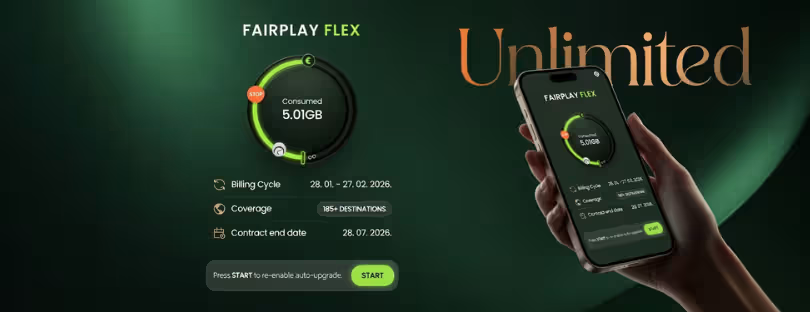
FairPlay: A New Philosophy of Unlimited — The End of Marketing Unlimited?
Let’s admit something the industry rarely says out loud:
“Unlimited” has lost its meaning.
In travel eSIM marketing, it has become a reflex. Unlimited Europe. Unlimited global. Unlimited data. The word appears everywhere — yet experienced travellers know that most unlimited plans are governed by thresholds, speed reductions, tethering limits, or quiet fair-use clauses buried in the terms.
So when FairPlay talks about unlimited, the interesting part isn’t the word.
It’s the structure behind it.
FairPlay isn’t trying to shout louder than the competition. It is attempting something more structural: redefining what unlimited should mean in practical, financial, and behavioural terms.
And that shift matters.
From Marketing Unlimited to Structured Unlimited
Most travel eSIM providers fall into three familiar models:
Local bundles with fixed GB allowances.
Regional plans covering multiple countries.
Time-based “unlimited” plans that are unlimited in theory, but managed in practice.
Holafly, for example, has popularised daily unlimited plans that work well for short stays. You activate, you travel, you don’t count gigabytes. For tourists, that simplicity is appealing.
Yesim offers unlimited day plans that remove usage anxiety for specific durations.
These models optimise for time.
FairPlay optimises for behaviour.
That’s the difference.
Instead of selling unlimited time tied to days, FairPlay FLEX introduces a progressive usage model with a hard cost cap. It acknowledges something most plans ignore: heavy data usage is volatile.
Some months you use 5GB.
In other months, you burn through 60GB.
Traditional telco logic prices for averages. FairPlay prices for fluctuation — but with guardrails.
How FairPlay Actually Works
Here’s the mechanics without the marketing layer.
When you activate FairPlay FLEX, you start with a baseline:
5GB of high-speed data.
From there, the plan scales automatically as your usage grows.
The structure unfolds like this:
Tier 1: 5GB
Tier 2: +15GB
Tier 3: +15GB
Tier 4: +15GB
As you cross each threshold, your plan upgrades progressively. There are no arbitrary slowdowns triggered by hidden daily limits. The model is transparent.
And here is the critical difference:
You control the escalation.
Inside the FairPlay app, users can enable or disable automatic upgrades. If you want to stop progression at a certain level, you can. This introduces a layer of financial control rarely seen in travel eSIM plans.
 Then comes the structural safeguard:
A hard monthly cost cap.
Depending on contract duration, that cap sits around €85 to €95. Once you hit it, your bill does not increase further — even if your data consumption continues climbing.
That is not marketing language. It is a billing architecture.
Instead of pretending data is infinite, FairPlay builds a system where cost predictability is infinite.
No Artificial Throughput Caps
Another structural point: FairPlay claims no artificial hard speed caps layered on top of usage.
Many so-called unlimited plans degrade to heavily throttled speeds after hitting soft caps. For light browsing, this may not matter. For hotspotting, streaming, cloud uploads, or video conferencing, it does.
FairPlay positions its network access as high-speed, best-effort, without engineered slowdowns designed purely for margin protection.
That matters for digital nomads, remote teams, and content creators whose usage patterns break traditional assumptions.
Why This Model Exists
The reason this structure makes sense is simple:
Modern travel behaviour does not fit old telecom pricing logic.
The rise of remote work, long-term travel, hybrid lifestyles, and location-independent careers has created a user profile that traditional roaming bundles were never built for.
Heavy users fluctuate. They do not consume data linearly.
Classic unlimited models solve for simplicity but often mask throttling. Cheap bundles solve for price but punish overuse. Enterprise-grade orchestration models solve for compliance and risk, but not lifestyle flexibility.
FairPlay is attempting to occupy a different middle ground:
Predictable subscription infrastructure for lifestyle travellers.
Not the cheapest.
Not the flashiest.
But structured.

Prediction Over Promotion
The travel eSIM market is now bifurcating.
On one side: ultra-cheap country plans and short-term unlimited passes competing on headline pricing.
On the other: subscription-based connectivity is designed for frequent cross-border movement.
GSMA data shows steady growth in eSIM-enabled device penetration globally, and research firms like Juniper Research have repeatedly highlighted the rapid expansion of consumer eSIM adoption. As devices standardise around eSIM, the real differentiation shifts away from hardware compatibility and toward pricing logic and user experience.
Unlimited, as a word, no longer differentiates.
Predictability does.
FairPlay bets that serious travellers are less interested in the illusion of infinity and more interested in certainty.
What This Means for Travellers
For short-term tourists, traditional unlimited day passes may still be simpler.
But for:
- Digital nomads
- Remote professionals
- Frequent multi-country travellers
- Heavy tethering users
FairPlay’s structure offers something psychologically powerful:
You know your ceiling.
You know your progression.
You know you won’t wake up to a roaming-style surprise.
That transforms connectivity from a risk variable into a utility.
Instead of asking:
“How many gigabytes do I get?”
Users start asking:
“What is the worst-case bill scenario?”
And when the answer is capped and transparent, behaviour changes.
Conclusion: The End of Marketing Unlimited?
FairPlay is not the only company rethinking connectivity pricing. But its structured cost-cap logic represents something more mature than conventional unlimited marketing.
Holafly and Yesim optimise for simplicity over short durations. Airalo optimises for flexibility and coverage breadth. Enterprise players like SureSIM optimise for risk management and orchestration.
FairPlay optimises for behavioural volatility.
That is a subtle but important distinction.
Structured unlimited may not replace marketing unlimited overnight. The word is too powerful and too embedded in consumer psychology. But as the market matures and heavy users become more sophisticated, models built around transparency and cost ceilings may become the benchmark that serious travellers measure others against.
If the next decade belongs to mobility and borderless work, then the real competitive edge in travel connectivity will not be who shouts “unlimited” the loudest.
It will be the one who designs the most intelligently.
And that is where FairPlay is trying to position itself.
Not the cheapest unlimited.
But as the end of unlimited as a marketing trick, and the beginning of unlimited as a predictable system.
That shift is bigger than a tariff plan.
It’s a category evolution.