What Travel Platforms Look for in an eSIM Partner?
There’s a moment every serious travel platform eventually reaches — the one where leadership looks at the connectivity gap in their product and decides to close it. Airlines, OTAs, corporate travel tools, and hotel booking apps all get there sooner or later. And when they do, the question is no longer whether to add an eSIM offering. It becomes who to trust with it.
The answer is more complicated than most people outside the industry expect.
Choosing an eSIM partner isn’t comparable to adding a payment processor or a currency converter. You’re embedding a live telecom product directly into your platform. If it fails, your brand takes the hit. If coverage is weak in the markets your customers actually travel to, users discover that at the worst possible moment — usually in transit, under pressure, and with no fallback. That is why the bar is genuinely high, even if many providers present it as a simple integration.
The API Question Is Usually First
Any platform with an internal development team will start here. Can we integrate this cleanly? How usable is the documentation? How long does onboarding realistically take?
This matters more than it initially appears. Many eSIM providers technically offer APIs, but far fewer have invested in making them partner-ready. Sparse documentation, delayed responses from technical teams, and limited flexibility in pricing or UX control are still common. That friction compounds quickly. A poorly structured API does not just slow down integration. It creates ongoing maintenance overhead and, more importantly, erodes internal confidence in scaling the product.
That is where the distinction becomes clear: having an API is not the same as building for partners.
Yesim’s Partner API is designed specifically for resellers and platform integrations, covering websites, apps, eCommerce platforms, airlines, and hotels, with structured documentation and active technical support during implementation. That should be considered the baseline for any serious B2B partner.
The white-label capability matters just as much. If a platform cannot control branding and pricing logic, it is not really building a product. It is simply distributing someone else’s.
For platforms without heavy engineering resources, details like a WordPress plugin with API integration and flexible SEO and payment settings are not minor features. They directly reduce time to market and expand who can realistically deploy an eSIM product.
Coverage Depth vs. Coverage Breadth
This is where many provider pitches collapse under closer inspection.
“Global coverage” is almost universal as a claim. In practice, it often means very different things. There is a clear difference between having nominal availability in 150 countries and delivering stable, high-quality connectivity in the markets your users actually rely on.
Travel platforms already understand their demand patterns. A corporate travel platform knows where its users travel most frequently. A digital nomad platform knows its core hubs. An airline knows exactly where its routes create demand.
Coverage needs to align with those realities, not with a generic country count.
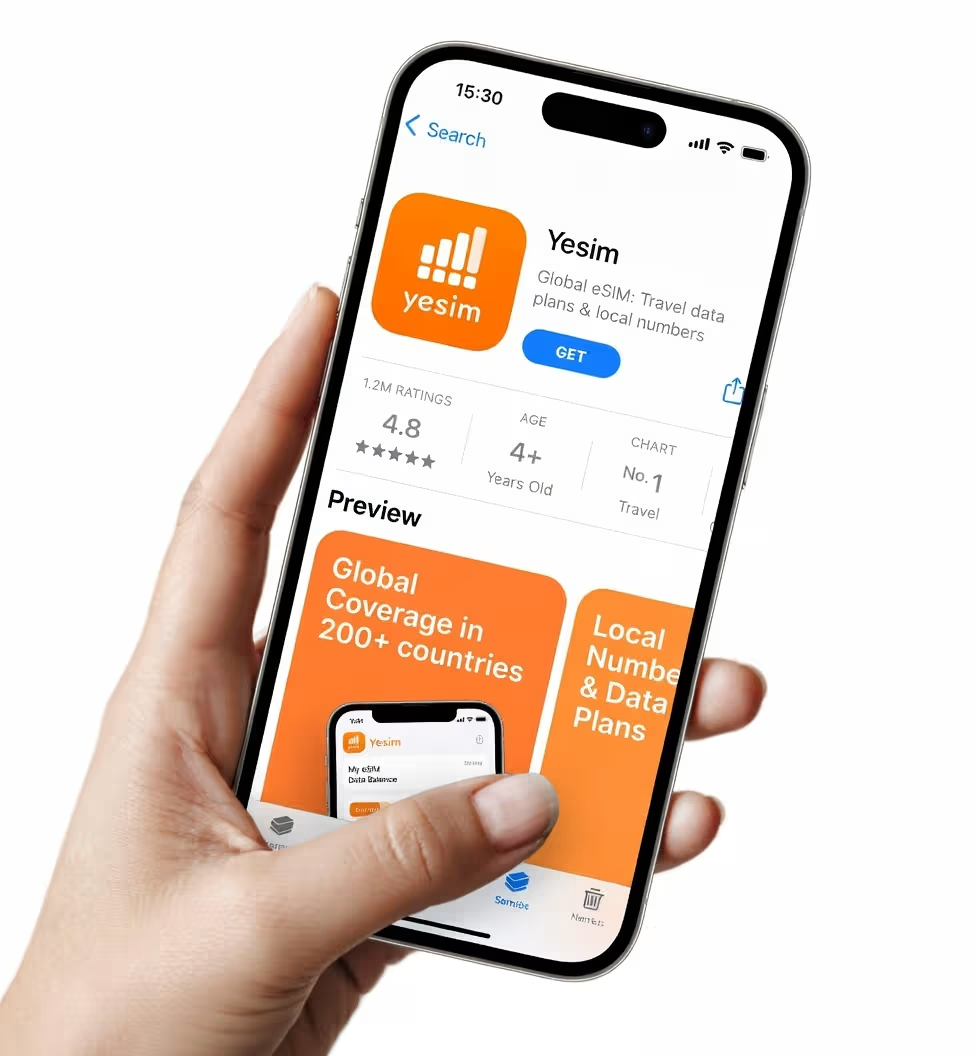
Yesim’s partner offering spans 200+ destinations with access to more than 1,000 network operators, supported by local, regional, and global plans. The number itself is less important than what it represents: real carrier relationships rather than superficial coverage listings.
That difference becomes visible quickly in real-world performance, and it is often where weaker providers are exposed.
Yesim is also officially listed by Apple as a global eSIM provider offering prepaid plans. That type of validation carries weight, particularly for platforms building iOS-heavy user experiences.
The Corporate Travel Layer
One of the most overlooked dynamics in this space is where distribution is actually shifting.
A growing share of eSIM adoption is moving through corporate channels. Travel management platforms, HR systems, and expense tools are increasingly integrating connectivity as part of the employee experience.
The requirements on this side are different. Pricing alone is not the decision driver. Control is.
Centralized billing, real-time visibility, elimination of reimbursement processes, and clear usage reporting are the baseline expectations. Many consumer-first eSIM providers are not structured to support this.
Yesim’s OneBalance platform addresses this layer directly. Companies operate with a shared balance, distribute it across employees, monitor usage in real time, and export reports without dealing with fragmented billing flows. There are no platform fees, and companies pay only for actual consumption, which aligns well with enterprise expectations around cost transparency.
Operationally, one detail stands out: a single eSIM profile that works across destinations, without requiring reinstalls or profile switching.
In practice, this is where many deployments fail. Not on pricing or coverage, but on friction.
|
Save on Roaming Costs
Cut roaming costs for your business. With OneBalance, there are no platform fees. You only pay for the data your team actually uses while ensuring reliable global connectivity.
|
Centralized Balance with Real-Time Control
Fund your company’s balance and distribute it across your team. Monitor spending and adjust allocation in real time.
|
Best User Experience for Your Team
Equip your employees with the highly rated Yesim app. Get seamless global coverage, responsive support, and reliable mobile connectivity.
|
Virtual Numbers — Still Underrated in the Partner Conversation
Most eSIM partnership discussions remain focused on data.
That is understandable, but increasingly incomplete.
Platforms operating across multiple markets often face a parallel challenge: communication and identity. Cross-border teams, gig platforms, logistics companies, and marketplace ecosystems all require some form of local presence without physical infrastructure.
This is where virtual numbers become relevant.
Yesim’s virtual number solution allows businesses to manage large volumes of numbers, handle OTP verification, integrate messaging workflows through APIs, and operate across multiple services such as WhatsApp, Telegram, LinkedIn, and Google. Flexible subscription structures and the absence of strict KYC requirements make it operationally easier to deploy.
For platforms managing user communication or marketplace interactions, this layer can extend an eSIM integration into a broader product capability.
What Actually Gets Partners Over the Line
Beyond technical evaluation, experienced teams tend to focus on a smaller set of practical questions.
Support reliability is one of them. If activation fails in a critical moment, the provider must be able to respond immediately. Yesim offers 24/7 technical support, which is expected at this level, but not consistently delivered across the market.
Commercial flexibility is another. Volume pricing, margin control, and co-marketing structures determine whether a partnership remains sustainable or becomes constrained over time.
Brand credibility also plays a role. Embedding a connectivity provider is effectively extending your product experience. That carries reputational implications that go beyond feature comparison.
Where This Is Going
According to GSMA Intelligence, eSIM adoption in consumer devices is expected to exceed 300 million connections by the end of 2025, with travel and enterprise use cases driving a growing share of that growth.
Platforms that have not yet addressed connectivity are increasingly behind. And when they move, the quality of the partner they choose will directly shape how that feature performs in real-world conditions.
The eSIM market does not yet have a dominant monopoly. But the number of providers that meet the operational, technical, and commercial requirements of serious platforms is small.
Yesim is one of them.