eROAMING Brings eSIM Retail Packs to Travel Stores
The travel eSIM market has been built almost entirely around apps.
Download an app, choose a plan, scan a QR code, and you are connected. It is a model that works well for digital natives and frequent travelers who already know what an eSIM is and how to install it.
But outside that group, a surprising amount of the travel retail ecosystem still operates the old way.
Travel agencies. Airport electronics stores. Hotel concierge desks. Cruise terminals. Duty-free shops.
All of them understand how to sell SIM cards. Many of them still do. But selling eSIM has been far less straightforward.
That is exactly the gap that Travel MVNO eROAMING says it wants to close with its newly launched chipless eSIM retail pack, a product designed to bring eSIM back into physical retail environments.
At first glance, the idea sounds simple. But behind it is a much bigger question about how eSIM distribution will actually evolve.
Bridging the Physical and Digital Sales Models
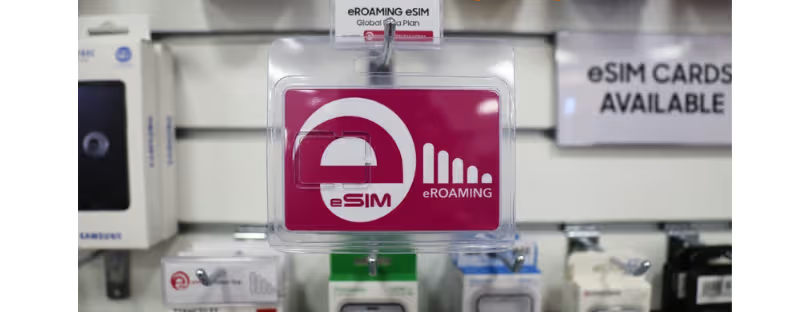
The new product from eROAMING essentially recreates the familiar SIM card retail experience without the physical SIM card itself.
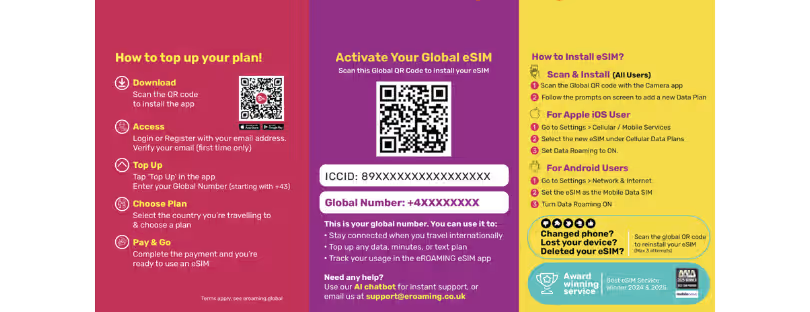
Instead of containing a chip, the pack contains a dynamic QR activation code linked to a unique ICCID. The ICCID is the global identifier used to associate a SIM profile with an operator, issuing country, and subscriber number.
When a traveler purchases the pack, they simply scan the QR code with their smartphone. That installs and activates the eSIM profile instantly.
From the traveler’s perspective, the experience remains very close to the traditional SIM purchase model.
You buy a product from a store. You scan it. You connect.
The difference is that the connectivity itself is entirely digital.
For retailers, the model also removes the operational friction associated with physical SIM cards. There is no chip inventory to track, no stock expiry, no packaging returns and no logistics tied to shipping SIM stock across regions.
Each pack is essentially just a retail trigger for a digital activation.
Commission Tracking Without SIM Inventory
One of the more interesting pieces of the model sits behind the scenes.
Each retail pack includes a QR code and ICCID tied to a specific retailer or distribution partner. When a traveler activates the eSIM, the platform records the ICCID and attributes that activation to the originating retailer.
This allows partners to earn commission on the activation in a way that closely mirrors traditional SIM card distribution models.
In other words, the economic structure of the old SIM retail system remains intact.
Retailers can still participate in the connectivity market without needing to operate digital marketplaces or integrate eSIM APIs directly into their own systems.
For many travel businesses, that is a far easier entry point.
Airports, hotels, and travel agencies often want to sell connectivity to travelers, but they do not want to build technology infrastructure to do it.
A retail pack solves that problem.
Built for the Travel Distribution Network
The company says the product is specifically designed for travel-focused retail environments.
These include:
- Travel agencies
- Airport electronics and duty-free stores
- Hotels and concierge desks
- Cruise terminals
- Travel accessory retailers
These are places where travelers often make last-minute connectivity decisions.
Despite the rapid growth of app-based eSIM providers, a large portion of travelers still purchase connectivity physically at the airport or at their destination.
Retail presence remains extremely valuable.
That is particularly true for first-time eSIM users who may prefer a physical product they can see, buy and understand before installing it.
The Network Behind the Activation
Once activated, the eSIM connects to eROAMING’s aggregated global connectivity platform.
According to the company, the service provides access to more than 600 mobile networks across over 165 countries.
The device automatically attaches to the strongest available partner network in each destination without requiring manual configuration from the user.
This type of aggregated network infrastructure has become increasingly common in the travel eSIM market. Many providers now operate as MVNO aggregators, sourcing wholesale data capacity from multiple operators worldwide.
For travelers, that typically means one eSIM profile can work across dozens or even hundreds of countries.
For retailers, it means they can sell a single product that works almost anywhere.
Why Physical Retail Still Matters
At first glance, the move back toward physical retail may seem counterintuitive in an industry built around digital distribution.
After all, the biggest travel eSIM brands today rely heavily on apps, search traffic, affiliate marketing and influencer promotion.
But distribution is rarely that simple.
In fact, the traditional SIM card market has long relied on retail distribution networks that span airports, convenience stores and electronics shops worldwide.
Companies such as Sim Local and SimCorner built large businesses by placing SIM card kiosks directly inside major international airports.
Those retail touchpoints still capture a significant share of last-minute connectivity purchases.
What eROAMING appears to be doing is applying that same logic to the eSIM era.
Instead of eliminating retail, it is digitizing it.

A Transitional Model for the eSIM Market
The company frames the product as a bridge between physical SIM retail and fully digital eSIM platforms.
“Most travel eSIM providers offer activation purely through apps or websites. The eROAMING chipless eSIM pack introduces a retail ready format designed to make eSIM technology easier for consumers to understand and purchase”,
said eROAMING founder and director Ravi Navaratnam,
The packaging itself becomes part of the customer experience.
Consumers who still associate connectivity with a physical product can buy something tangible, while the actual service remains entirely digital.
It is a hybrid model designed to reduce friction during the industry’s transition from physical SIM cards to embedded connectivity.
The Bigger Distribution Battle
What makes this development interesting is how it fits into a broader shift currently happening in the travel connectivity market.
Over the last two years, distribution has quietly become the most important competitive factor in the industry.
Customer acquisition costs are rising rapidly across the sector.
Travel eSIM providers now spend heavily on Google advertising, affiliate commissions, influencer marketing and app store promotions just to acquire new users.
In some cases, acquiring a customer can cost significantly more than the first data plan they purchase.
This is why distribution innovation is becoming so important.
Companies are exploring new ways to reach travelers without relying exclusively on digital advertising.
Retail partnerships, airline integrations, travel platforms and embedded connectivity inside travel apps are all becoming part of the new distribution landscape.
The chipless retail pack sits squarely within that strategy.
It opens a new channel without requiring large marketing budgets.
Conclusion: eSIM Is Becoming a Distribution Game
The launch of eROAMING’s chipless retail pack highlights a simple but important truth about the travel eSIM industry.
Technology is no longer the hard part.
Provisioning, global coverage and digital activation are now relatively mature. The GSMA’s Remote SIM Provisioning standards and widespread eSIM support across smartphones have largely solved the technical barriers.
The real battle is shifting toward distribution.
Who can reach travelers first.
Who can acquire them at a sustainable cost.
And who can remain present across multiple touchpoints in the travel journey.
That is why we are now seeing multiple distribution strategies emerge across the market. Some companies focus heavily on digital channels and app ecosystems. Others pursue airline partnerships, travel booking integrations or enterprise travel platforms.
Now we are also seeing a hybrid retail model re-enter the conversation.
In many ways, this mirrors what happened in other industries moving from physical to digital products. Streaming did not eliminate cinema. Digital books did not eliminate bookstores.
Instead, the market found ways to combine both.
The same dynamic may now play out in travel connectivity.
Retail will not disappear. It will simply become another entry point into a digital connectivity platform.
And for a market projected by GSMA Intelligence and Juniper Research to reach hundreds of millions of active eSIM users globally within the next decade, distribution innovation may ultimately determine which providers survive the increasingly competitive travel connectivity race.