
Missed Check-ins, Missed Signals: How Connectivity Failures Delay Incident Response
Here’s a scene every travel manager, ops lead, or security person recognizes. It is 08:10. A project lead lands, heads to a client site, and is supposed to check in on Teams before walking into a meeting. Nothing dramatic. Just a quick “I’m in, all good.”
08:14 comes. No check-in.
08:19. Still nothing. You assume they are busy.
08:27. A colleague pings them. The message shows “sent”, not “delivered.”
08:33. You try WhatsApp. One tick. Then nothing.
08:41. Someone calls. It rings out. Again.
And suddenly the story in your head changes. Not because you have new information, but because you have none. The gap becomes the signal.
This is the part of incident response people rarely talk about: the first delay is usually not a broken process. It is a broken assumption. We assume the person is reachable. We assume the phone is “basically connected.” We assume a push notification will get through. We assume the check-in is just a formality.
Then the assumptions fail, and the clock keeps ticking.
Small delays compound into operational risk
In incident response, time is not just time. Time is uncertain. And uncertainty triggers escalation, parallel work, and sometimes panic.
NIST’s incident response guidance spends a lot of energy on coordination and communication because response is a team sport, not a heroic sprint. If communication is delayed, everything downstream slows or fragments: triage, decision-making, approvals, containment, and recovery.
In travel risk and duty of care, it is the same logic. ISO 31030 is essentially a structured way to prove that your travel decisions and controls are proportionate to risk, and that you can support travellers before and during an incident, not only write policies afterward. Communication and the ability to reach people in motion are core dependencies, even when it is not written as “telecom.”
Now zoom back into the reality of modern travel: enterprise eSIM backup solution
You have people moving through airports, border zones, underground metros, industrial sites, rural roads, concrete hotels, and conference venues with overloaded networks. They may be on personal devices, dual SIM setups, corporate VPN, or restrictive roaming policies. They may be switching eSIM profiles, toggling data roaming, or landing in a country where their primary operator’s roaming partner is simply not performing today. enterprise eSIM backup solution
The point is not that connectivity fails in spectacular ways. The point is that it fails quietly, and quiet failures are the most dangerous in incident response because they look like human non-compliance until they do not.
 Missed meetings are often the first symptom
A missed meeting sounds like a calendar problem. In incidents, it is often a connectivity problem wearing a calendar costume.
If your employee cannot load the building pass QR code, they are stuck at reception. If they cannot open the map pin, they get rerouted. If they cannot pull up the emergency procedure, they improvise. If they cannot send a quick location update, your team is blind.
And if they cannot receive your messages, your escalation ladder becomes guesswork.
This is why “check-ins” matter. Not because people love check-ins, but because they are low-friction early signals. When check-ins fail, you lose the simplest confirmation loop you have.
Travel risk management platforms understand this. Tools like International SOS and Safeture focus heavily on alerts, traveller information, and emergency communication workflows. Everbridge positions travel risk management around monitoring, tracking, and instant alerts with two-way communications.
But there’s a practical catch nobody loves admitting:
All of those tools assume the phone has working data.
When data fails, the best workflow in the world becomes a beautifully designed screen that never loads.
“Unanswered messages” is not a behaviour problem
A lot of organizations, especially in high-compliance environments, treat non-responsiveness like a people issue:
“They didn’t follow protocol.”
“They ignored the alert.”
“They should have checked in.”
Sometimes that is true. Often it is not.
If you want fewer missed signals, you do not start by lecturing travellers. You start by hardening the last mile: the mobile data path that carries the check-in, the location ping, the escalation message, and the “I’m safe” confirmation.
This is exactly where enterprise eSIM has been quietly shifting from convenience to resilience.
Not the consumer version of eSIM, where you download a plan and hope for the best. The enterprise version, where IT and operations treat connectivity like an availability layer.
Where SureSIM fits: backup data that actually behaves like backup
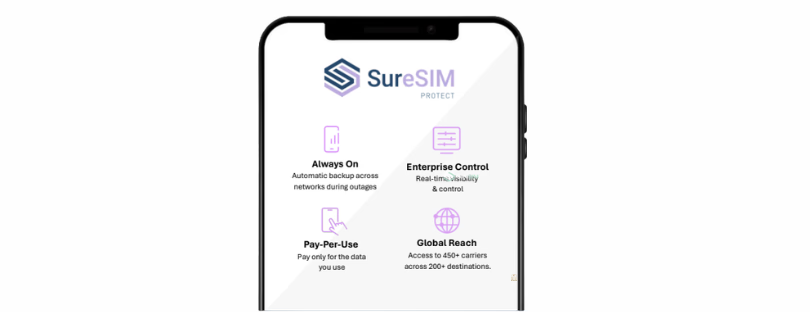
SureSIM’s pitch is refreshingly direct: make sure the traveller has a second resilient data network sitting on the device, ready when the primary network is unavailable or degraded.
SureSIM Protect is positioned specifically around duty of care support and ISO 31030 alignment for business travellers, plus real-time control and visibility for IT and operations.
Two details matter here if you care about incident response speed:
- It is designed as a silent backup, not a “remember to buy data” task
SureSIM describes Protect as sitting on corporate and BYOD smartphones as a second resilient data network, ready when the primary network becomes unavailable due to coverage or network faults.
That matters because in real incidents, people do not have cognitive bandwidth to troubleshoot connectivity. If the contingency plan requires five steps and a QR code, it will fail at the worst possible moment. - Multi-network access reduces single-partner fragility
SureSIM Protect is described as providing a multi-network, un-steered data connection with access to a range of networks.
In plain language: if one roaming path is having a bad day, you have more shots at a working network. For incident response, that increases the chance that your first escalation message actually lands, not your fifth.
SureSIM also frames the broader platform as “global data, total control,” with an enterprise management layer behind it. That management piece is not cosmetic. In incident conditions, visibility beats optimism. Knowing who has connectivity and where issues are happening lets you separate a real safety concern from a comms outage faster.

Enterprise eSIM backup solution – How does this compare with the broader market?
Most travel risk management stacks today are building upward:
More risk intelligence feeds, more geolocation, more automated alerts, more dashboards, more two-way comms features.
At the same time, enterprise connectivity is building downward:
More control, more profile management, more global coverage claims, and a steady move toward treating connectivity as programmable infrastructure rather than “a SIM.” GSMA’s published eSIM specifications and the industry push toward more scalable remote provisioning for constrained devices are part of that bigger direction of travel.
SureSIM sits in a useful intersection: it is not trying to replace your travel risk platform. It is trying to keep your travel risk platform reachable.
That’s a subtle difference, but it is exactly the difference between “we sent the alert” and “they received the alert.”
What changes when you treat connectivity as an incident-response dependency
When you treat connectivity as a dependency, you start designing for three practical outcomes:
Faster acknowledgement
If check-ins and messages get through more reliably, you reduce the time spent wondering whether you have an incident or a dead signal.
Cleaner escalation
Escalation becomes evidence-driven. Not “they are offline, so we panic,” but “their primary network is down and the backup is active,” or “we still cannot reach them, escalate to physical verification.”
Lower operational noise
Fewer false escalations means less churn across security, travel, HR, and leadership. And that is not just comfort. It is capacity. In real incidents, capacity is everything.
Final Thoughts about the enterprise eSIM backup solution needs and SureSIM
Most organizations are currently investing in incident response maturity at the workflow layer: better playbooks, better comms templates, better crisis tools, better duty-of-care documentation. That is good, and standards like ISO 31030 are pushing the market in the right direction by making travel risk management auditable and structured.
But the market still under-invests in the boring failure mode: the moment a traveller’s phone becomes “almost connected,” and your entire escalation tree turns into a waiting game.
This is why I think the next wave of travel risk and incident response will look more like resilience engineering than policy writing. The winners will be the organizations that design communications as an always-on capability, not a best-effort feature.
Travel risk platforms like International SOS, Safeture, and Everbridge are getting stronger at intelligence and orchestration. The missing link is often the data path itself.
SureSIM’s strongest argument is that it targets that missing link directly: reliable backup mobile data, multi-network access, and an enterprise control layer that keeps the signal alive when the traveller is the most unreachable.
In incident response, minutes are not just minutes. Minutes are the difference between “we confirmed they’re fine” and “we escalated blind.” If you want to reduce that gap, stop treating connectivity as a travel perk. Start treating it as your first responder.