Airalo Chooses Busan as Gateway to Korea eSIM Market
International travel today runs on connectivity. The moment you land in a new country, you need data. Maps, ride-hailing apps, boarding passes, translation tools, restaurant bookings, and messaging platforms. None of it works without internet access.
That reality is exactly why the travel eSIM industry has grown so quickly over the past few years.
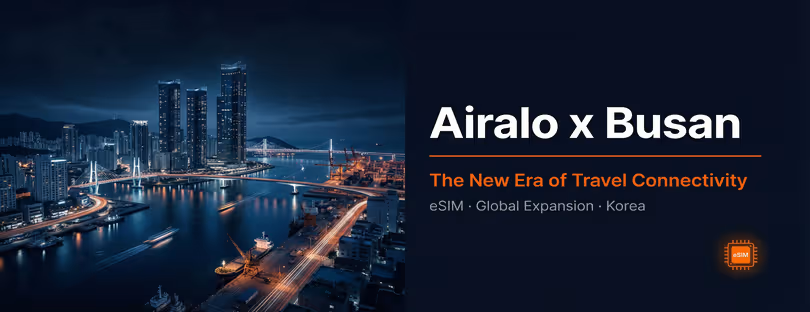
On March 16, Airalo, widely recognized as the world’s first eSIM marketplace, announced that it has selected Busan as its first Korean partner city as part of its global expansion strategy. The collaboration focuses on providing seamless connectivity solutions for international visitors arriving in South Korea’s second-largest city.
Busan is not just a tourist destination. It is one of Asia’s most important port hubs, a major business gateway, and a growing center for international events and conferences. For a global connectivity platform like Airalo, it represents a strategic entry point into one of the most technologically advanced telecom markets in the world.
A Gateway Into the Korean Market
South Korea has long been known for its cutting-edge telecommunications infrastructure. The country consistently ranks among the global leaders in broadband speeds, 5G deployment, and smartphone adoption.
But entering the Korean telecom environment is not always simple for international providers. The market is dominated by powerful domestic operators such as SK Telecom, KT, and LG Uplus. Foreign connectivity platforms must build partnerships that ensure both regulatory compliance and reliable nationwide coverage.
Busan provides a natural testing ground.
As Korea’s second-largest city and a major international port, Busan receives millions of visitors every year. Travelers arrive for business, tourism, global events, and increasingly for Korea’s booming cultural industries.
For a travel connectivity company, that flow of international visitors makes Busan a perfect starting point.
“Busan represents a perfect gateway for our Korean market entry,” said Badr Wardeh, CEO of Airalo. “The city’s strategic location, vibrant tourism industry, and tech-forward approach make it an ideal partner for our expansion in Asia.”
The partnership reflects a broader trend in the telecom industry: connectivity is no longer just about networks. It is becoming a key part of the travel experience itself.
Eliminating the Airport SIM Card Hunt
For decades, international travelers had only a few options when it came to mobile connectivity abroad.
They could rely on expensive roaming plans from their home operator. They could buy a local SIM card after landing. Or they could simply search for Wi-Fi wherever possible.
None of these solutions was particularly convenient.
Travel eSIM platforms have changed that equation by turning connectivity into a digital service that can be installed instantly on compatible devices.
Under the new partnership, Airalo will offer special eSIM packages designed specifically for tourists and business travelers visiting Busan. The plans will be available through the company’s mobile app and will connect users to major Korean telecom networks, delivering high-speed mobile data across the country.
For travelers, the benefit is straightforward.
There is no need to visit a SIM card kiosk at the airport. No paperwork. No swapping physical SIM cards. Instead, users can simply download a plan before departure and activate it the moment they land.
In a world where smartphones are the central hub of travel logistics, that convenience is becoming increasingly valuable.
Why Cities Care About Connectivity
The involvement of Busan’s city government in this partnership highlights an interesting shift in how destinations think about tourism infrastructure.
Mobile connectivity has quietly become one of the most important services international visitors depend on. From navigating public transportation to translating menus or booking local experiences, travelers expect to stay connected at all times.
If connectivity fails, the travel experience can quickly become frustrating.
Busan Mayor Park Heong-joon welcomed the partnership, noting that it aligns with the city’s broader ambitions to become a leading smart city and enhance the experience for global visitors.
In other words, connectivity is no longer just a telecom issue. It has become a tourism issue.
Cities increasingly compete not only on attractions and hotels but also on how digitally friendly they are for visitors.
Airalo’s Rapid Global Growth
Airalo’s move into Korea reflects the company’s rapid expansion since its founding in 2019.
In just a few years, the startup has grown into one of the most recognizable names in the travel connectivity space. The platform now offers eSIM packages covering more than 200 countries and regions and has served over five million users worldwide.
Its success is largely built on a marketplace approach.
Rather than operating its own mobile networks, Airalo aggregates connectivity packages from telecom partners around the world and distributes them through its mobile app. Travelers can browse plans by destination, purchase them instantly, and install them digitally.
This model allows the company to scale globally without the infrastructure costs faced by traditional telecom operators.
It also reflects a wider transformation taking place across the industry.


The New Travel Connectivity Platforms
Airalo is part of a growing ecosystem of travel eSIM providers that treat connectivity as a flexible digital service rather than a traditional telecom contract.
Several companies are now competing in this rapidly expanding market.
Holafly
Known for its focus on unlimited data plans designed primarily for tourists.
Nomad eSIM
Offers flexible regional packages and dynamic pricing for frequent travelers.
Ubigi
Leverages partnerships with automotive manufacturers and IoT ecosystems.
Yesim
Positions itself as a programmable telecom platform with strong enterprise and business connectivity use cases.
Each platform targets slightly different audiences, but they all share the same core idea: connectivity should be instant, digital, and borderless.
Industry organizations such as the GSMA have repeatedly highlighted the long-term potential of eSIM technology. Analysts expect billions of connected devices to rely on eSIM profiles within the next decade, from smartphones to laptops, wearables, and connected vehicles.
Research firms such as Juniper Research also forecast strong growth in travel eSIM adoption as international travel rebounds and remote work becomes more common.
The Bigger Shift Behind eSIM
The significance of the Busan partnership goes beyond a single city.
For decades, mobile connectivity was tied to geography. A SIM card belonged to a specific operator and country. Crossing a border meant entering the complex world of roaming agreements and unpredictable charges.
eSIM technology is gradually dismantling that model.
Connectivity is becoming software-defined, meaning users can switch networks digitally without replacing physical hardware. This flexibility allows travel connectivity platforms to offer instant data access across multiple countries.
For travelers, the result is a simpler experience.
For telecom operators, however, it represents a fundamental shift in how connectivity is distributed and monetized.
Global digital platforms are slowly challenging traditional roaming revenue models.
Conclusion: Connectivity Becomes Part of the Destination
Airalo’s partnership with Busan illustrates how the boundaries among telecommunications, tourism, and digital services are blurring.
Cities increasingly recognize that seamless internet access is essential to the visitor experience. At the same time, travel eSIM platforms are positioning themselves as global connectivity gateways for mobile-first travelers.
The competitive landscape is also intensifying. Companies such as Holafly, Nomad, Ubigi, and Yesim are all racing to capture a growing market of travelers who expect connectivity to work instantly wherever they go.
According to projections from the GSMA and Juniper Research, eSIM adoption will continue accelerating as more smartphones and connected devices ship with embedded SIM capabilities.
That trend suggests that partnerships like the one between Airalo and Busan may become more common.
In the future, connectivity could become something travelers never have to think about again. It will simply be there, ready the moment they arrive.