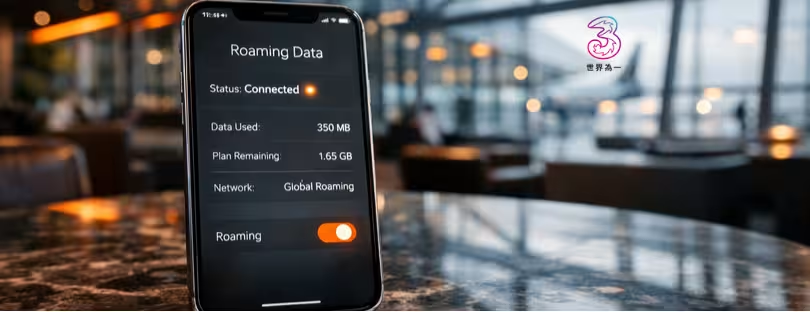
Hutchison Telecommunications Hong Kong is preparing to launch World Plan 2.0, a new version of its roaming offer designed to make global data access easier and more practical for travelers. On paper, it looks like a product update. In reality, it says something bigger about where telecom is heading.
The company’s 3 Group wants to improve how customers stay connected across borders, and this time it is adding a more flexible structure. That includes an add-on SIM that lets users share the plan with others, plus an upgraded value-added service package for travel in the Greater Bay Area.
That combination matters. Roaming is no longer just about buying data before a trip and hoping it lasts. Travelers increasingly expect connectivity to fit into the wider journey, alongside transport, convenience, and digital services. World Plan 2.0 seems built around that shift.
More than a data bundle
One of the most interesting parts of the launch is the shared-plan angle. The add-on SIM gives users a way to extend access beyond a single device or person. That may sound simple, but it reflects a real market change.
People travel with more devices than before. Phones, tablets, laptops, portable hotspots, and family members all compete for data. Traditional roaming plans were built for one subscriber, one number, one bill. Newer travel behavior does not always fit that model.
HTHK is also packaging connectivity with lifestyle perks. According to the company, customers who buy the world plan with 70GB or more can receive a bundled offer that includes a free Shenzhen Huafa Snow BONSKI, a Trans-Island Chinalink bus ticket, and travel insurance.
This is a smart move because it turns roaming into part of the travel product, not just a telecom utility. It suggests the operator is thinking less like a network provider and more like a mobility partner.
Demand is already changing
The company also shared a telling number. Damien Leong, chief technology and transformation officer of HTHK, said that after a data service upgrade between Kam Sheung Road station and Tsuen Wan West station, roaming usage demand in that area grew by 52 percent.
That is not just a network statistic. It shows how usage rises when coverage and performance improve. Better infrastructure does not only support demand. It creates it.
This is especially relevant in a region like Hong Kong, where cross-border movement, business travel, and short-distance regional trips all drive mobile data needs. When people feel they can rely on the network, they use it more freely for maps, payments, messaging, transport apps, and work.
So while World Plan 2.0 is being presented as a commercial launch, it is also tied closely to investment in underlying network quality.
Northern Metropolis and the 6G signal
Leong also said the company will continue strengthening network development in the Northern Metropolis together with the government and other telecom companies. On top of that, HTHK plans to launch a 6G network in 2030.
That date is important because it places the company within the broader telecom race toward next-generation infrastructure. Even if 6G still feels distant for ordinary users, operators are already using these timelines to show they are planning beyond immediate product cycles.
In other words, World Plan 2.0 is not just about selling more roaming passes this year. It is part of a wider story about long-term competitiveness, infrastructure relevance, and keeping pace with future connectivity expectations.
A cautious AI message
Another part of the announcement focused on artificial intelligence. Leong said the company is seeing rising demand for AI and is developing its AI strategy through GPU investment and internal support for teams. He also noted that internal AI training hours have already exceeded 1,000.
That sounds ambitious, but his tone was also careful. He said artificial intelligence is only an agent and has not yet replaced human resources. That is probably the most grounded part of the entire update.
In telecom, AI is becoming a standard talking point, but not every operator is equally clear about what it actually means. HTHK appears to be taking a more measured route, investing in capability without pretending the technology is mature enough to do everything.
That same caution came through when Leong addressed OpenClaw. He said its development is not mature enough for HTHK to include it in the company’s service system. In a market full of hype, that restraint is notable.
Stable spending, mixed results
From a financial standpoint, HTHK is keeping a relatively steady course. Chief financial officer Marcus Ng said capital expenditure this year is expected to stay between HK$400 million and HK$500 million, roughly in line with last year. Most of that spending will go toward network infrastructure and IT development.
Ng also said that although the company recorded a HK$25 million loss last year, it still maintained the final dividend at 5.21 HK cents, which he said reflects healthy financial performance.
That may sound contradictory at first, but the message is clear enough. HTHK wants investors and the market to see stability, even in a tough operating environment.
Conclusion
World Plan 2.0 is not the most radical roaming launch on the market, but it is a useful example of how traditional operators are trying to adapt. Instead of competing only on raw data, HTHK is combining network investment, plan sharing, travel perks, and regional relevance.
That matters because the real pressure is no longer coming only from rival telecom operators. It is also coming from traveleSIM brands and digital-first players that have made instant activation, app-based control, and flexible pricing feel normal. Compared with those providers, World Plan 2.0 still looks more operator-driven than software-driven.
But that does not make it irrelevant. In fact, its strength may be the opposite. HTHK is using assets that many travel tech players do not have: local infrastructure, regional partnerships, and a tighter link between mobility and network performance. The bigger picture is this: roaming products are no longer just about coverage. They are becoming part of a wider travel ecosystem, and operators that understand that shift still have a chance to stay important.
Driven by wanderlust and a passion for tech, Sandra is the creative force behind Alertify. Love for exploration and discovery is what sparked the idea for Alertify, a product that likely combines Sandra’s technological expertise with the desire to simplify or enhance travel experiences in some way.