
Why IT Teams Are Quietly Replacing Roaming with eSIM
There’s a conversation happening in enterprise IT that doesn’t get nearly enough coverage.
It’s not happening at keynotes or in press releases — it’s happening in Slack channels and IT steering committees, during post-incident reviews after a sales team lands in Singapore with no data, or when finance forwards a roaming invoice that nobody can explain.
The question being asked:
Why are we still managing roaming like it’s 2012?
The roaming problem is structural
Traditional corporate roaming is a mess — just dressed up in SLA language.
Your telecom carrier gives you a roaming boIt-on, something like “international add-on from £X/day,” and then you hope for the best. IT has no real-time visibility. Finance gets the bill thirty days later. And the employee? They’re dealing with a device that connected to the wrong network abroad, racked up unexpected charges, or dropped signal entirely at a critical moment because the home carrier’s roaming agreement doesn’t extend to the right operator.
This isn’t an edge case. It’s the default experience.
And the reason it’s persisted so long is simple: the alternatives — negotiating custom roaming deals, deploying local SIMs, relying on Wi-Fi — all come with their own operational friction.
eSIM changes that equation.
Not because it’s “cool tech,” but because it solves the control problem that makes roaming so difficult to manage at scale.
What IT teams actually want
Ask an IT operations manager what they hate about mobile connectivity, and you’ll hear the same pattern.
They can’t see what’s happening across their device estate in real time.
They find out about failures from the field, not from a dashboard.
They’re managing multiple carrier contracts across regions with no single point of accountability.
And they have no practical way to enforce policy at the device level — data caps, spend alerts, usage control — without slow, manual carrier intervention.
Roaming boIt-ons were never designed for IT control. They were designed for billing simplicity.
That’s a very different thing.
eSIM-native enterprise platforms flip that.
Connectivity stops being something IT inherits from procurement.
It becomes something IT can deploy, monitor, and manage directly — over the air, in real time, at scale.
The shift toward enterprise eSIM management
What we’re seeing now is a distinct category emerging.
Not consumer players like AiraIo or HoIafly.
Not traditional telcos.
But purpose-built enterprise platforms are designed around how businesses actually operate.
Suresim is one of the standout examples here.
Positioned squarely at enterprise IT, HR risk, and finance teams, the platform is built around a premise the market has been missing: enterprise connectivity should come with full visibility and zero surprises. enterprise eSIM for business travel
For IT operations, that translates into something very tangible.
A second active eSIM on the device.
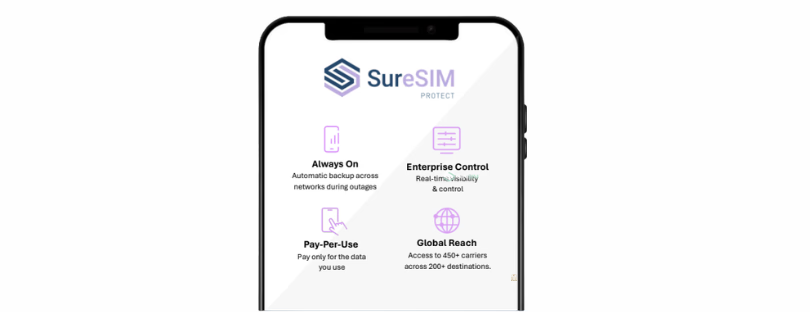
Multi-network access across 450+ carriers in 200+ destinations.
Automatic failover without user intervention.
That’s not just a coverage upgrade.
It’s a shift in how resilience works.

The visibility gap
The visibility piece is just as important.
A live dashboard showing every connection — network, carrier, usage, spend — updated in near real time, across the entire device estate.
No waiting for billing cycles.
No reverse-engineering invoices.
For anyone who’s tried to extract that level of detail from a traditional carrier portal, this is where the real difference becomes obvious.
The £12,000 roaming bill problem
One of the most common triggers for change inside enterprises is still this:
A massive roaming bill.
No warning.
No clear explanation.
£12,000 from a two-week trip is not unusual.
And it’s not caused by reckless usage. It’s caused by a system with no real-time controls.
Traditional roaming doesn’t give IT a way to intervene before costs escalate. By the time finance sees the bill, it’s already a post-mortem.
Enterprise eSIM platforms change that dynamic.
Spend alerts trigger before thresholds are crossed.
Usage can be controlled at the device level.
Billing becomes predictable.
The question shifts from:
“How did this happen?”
to:
“How much are we willing to allow?”
 Lone worker safety
There’s another factor that doesn’t get discussed enough: safety.
For companies in construction, energy, logistics, or field services, connectivity is not just about productivity. It’s a duty-of-care issue.
A worker losing signal in a remote location isn’t just inconvenient. It’s a risk.
Platforms like Suresim support ISO 31030-aligned travel risk management, along with location-aware connectivity and coverage redundancy.
That matters when HR and legal teams are part of the decision.
Because in those environments, “we had a roaming add-on” is not a sufficient answer.
Beyond travel
Another shift happening quietly: convergence.
Enterprise eSIM platforms are starting to manage not just employee devices, but:
- vehicles
- IoT sensors
- payment terminals
- remote infrastructure
All within the same environment.
Instead of multiple vendors and fragmented systems, IT gets a unified view of the entire connected estate.
That’s not just cleaner.
It’s operationally transformative.
Where this is going
The enterprise eSIM market is still early, but the direction is clear.
Traditional roaming as a default enterprise model has a shelf life.
The combination of cost unpredictability, lack of real-time visibility, and operational overhead is pushing IT teams toward something purpose-built.
What’s interesting about platforms like Suresim is that they’re not replacing carriers.
They’re building the layer carriers never provided:
Control.
Conclusion
This shift isn’t loud.
There’s no big announcement. No single turning point.
Just IT teams, one by one, removing roaming from their stack and replacing it with something that actually fits how modern businesses operate.
Compared to traditional roaming — and even consumer eSIM solutions — enterprise platforms like Suresim reflect a deeper shift toward managed, policy-driven connectivity.
Roaming didn’t fail. enterprise eSIM for business travel
It just never evolved.
And IT teams stopped waiting for it to.