What Fair Usage Policy (FUP) Really Means for eSIM Users (And Why You Should Care)
If you’ve ever used an eSIM for travel or checked the fine print of your mobile plan, you’ve probably stumbled across a line that says something like “Subject to Fair Usage Policy” — and then… nothing more. No clear explanation, no specific limits, just that mysterious phrase hanging there.
Let’s fix that.
Because understanding Fair Usage Policy (FUP) can save you from unexpected slowdowns, blocked data, or sudden service restrictions—especially when you’re roaming or using a gIobal eSIM.
So, what exactly is it, how does it work, and why does every mobile operator seem to have one?
Let’s break it down simply and honestly.
What “Fair Usage Policy” Actually Means
At its core, a Fair Usage Policy is a rulebook that ensures all users get fair access to the network—without a few people hogging the bandwidth or abusing cheap data plans.
In theory, it’s there to protect you.
In practice, it’s also how operators quietly control data consumption, especially on roaming or international eSIM plans where costs can be high.
Think of it like an “invisible speed bump.” You’re free to drive fast (use data freely) up to a certain point, but if the network thinks you’re going too fast for too long, it slows you down — for the greater good of everyone else.
Why FUP Exists (and Why It’s Not Always Bad)
Let’s be fair — without some kind of usage control, networks could get overloaded. A handful of heavy users streaming 4K Netflix abroad could ruin the experience for everyone else trying to check Google Maps.
That’s why FUPs exist: to maintain network stability and prevent abuse of cheap or unlimited plans.
Especially in roaming situations, where an eSIM provider buys network access from a local carrier, FUPs protect them from customers who might, say, buy a “Europe unlimited data eSIM” and start using it as their home broadband replacement.
In short:
- It keeps prices reasonable by avoiding system abuse.
- It keeps networks fast by distributing bandwidth fairly.
- It helps eSIM providers negotiate deals with local carriers.
So far, so good—until you hit that hidden limit yourself.
How FUP Affects eSIM Users
Here’s where things get real.
Most eSIM providers — even those advertising unlimited or high-speed plans—apply a Fair Usage Policy. The catch? They rarely say how much data you can use before it kicks in.
Here’s what can happen once you cross that invisible line:
- Speed throttling: your 4G/5G data suddenly drops to 2G or 3G speeds.
- Data suspension: you lose connection until your plan resets or renews.
- Service block: your eSIM may be temporarily deactivated.
- Usage alerts: some providers send an email or app notification.
That’s why reading the fine print is essential. Some eSIMs that claim “unlimited data” might only include 2–5 GB of high-speed data, then drop to 128 Kbps — which is barely enough to load an email.
The “Unlimited” Illusion
Let’s talk about that magic word — unlimited.
We all love the sound of it. But in mobile terms, “unlimited” almost never means truly unlimited. Instead, it means unlimited access to a certain amount of high-speed data, followed by slow-speed data under FUP.
Example:
- A plan says: “Unlimited data for 30 days.”
- Reality: 5 GB at 4G/5G speeds, then unlimited 128 Kbps speeds for the rest of the month.
Still technically unlimited. Just not usefully unlimited.
That’s the difference between marketing language and network reality — and it’s why savvy travelers always read the FUP section before buying an eSIM.
FUP and Roaming: A Grey Zone
Now, here’s where things get even trickier: roaming.
Let’s say you buy a European eSIM that includes 30 GB of data. Sounds perfect for your month-long trip, right?
But then you notice the fine print:
“FUP applies to data usage outside the home country.”
This usually means you can’t actually use the full 30 GB across multiple countries. The provider may cap roaming data to, say, 10 GB or less under their Fair Usage Policy.
This rule comes from EU roaming regulations, which allow operators to limit “roam-like-at-home” usage to prevent abuse — for example, people buying cheap French SIMs to use full-time in Germany.
So even within the EU, Fair Usage Policies decide how much data you can roam before you’re charged extra.
And when it comes to global eSIMs that rely on multiple partner networks, the same logic applies — just without the regulation or transparency.
How to Spot (and Avoid) Hidden FUP Traps
Let’s be honest — most travelers don’t have the time (or patience) to dig through the fine print. But there are a few easy signs that tell you an eSIM plan has strict or unclear FUPs.
Watch out for:
- 🚩 “Unlimited” plans with no mention of high-speed data caps
- 🚩 Vague terms like “excessive use may result in speed reduction”
- 🚩 No clear info about data speeds after the limit
- 🚩 No support or contact info for usage issues
Instead, look for transparency. Reliable providers like Airalo, Nomad, Airhub, and aloSIM usually mention high-speed limits or throttling thresholds in their plan details.
A good rule of thumb?
If a provider doesn’t clearly state what “unlimited” means — assume it isn’t.
FUP in Numbers: What’s “Fair”?
So what’s a fair limit under a Fair Usage Policy?
It depends.
But for most global or regional eSIMs, here’s the typical pattern:
| Plan Type | High-Speed Limit Before FUP | Post-FUP Speed |
|---|---|---|
| Unlimited (daily) | 500 MB–1 GB per day | 128–512 Kbps |
| Unlimited (monthly) | 5–10 GB per month | 128 Kbps |
| Regional (EU/Asia) | 10–20 GB | 128–256 Kbps |
| Global (multi-country) | 2–5 GB | 128 Kbps |
So if you’re planning to work remotely, stream video, or use heavy apps abroad, you’ll want to calculate your data needs carefully.
Why eSIM Providers Don’t Always Reveal FUP
Here’s the honest truth: they often don’t know the exact threshold themselves.
Since many eSIM companies rely on aggregators or wholesale partners, the FUP limits are decided by the underlying local network — and those networks may change them without notice.
This is why your friend might say, “My unlimited plan worked great in Spain,” while yours slowed down after 3 GB in Italy. Same provider, same plan — different underlying carrier, different rules.
It’s not ideal. But it’s how global connectivity currently works.
How to Stay on the Safe Side
You can’t eliminate FUPs, but you can manage them smartly:
✅ Compare before buying – use platforms (like Alertify’s eSIM Finder) that show provider transparency and data details.
✅ Avoid “unlimited” marketing traps – go for defined data packages.
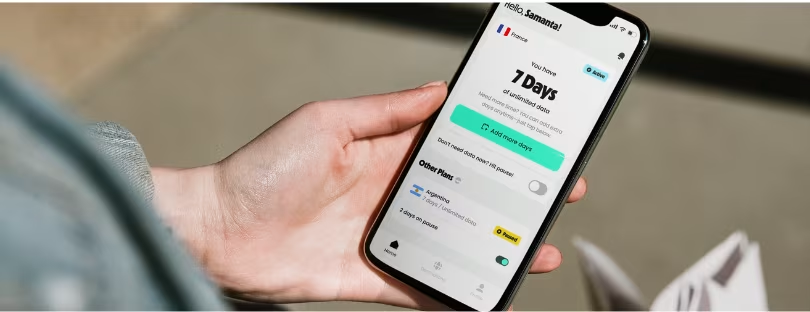
✅ Track your usage – most eSIM apps show real-time data stats.
✅ Buy local eSIMs for long stays – local carriers usually have higher thresholds.
✅ Use Wi-Fi whenever possible – airports, hotels, cafés, coworking spaces.
The Bottom Line
Fair Usage Policy isn’t evil. It’s just misunderstood.
It’s a network management tool — a balance between customer freedom and system fairness. But when applied vaguely or marketed poorly, it can easily feel like a gotcha clause that punishes travelers who simply didn’t know better.
As eSIM adoption grows, transparency around FUPs will matter more than ever. The best providers will be the ones who stop hiding behind fine print and start explaining exactly what “fair” means.
Until then, the smartest move you can make as a traveler is simple:
Read before you roam.
Because nothing ruins a digital-nomad vibe faster than “Fair Usage Policy applied.”