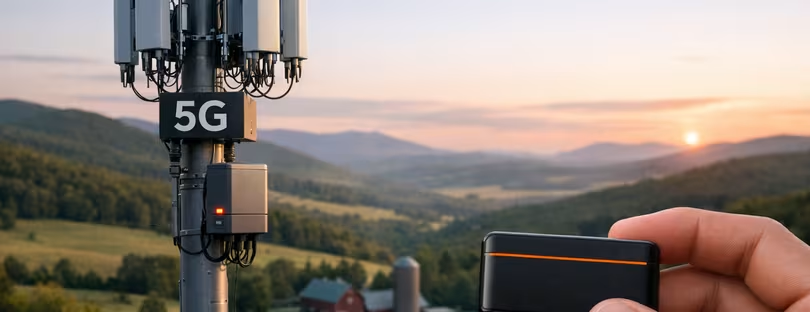
Turkey Enters 5G Era: What Changes from April 2026
After years of delays and speculation, Turkey has officially entered the 5G era.
At a launch ceremony in Ankara this week, authorities confirmed that commercial 5G services will begin rolling out from April 1, 2026. But unlike the headline-grabbing “nationwide launches” we’ve seen elsewhere, this one will be gradual. The network will expand step by step across all 81 provinces, with meaningful nationwide coverage expected within the next two years.
It’s a long-awaited shift. Until now, Turkey has relied heavily on its 4.5G infrastructure while regulators worked through licensing, spectrum allocation, and investment frameworks. That process culminated in a major spectrum auction in October 2025, raising $2.95 billion and clearing the path for the country’s three main operators to finally move forward.
Turkcell, Türk Telekom, and Vodafone Turkey are now officially in the 5G game.
What actually changes with 5G
Let’s cut through the marketing noise. 5G is not just “faster internet.”
Yes, speeds jump from megabit to gigabit levels. That alone can mean downloads in seconds instead of minutes. But the real shift is latency and capacity.
5G dramatically reduces delay to milliseconds. That’s what enables real-time interactions, not just faster browsing. At the same time, it allows far more devices to connect simultaneously without congestion.
This is why 5G is often framed as infrastructure rather than just a consumer upgrade. It underpins things like smart cities, connected vehicles, and industrial automation.
In Turkey’s case, officials are positioning 5G as a foundation for digital transformation across sectors, from healthcare to manufacturing.
How the rollout will actually happen
Unlike some markets that launched in major cities first, Turkey is taking a slightly different approach.
The initial phase aims to activate 5G across all provincial centers simultaneously. From there, coverage will deepen and expand into smaller towns and rural areas over the next two years.
The licenses granted in the 2025 auction run through the end of 2042, giving operators a long runway to invest in infrastructure and scale services.
Behind the scenes, this rollout is supported by a mix of fiber expansion, base station upgrades, and ongoing R&D programs. Turkey has also made a clear push toward domestic technology, setting initial requirements for local production and signaling that this share should increase over time.

Who can actually use it today?
Here’s the reality check: not everyone will benefit from day one.
To access 5G, users need compatible devices. Turkey currently has around 95 million mobile phones in use, but only about 32 million are 5G-ready. That number has doubled in the past year and is expected to grow quickly, but there is still a gap.
This mirrors what we’ve seen globally. Network availability tends to move faster than device adoption in the early stages.
For travelers and business users, this creates an interesting dynamic. Even if the network is live, the experience will depend heavily on whether your device and plan are actually optimized for it.
Where 5G will make a real difference
The biggest impact of 5G will not show up in speed tests. It will show up in how systems behave.
In healthcare, the promise is real-time monitoring and remote procedures. In manufacturing, it’s Industry 4.0 with connected machines operating on live data. In transport, it’s smarter traffic systems and the groundwork for autonomous mobility.
Even consumer experiences shift. Streaming, live broadcasting, AR, and VR become smoother and more reliable. Not revolutionary overnight, but noticeably better.
And then there’s IoT. 5G is built to handle massive device density, which is what makes large-scale smart infrastructure viable.
Turkey is clearly aligning its rollout with these broader ambitions rather than positioning 5G as just a consumer upgrade cycle.
The operator landscape
All three major operators are entering 5G at the same time, but their strategies will likely diverge quickly.
Turkcell has historically pushed performance and premium positioning. Türk Telekom brings strong fixed-line and fiber integration. Vodafone Turkey benefits from global scale and experience in other 5G markets.
What matters now is execution. Coverage depth, pricing models, enterprise offerings, and partnerships will define who actually captures value.
Globally, we’ve seen that 5G alone does not guarantee revenue growth. The real opportunity lies in how operators package and monetize it, especially in enterprise and B2B segments.
|
HOTELS
Turkey Hotels, best prices.
Top-rated stays · flexible booking
|
EXPERIENCES
Skip the tourist traps
Guided tours · skip-the-line tickets
|
GETTING AROUND
Don’t figure out transport on arrival
Book trains, buses & flights in advance
|
CONNECTIVITY
Get Turkey eSIM before landing
Avoid roaming · instant data · no SIM swaps
|
The bigger picture
Turkey’s timing is interesting.
According to the GSMA, global 5G adoption is accelerating rapidly, with coverage now reaching a majority of the world’s population. At the same time, reports from Ericsson suggest that the next phase of 5G growth will be driven less by consumer upgrades and more by enterprise use cases and network slicing.
In that context, Turkey is not early. But it is not too late either.
Markets like South Korea, the US, and parts of Europe have already moved into more advanced 5G deployments, including standalone networks and enterprise applications. Others are still catching up.
Turkey sits somewhere in the middle. The key question is whether it can leapfrog into more advanced use cases rather than just replicating first-wave deployments.
What this means for connectivity players
For the broader connectivity ecosystem, including eSIM providers and travel tech platforms, this rollout is another signal that network quality is becoming more standardized globally.
As more countries move to 5G, differentiation shifts away from raw connectivity and toward experience, pricing models, and distribution.
We’re already seeing this in the travel eSIM space. Unlimited plans, regional bundles, and subscription models are competing less on speed and more on predictability and usability.
Turkey’s rollout reinforces that trend.
Conclusion
Turkey’s 5G launch is less about catching up and more about setting the stage for what comes next.
The real story is not the switch-on moment. It’s how the network gets used.
If Turkey follows the same trajectory as early 5G markets, the first wave will be underwhelming for consumers. Speeds improve, but not dramatically enough to change behavior overnight. The second wave is where things get interesting, when enterprise applications, IoT ecosystems, and new service models start to take shape.
That’s where countries like South Korea and operators backed by players like Ericsson have already begun to move.
The question for Turkey is whether it can accelerate into that second phase faster, using its rollout as a platform for innovation rather than just coverage expansion.
Because in 2026, launching 5G is no longer the milestone.
What you build on top of it is.