Travelers Are Tired of Counting Gigabytes
Before almost every international trip, many travelers perform the same small ritual. They open an eSIM marketplace and begin estimating how much data they might need. travel eSIM unlimited data
Three gigabytes for five days.
Five gigabytes for a week.
Ten gigabytes if video calls are likely.
Will that be enough? What happens if Google Maps runs all day, or if photos and videos are uploaded regularly?
Instead of simply using their phones, travelers often end up monitoring their data usage throughout the journey. The experience can feel like watching a fuel gauge while driving, constantly checking whether enough capacity remains.
eSIM technology solved one major problem in travel connectivity by eliminating the need to buy local SIM cards at airports or pay high roaming fees. However, it did not completely solve the user experience problem.
Most travel eSIM products still follow the same logic telecom operators have used for decades: they sell connectivity in gigabytes.
For many travelers today, that model increasingly feels outdated.
The gigabyte guessing problem
The core issue is simple. Most people have no clear idea how much mobile data they use when traveling.
A typical travel day can include navigation, ride-hailing services, restaurant searches, messaging apps, social media uploads, and occasional video calls. Depending on how the day unfolds, mobile usage may remain under 300 MB or exceed 2 GB.
The result is uncertainty.
If travelers purchase a small data package, they risk running out of connectivity at an inconvenient moment. If they purchase a larger package, they often finish the trip with unused gigabytes that cannot be refunded or transferred.
This dynamic forces users to think about connectivity far more than they should. Instead of focusing on the destination, travelers sometimes find themselves adjusting their behavior to conserve data.
They delay uploads, search for Wi-Fi, or repeatedly check how much data remains in their plan.
Connectivity becomes something to manage rather than something that simply works.
Travel behavior has changed faster than telecom pricing
The persistence of gigabyte-based plans reflects a deeper structural issue in the telecom industry.
Mobile pricing models were originally designed in a period when mobile internet usage was relatively predictable. Email, browsing, and occasional messaging produced modest and fairly stable data consumption.
Travel behavior today is very different.
Navigation apps run continuously while moving through unfamiliar cities. Social media encourages frequent photo and video uploads. Video calls are common for both business travelers and remote workers. Cloud services synchronize files automatically in the background.
As a result, daily data usage has become far less predictable.
Many travel eSIM providers still package connectivity using the same gigabyte bundles that worked in the early mobile data era. But modern travel behavior does not always fit neatly into those packages.
This is one reason a different model is starting to attract attention in the travel connectivity market.
Selling connectivity by time instead of data
A growing number of providers are experimenting with a different pricing logic.
Instead of selling gigabytes, they sell connectivity by time.
In practical terms, this means travelers purchase access for a defined period, such as one day or several days, rather than purchasing a specific data volume.
During that period, internet access functions normally without requiring constant attention to data consumption.
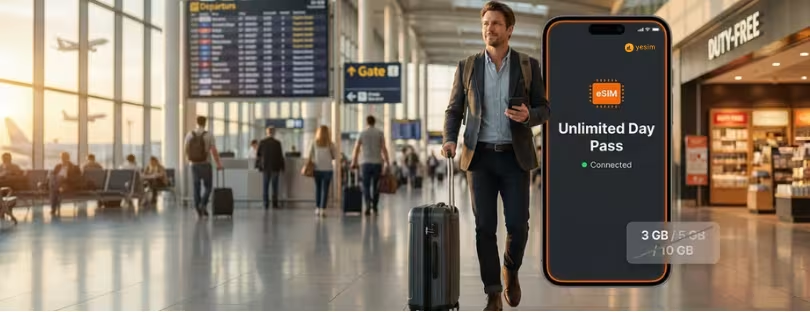
One example of this approach is the Unlimited Day Pass model offered by Yesim.

Rather than purchasing a data bundle such as 5 GB or 10 GB, users purchase days of connectivity through a globaI eSIM. Each day begins when the device first connects to the network and provides internet access for the followitcang twenty-four hours.
If the user does not connect that day, the pass remains unused.
This structure removes one of the most frustrating aspects of traditional travel data plans: the need to estimate usage in advance.
Travelers simply activate connectivity for the days they actually need it.
Why the day-pass model feels more natural
From the traveler’s perspective, the difference is subtle but important.
The product is no longer defined by megabytes or gigabytes. Instead, it is defined by availability.
If internet access is required during the day, the connection is available without calculations or monitoring.
If the phone remains offline that day, the pass is not consumed.
This aligns much more closely with how people actually travel. Some days involve heavy navigation, photo sharing, and work-related communication. Other days involve minimal mobile usage.
Gigabyte plans to force travelers to estimate those patterns before the trip begins. Time-based access models remove the need for that guesswork.
Yesim’s global eSIM also allows travelers to maintain a single connectivity profile across more than two hundred destinations, which eliminates the need to install new plans for each country visited.
For frequent travelers, this continuity becomes particularly useful.
Connectivity that adapts to the trip
Yesim has also introduced another concept called Pay & Fly eSIM, which reflects a broader trend toward usage-based digital services.
Instead of committing to large data bundles in advance, travelers activate connectivity as needed during the trip. The idea is similar to how many other digital services now operate.
Streaming platforms replaced the purchase of individual media content with subscription access. Cloud computing replaced the need to buy physical servers with usage-based infrastructure.
Telecom services are gradually moving in a similar direction. Connectivity becomes something that adapts to the user’s behavior rather than forcing users to plan around rigid packages.
For travelers, this means internet access becomes more predictable and flexible.
Competition in the travel eSIM market
Yesim is not alone in exploring unlimited connectivity models. Several travel eSIM providers, including companies such as Holafly, offer unlimited plans for certain destinations.
However, the details of these offers often vary significantly. Some plans apply strict daily usage thresholds, while others reduce speeds after certain consumption levels.
The key difference in newer models, such as the day-pass approach, is not only the promise of unlimited data. The more important change lies in the pricing structure itself.
Instead of selling data capacity, providers sell connectivity access for a specific period of time.
This change may appear simple, but product design often determines which companies gain traction in emerging technology markets.
The next phase of travel connectivity
The travel eSIM market has expanded rapidly over the past few years. According to the Trusted Connectivity Alliance, global eSIM shipments surpassed 600 million units in 2025, reflecting accelerating adoption across smartphones and connected devices.
The first phase of the travel eSIM boom focused on replacing expensive roaming. Companies such as Airalo, Holafly, GigSky, and others made it possible for travelers to avoid traditional roaming charges by purchasing prepaid data plans before or during their trips.
That development alone significantly improved international connectivity.
However, the next phase of the market appears to focus less on cost and more on user experience.
Travelers do not necessarily want to think about gigabytes at all. They simply want reliable connectivity that works when they need it.
A shift that mirrors telecom history
In many ways, the evolution of travel eSIM pricing resembles earlier changes in telecom services.
Early mobile phone plans charged users by the minute. Over time, those plans gradually shifted toward unlimited calling because customers did not want to calculate every conversation. travel eSIM unlimited data
Mobile data may now be moving through a similar transition.
As eSIM adoption expands and the travel connectivity market matures, the providers that succeed will likely be the ones that remove friction from the experience.
The future of travel connectivity may therefore be defined not by how many gigabytes travelers purchase, but by how little they need to think about them.
For travelers who are tired of estimating data usage before every trip, that shift could make connectivity feel as effortless as it was always supposed to be.