Travel eSIM: The Smart Way to Stay Connected Abroad
If you travel regularly, you have probably noticed something quietly disappearing from airports and convenience stores: the little plastic SIM card packs that used to promise “cheap local data.” travel e sim
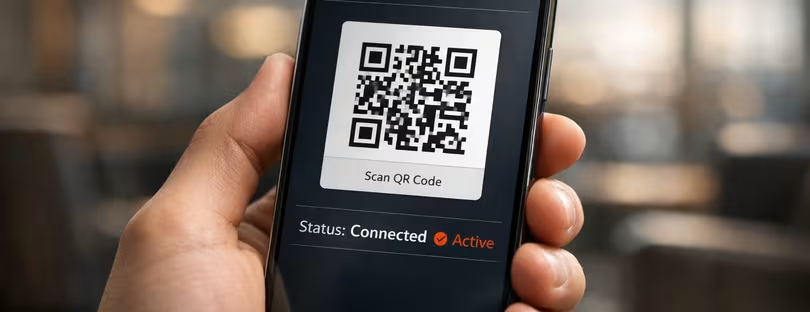
In their place, a different kind of connectivity is emerging. It lives inside your phone, activates with a QR code, and works before your plane even lands.
For travelers, the appeal is obvious. No SIM swaps. No hunting for a telecom shop after landing. No surprise roaming bills. Just open an app, buy a data plan, scan a code, and you are online.
What started as a niche product for digital nomads has now become one of the fastest-growing segments of the telecom industry. And increasingly, it is reshaping how global connectivity works.
From roaming to digital connectivity
For decades, international connectivity followed a simple pattern. You either paid roaming charges to your home operator or bought a local SIM card when you arrived.
Neither option was ideal.
Roaming was convenient but notoriously expensive. Many travelers remember coming home to bills worth hundreds of euros for a few days of data usage. Local SIM cards were cheaper but required finding a store, swapping cards, and sometimes registering personal details.
Instead of inserting a physical card, the eSIM is embedded directly in your device. You download a mobile plan remotely, and the profile is installed digitally. The concept may sound simple, but the implications are significant.
Because the SIM becomes software, connectivity becomes something you can buy instantly online, just like booking a hotel or flight.
According to telecom analysts, this shift is rapidly changing the market. The global travel eSIM market is already valued at hundreds of millions of dollars and is projected to reach roughly $1.85 billion by 2032, growing at nearly 18% annually.
In telecom terms, that kind of growth is dramatic.
Travel: the real driver of eSIM adoption
Interestingly, travel has become the primary entry point for eSIM adoption.
While telecom companies initially envisioned eSIMs transforming the entire mobile industry, it was travelers who embraced the technology first.
Research from GSMA indicates that around 51% of eSIM users first adopted the technology specifically for travel.
That makes sense. Travel creates the perfect problem for eSIMs to solve.
When you cross borders, connectivity suddenly becomes complicated. Network compatibility changes. Roaming costs spike. SIM cards may not even be available in airports.
A travel eSIM removes that friction.
You can install a data plan for Spain while still sitting at home in Zagreb. Land in Istanbul, turn on mobile data, and your phone simply connects.
For business travelers and digital nomads, that reliability is not just convenient. It is essential.
Why travelers are switching
Several factors explain why travel eSIMs are gaining traction so quickly.
Instant activation
The biggest advantage is speed. With a travel eSIM, connectivity can be activated in minutes. There is no waiting, shipping, or visiting a store.
This has become especially valuable for short trips where travelers do not want to spend time dealing with telecom logistics.
Multiple profiles
Most modern phones can store several eSIM profiles at once. That means you can keep your home number active while using a separate travel data plan.
For frequent travelers, this flexibility is transformative.
Global coverage
Many travel eSIM providers offer regional or global packages that work across dozens of countries.
Instead of buying a new SIM card in every destination, travelers can use one plan across an entire region.
Cost transparency
Roaming fees used to be unpredictable. Travel eSIMs tend to offer fixed packages, such as 5GB for 30 days or unlimited daily data.
That transparency makes it easier to control connectivity costs.
The growing ecosystem of travel eSIM providers
The rise of travel eSIMs has created a new ecosystem of telecom players.
Instead of traditional mobile operators selling connectivity through retail stores, many travel eSIM companies operate entirely online.
Some of the most visible names include providers like Airalo, Holafly, Nomad, Ubigi, and GigSky. These companies partner with local network operators around the world to provide data access through digital platforms.
According to industry forecasts, the number of travel eSIM installations could reach 280 million by 2030, reflecting a fourfold increase from current levels.
That growth is attracting new entrants, including fintech companies, airlines, and travel platforms that now bundle connectivity directly into their services.
In other words, the travel eSIM is not just a telecom product anymore. It is becoming part of the broader travel technology stack.
Device makers are accelerating the shift
The hardware industry is also pushing the eSIM transition forward.
Several smartphone manufacturers have already started experimenting with eSIM-only devices, removing the physical SIM slot entirely.
When companies like Apple and Google move in that direction, the message is clear: digital connectivity is the future.
More importantly for travelers, most modern smartphones now support eSIM technology. Recent estimates suggest that around 65% of new smartphones launched in 2024–2025 are eSIM compatible.
As device compatibility increases, travel eSIM adoption will likely accelerate even further.
Challenges still remain
Despite the excitement around travel eSIMs, the industry still faces a few obstacles.
One of the biggest is awareness. Globally, eSIM adoption is still relatively low compared to traditional SIM usage.
In fact, only about 3% of smartphone connections worldwide currently use eSIM technology, although adoption is growing quickly.
Another challenge is fragmentation.
Different providers offer different pricing models, network partnerships, and data limits. Some advertise unlimited data but throttle speeds after certain thresholds. Others offer cheaper plans but weaker coverage.
For travelers, choosing the right provider can still be confusing.
This is why comparison platforms and telecom analysts increasingly play a role in helping travelers understand what they are actually buying.
Travel eSIM vs traditional roaming
Perhaps the most important impact of travel eSIMs is what they mean for traditional telecom operators.
For decades, roaming charges were a lucrative revenue stream for mobile carriers. International travelers paid premium rates to use their home networks abroad.
Travel eSIM providers are now challenging that model by offering cheaper alternatives that connect directly to local networks.
Analysts increasingly view travel eSIMs as a major disruptor to the roaming market.
Some operators are responding by launching their own eSIM travel plans. Others are partnering with travel eSIM platforms or investing in digital provisioning technologies.
The telecom industry rarely changes quickly. But travel connectivity is one area where disruption is clearly underway.
Conclusion: connectivity becomes a travel service
The story of the travel eSIM is not just about SIM cards disappearing.
It is about something bigger.
Connectivity is gradually shifting from a telecom infrastructure product into a digital travel service.
Just as airlines sell seat upgrades and hotels sell Wi-Fi packages, connectivity is becoming another layer of the travel experience.
Travel eSIM providers are at the center of that shift, offering flexible, software-driven access to mobile networks around the world. Analysts expect the sector to grow rapidly over the next decade as international travel rebounds and more devices support digital SIM technology.
But the long-term outcome is likely more complex than simply replacing roaming.
Traditional operators still control the physical networks. Travel eSIM companies depend on partnerships with them. At the same time, tech platforms, fintech apps, airlines, and even smartphone manufacturers are entering the connectivity market.
The result is a new layer of competition.
In the coming years, travelers may no longer think about “roaming” or “SIM cards” at all. Connectivity will simply appear inside travel apps, airline bookings, or digital wallets. travel e sim
And when that happens, the travel eSIM will no longer feel like a clever telecom workaround.
It will feel like the default way the world connects.
Driven by wanderlust and a passion for tech, Sandra is the creative force behind Alertify. Love for exploration and discovery is what sparked the idea for Alertify, a product that likely combines Sandra’s technological expertise with the desire to simplify or enhance travel experiences in some way.


 Why travelers are switching