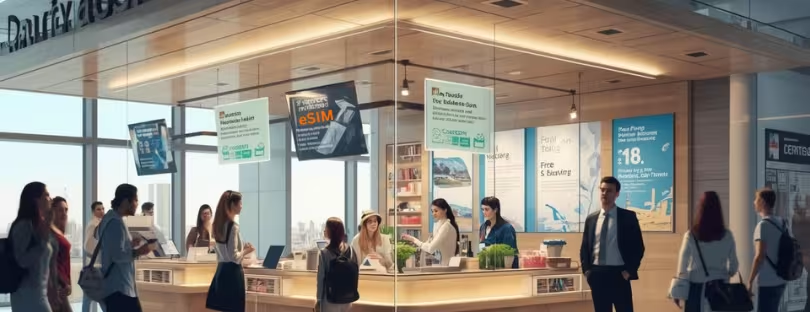
How Travel Agencies Upsell Trips With eSIM Vouchers
For years, travel agencies have perfected the art of selling the obvious extras. Seats, bags, transfers, insurance. Connectivity, meanwhile, was usually brushed aside with a casual “you can sort roaming with your operator” and quietly left to chance.
Travel eSIMs have crossed the line from niche tech to mainstream travel utility. Travelers expect to land connected, and agencies are uniquely positioned to make that happen before the plane even leaves the gate. According to multiple industry forecasts, travel eSIM adoption is accelerating sharply as roaming prices remain unpredictable and physical SIM distribution continues to fade. Connectivity has become an experience safeguard, not a luxury.
That is where Airhub is placing a very deliberate bet: treating eSIMs as a sellable travel product through vouchers that fit naturally into agency workflows rather than forcing agents to become telecom specialists.
This is not about “selling data.” It is about selling smoother trips.
Where eSIM vouchers actually belong in the booking journey
The biggest mistake agencies make with connectivity is timing. If you offer it too early, it feels abstract. Too late, and the traveler has already Googled “best eSIM” in the airport.
There are three moments where Airhub eSIM vouchers convert best because anxiety is already present:
Checkout, framed as arrival protection
At this point, travelers are thinking about what could go wrong. Pitch connectivity as insurance for the first hour after landing, not as a technical add-on.
Booking confirmation, not buried but visible
Most confirmation emails are wasted real estate. A single block that says “Want data when you land?” with one click to add the voucher can outperform checkout upsells.
72 hours before departure, when urgency peaks
This is the sweet spot. Travelers are packing, checking documents, and realizing they have not solved connectivity. A simple reminder converts because the clock is ticking.
Agencies that test all three touchpoints usually discover one clear winner based on their audience and destination mix.
Bundling strategies that increase attachment without friction
The smartest agencies are not selling eSIMs as standalone products. They are bundling them into something that feels complete.
Tiered packages beat yes-or-no add-ons
Instead of asking “Do you want an eSIM?”, restructure offers like this:
The middle option quietly becomes the default. Travelers choose it because it sounds sensible, not because they want to compare data plans.
Give the voucher “physical” presence
Even digital products need weight. Successful agencies:
Include a QR code on the itinerary labeled “Activate data before landing”
Add a one-line checklist to the travel documents
Mention the eSIM in the same section as transfers and hotel details
This reframes the voucher as part of the trip infrastructure, not an optional extra.
Match the pitch to the destination risk
Some destinations sell connectivity for you. Turkey, Switzerland, the US, the UK post-Brexit, island destinations, and cruises. In these cases, the message is simple: roaming surprises are common here.
For business travel, the pitch changes entirely. Calls, maps, and messaging must work immediately. “Hotel Wi-Fi” is not a plan.
The Lifetime eSIM angle agencies are just starting to exploit
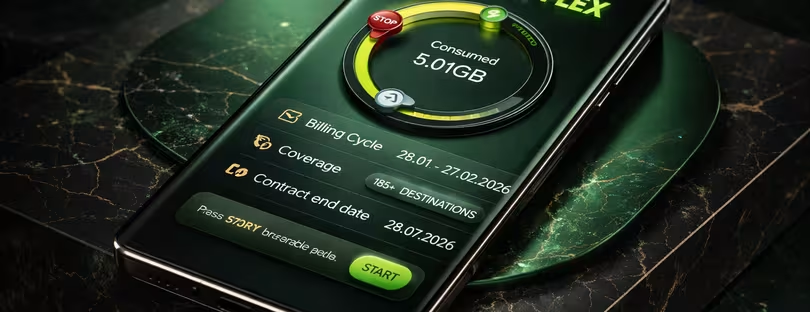
One of the more strategic options Airhub has introduced is its Lifetime eSIM concept, and it fundamentally changes how agencies can think about connectivity.
Instead of selling data per trip, agencies can issue one eSIM once and keep it active for the traveler indefinitely. The same eSIM is reused and topped up whenever the traveler goes somewhere new. For frequent travelers, SMEs, and corporate accounts, this shifts the product from a disposable add-on to a permanent travel tool.
For agencies, the implications are significant. A Lifetime eSIM can be bundled at onboarding, with the first booking, or as part of a corporate travel setup. Future trips no longer require reselling hardware or re-explaining activation. The traveler already has their travel SIM. Agencies benefit from repeat top-ups, fewer support questions, and stronger customer lock-in.
This aligns neatly with a wider industry trend toward reusable digital travel identifiers rather than one-off products, especially in managed travel and recurring business travel.
Email campaigns agencies can deploy immediately
Connectivity sells best when the tone is human and helpful, not technical.
Booking confirmation email
Subject ideas: “Your trip is booked. One thing that makes it smoother” “Quick upgrade: land connected, skip roaming.”
Body example: Your booking is confirmed. One small thing many travelers add is an Airhub eSIM voucher so their phone works the moment they land. No SIM shops, no roaming surprises. If you want it, you can add it here in one click.
CTA: Add eSIM voucher
Pre-departure reminder (3 days before)
Subject ideas: “Three days to go. Don’t forget this arrival-day essential.” “Last-minute checklist: data, transfers, documents”
Body example: Most travelers realize too late that mobile data is still unsorted. You can still add an Airhub eSIM voucher now and activate it in minutes before you fly.
CTA: Get data before departure
Day-of or post-arrival recovery email
This catches travelers who assumed Wi-Fi would be enough.
Subject ideas: “Need data today? Fastest fix here” “Landing support if you need it”
CTA: Activate now
A/B tests that actually move the needle
You do not need complex tooling to test connectivity upsells. Simple experiments consistently deliver insight.
Fear vs comfort framing
“Avoid roaming charges” versus “Land connected instantly.” One appeals to logic, the other to emotion.
Discount vs value anchor
“Save 10% today” versus “From €X for your destination.” Depending on audience maturity, one will outperform the other.
Default inclusion vs optional add-on
A clearly labeled “recommended” option with opt-out often lifts attachment without harming trust, if done transparently.
Timing windows
Some agencies convert best seven days before departure. Others spike at 72 hours. Test both.
QR codes vs buttons
QR codes in PDFs often outperform links because travelers save documents for later.
Making sure agents actually support the product
No upsell survives if agents feel it slows them down.
Winning agencies keep it simple:
A 20-second script, not a product lecture
CRM snippets with destination-based recommendations
Clear internal rules on when to pitch and when not to
Shared performance data to highlight what works
When agents see fewer post-arrival complaints and happier clients, adoption follows naturally.
Where Airhub fits in the wider eSIM landscape
Airhub is not alone in targeting partners. Consumer-first players like Airalo have built strong brand recognition and self-service ecosystems, while others focus on simplicity or unlimited plans. The difference is in positioning.
Airhub’s voucher-centric and Lifetime eSIM approach fits how agencies already sell travel: documents, codes, bundles, repeat customers. It reduces friction at scale rather than chasing one-off conversions.
At the same time, mobile operators are pushing harder to protect roaming revenue, and OTAs are experimenting with white-label connectivity. Competition will intensify, prices will compress, and differentiation will move toward trust, support, and how invisible activation feels.
Conclusion
The agencies that win with eSIM upselling will not be the ones who talk most about data plans. They will be the ones who understand that connectivity is now part of the travel promise. Airhub’s voucher model, and especially its Lifetime eSIM option, gives agencies a way to own that promise without becoming telecom experts. Compared with purely consumer-driven eSIM brands and operator roaming packs, the real advantage lies in control of timing, bundling, and repeat engagement. As travel eSIM adoption accelerates and connectivity becomes a standard ancillary alongside insurance and transfers, agencies that start testing now will be the ones setting the benchmark rather than reacting to it later.
Driven by wanderlust and a passion for tech, Sandra is the creative force behind Alertify. Love for exploration and discovery is what sparked the idea for Alertify, a product that likely combines Sandra’s technological expertise with the desire to simplify or enhance travel experiences in some way.