Europe Is Done Borrowing American Cloud Infrastructure
For years, European enterprises have had essentially two realistic options for cloud collaboration: Microsoft Teams or Google Workspace. Maybe Slack if the culture was right. The vendors were American, the servers were wherever those companies decided to put them, and the legal exposure under something like CLOUD Act was a background hum most IT departments learned to live with. Orange Business just decided that’s not acceptable anymore.
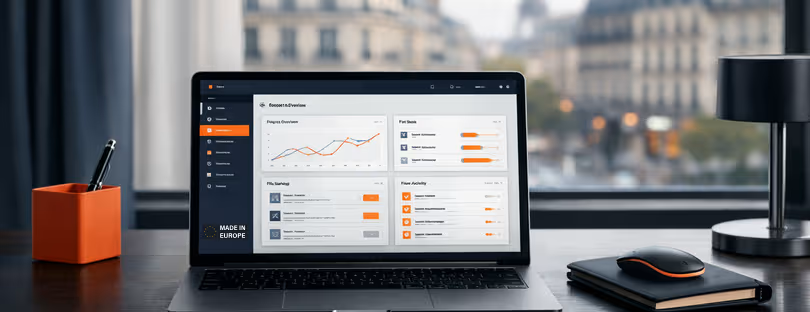
The French telecoms giant has launched Live Collaboration — a fully sovereign, end-to-end cloud collaboration suite that bundles email, video conferencing, telephony, document co-editing, intranet, and enterprise integration into one platform. Hosted in France. Operated by Orange Business. Built on a 100% European software stack.
That last part is what makes this genuinely interesting.
Not Just Another “European Alternative”
The market is littered with products that claim to be alternatives to Google or Microsoft but ultimately run on AWS or Azure infrastructure with a European flag slapped on the landing page. Live Collaboration is structured differently.
The platform runs on Cloud Avenue SecNum — Orange Business’s own SecNumCloud-qualified data center in Grenoble — and the entire software chain underneath is European, predominantly French. The tech partners involved read like a who ‘s-who of European open-source enterprise software: eXo Platform for the digital workplace layer, BlueMind for email, Pexip for video conferencing, OnlyOffice for document editing, Mailinblack for email security, and Linphone for telephony.
Each of those is a legitimate, production-grade piece of software in its own right. The trick Orange Business is pulling off here is integrating them into something that actually feels cohesive — single sign-on, unified support, one contract, one contact point. That’s where the real product engineering challenge lies, and it’s where most “open-source bundle” plays historically fall apart.
Whether the integration is as smooth as advertised will be the real test when enterprise customers get in.

The Lock-In Problem Is Real
Let’s be honest about what’s actually driving demand for this kind of product. It’s not ideology. It’s leverage.
When a company has 20,000 seats on Microsoft 365 and renewal comes around, Microsoft knows exactly how painful migration would be. That negotiating asymmetry has gotten more pronounced, not less, as Teams has embedded itself deeper into enterprise workflows. Prices have gone up. Licensing structures have gotten more complex. And organizations with specific security mandates — defense contractors, public sector bodies, critical infrastructure operators — increasingly can’t afford to depend on vendors subject to US extraterritorial legal reach.
Orange Business is explicit about this in its positioning. Wassila Zitoune-Dumontet, CEO of Orange Business France, framed it directly:
“With Live Collaboration, we are offering a sovereign and competitive solution to the major global collaboration ecosystems. In a context of rising prices, market concentration and risks of technological lock-in, our ambition is to give companies control over their data, their costs and their architectural choices, while providing their teams with a modern experience that is effective and easy to adopt.”
The “bargaining chip” positioning is smart. Live Collaboration doesn’t have to replace Microsoft 365 to be valuable. If it covers the most sensitive 20% of a workforce — people handling classified data or involved in business continuity planning — it gives the organization real negotiating leverage when contract renewal comes around. That’s a materially different pitch than “switch everything to us.”

How It Fits Into a Bigger European Shift
This launch doesn’t exist in isolation. It’s part of a broader, accelerating movement toward digital sovereignty infrastructure across Europe — one that’s gained serious institutional momentum since the Schrems II ruling destabilized EU-US data transfer frameworks and Russia’s invasion of Ukraine focused attention on supply chain resilience.
France has been particularly aggressive here. The French government’s EUCS (European Cybersecurity Certification Scheme) framework, and specifically the SecNumCloud qualification that Live Collaboration is built on, was designed precisely to give public sector and critical infrastructure organizations a trusted cloud tier. Germany has pursued similar pathways through Gaia-X (with mixed results). The EU’s own European Health Data Space and various public sector digitization mandates are pushing institutions toward sovereign-by-default infrastructure choices.
In that context, Orange Business‘s launch of Live Collaboration is less a surprise and more an inevitability. The regulatory and procurement environment is actively creating demand for exactly this kind of product.
Veronika Mazour of eXo Platform and Pierre Baudracco of BlueMind — two of the key technology partners — put it plainly:
“The trusted collaboration market is booming. The potential is enormous and the challenge for Europe fundamental.”