Roaming Margins vs Travel eSIM Margins: Who Really Wins
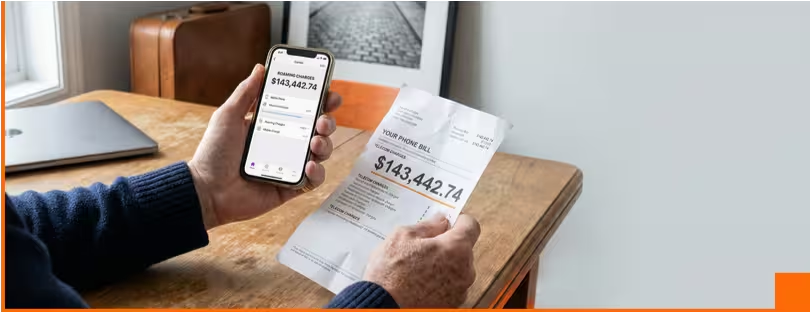
Roaming is one of those products that looks simple from the outside and weirdly profitable from the inside. You land, your phone connects, the internet works, and later something happens: either you never notice the cost (best case), or you notice it very loudly (worst case).
But if you zoom out, roaming and travel eSIMs are basically two different margin machines competing for the same travel data spend. And the question “who really wins?” depends on which layer you’re looking at: wholesale roaming economics, aggregator economics, or retail travel eSIM margins.
Let’s unpack it like adults, but keep it human.
Wholesale roaming economics
At the wholesale level, roaming is not “a traveler buying data.” It is one operator paying another operator for access, under negotiated inter-operator tariffs (IOTs). The ITU describes wholesale roaming rates as the price the visited operator charges the home operator for letting that subscriber roam.
That detail matters because wholesale roaming is built on operator-to-operator negotiation power, traffic balance, and inbound tourism flows. Some countries are naturally “inbound heavy” (lots of tourists arriving), others “outbound heavy” (lots of locals traveling). The European Commission explicitly flags these inbound vs outbound patterns when assessing the roaming market.
Now, inside the EU/EEA, “Roam Like At Home” squeezed the easy money. Wholesale caps are literally written into the regulation’s glidepath. The Commission review notes wholesale data caps of €1.55/GB in 2024, €1.30/GB in 2025, and €1.10/GB in 2026.
So if you’re thinking “operators must be drowning,” not exactly. Two reasons:
- Even regulated wholesale roaming is still a big market
Juniper Research forecasts wholesale roaming revenue rising sharply, with their 2025 infographic putting wholesale roaming revenue at $11B in 2025, growing to $26.7B by 2029. - IoT roaming is becoming a margin anchor
Juniper also highlights IoT roaming revenue nearing $2B by 2028, and calls out the need for real-time monitoring to monetize it properly. - So wholesale roaming is not dying. It’s being rebalanced: less consumer price-gouge headroom (especially in the EU), more structural monetization via IoT and managed roaming relationships.
The aggregator layer
Here’s where it gets fun. The travel eSIM boom did not magically remove wholesale economics. It mostly rerouted them through aggregators, MVNEs, and platform enablers.
Think of this layer as “connectivity supply chain management”:
- Someone sources capacity (operator deals, IMSI ranges, roaming agreements, or MVNO constructs)
- Someone packages it into eSIM plans (including profile provisioning, SM-DP+ infrastructure, entitlement flows)
- Someone distributes it (apps, affiliate networks, OTAs, airline bundles, fintech “travel perks,” hotel flows)

This middle layer makes money in two classic ways:
Margin type 1: Spread
They buy data capacity at one effective rate and sell it to retail brands (or directly to consumers) at a higher blended rate.
Margin type 2: Take-rate
They enable the retail sale and take a cut, which is often more attractive than holding inventory risk.
Kaleido Intelligence’s research focus makes the market structure point clear: travel eSIM is now a defined retail segment with distinct vendor types, buying behavior, and distribution models, not just “roaming but digital.”
And the aggregator layer is where a lot of “who wins” quietly shifts, because aggregators can capture value without owning the customer relationship forever, and without being the network carrying the traffic.
Retail travel eSIM margins
At retail, travel eSIMs win hearts for one reason: they often feel like pricing honesty.
Not perfect honesty. But a big upgrade over “surprise roaming bill roulette.”
Juniper Research puts real numbers on the travel eSIM surge: revenue from travel eSIM packages is forecast to reach $1.8B by end of 2025, up 85% from $989M in 2024.
That growth implies something important: retail pricing power is shifting. Travelers are increasingly choosing “prepaid travel connectivity” as a product category.
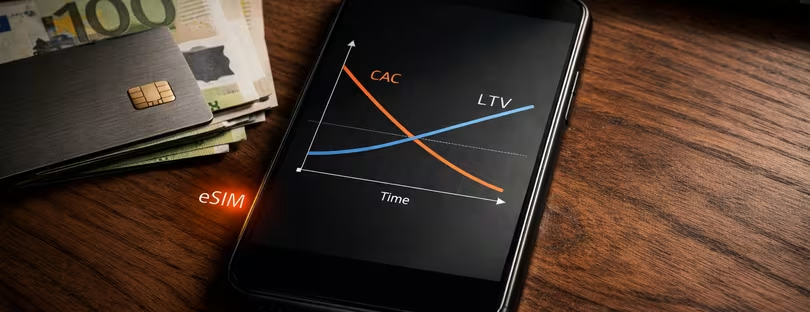
But are retail travel eSIM margins always huge? Not necessarily. Retail eSIM margins are messy because retail eSIM brands have to pay for:
- Customer acquisition (paid search, affiliates, app store, OTA partnerships)
- Customer support (activation issues, device settings, refund requests)
- Payment costs and fraud
- Platform and provisioning costs
- Sometimes, surprisingly expensive distribution deals
So yes, retail prices can look healthy compared to raw wholesale cost, but margins can be eaten alive by acquisition.
This is also why Juniper’s press release notes mobile operators will play a growing role in travel eSIMs. Translation: operators see the margin shift and want a piece of the new retail shelf, not just the old roaming shelf.
So who really wins?
Here’s the honest answer: different winners at different layers, and the “winner” changes by region.
In the EU/EEA, regulation changes the winner
With wholesale caps stepping down, and retail roaming constrained by “Roam Like at Home,” the classic roaming margin story is muted.
So in regulated regions, retail travel eSIMs win more often because they create a new retail product that is easier to sell than “roaming add-ons,” and they expand distribution beyond telco storefronts.

Outside the EU/EEA, wholesale roaming can still be a cash machine
BEREC’s benchmarking work exists for a reason: roaming outside the EEA remains a different beast, and regulators monitor the relationship between wholesale and retail pricing.
In many non-regulated corridors, traditional roaming can still produce strong margins, especially where travelers are inattentive, and where operator bundles are priced for convenience, not competition.
Aggregators win when distribution fragments
If travel eSIMs are sold through airlines, banks, OTAs, hotel apps, influencer codes, and app marketplaces, the aggregator layer becomes the plumbing that everyone uses. They win when there are many storefronts and nobody wants to build telecom plumbing in-house.
Operators win when they adapt the product
Operators are not powerless here. They can:
- Launch their own travel eSIM brands
- Partner with travel eSIM platforms
- Monetize wholesale roaming harder (especially IoT)
- Bundle roaming more intelligently to protect their base
The market signals point to that direction: travel eSIM is growing fast enough that operators are explicitly being told (by analysts) to enter and compete.
What this looks like in 2026 and beyond
This is where I’ll be blunt.
The travel connectivity market is turning into a two-track margin system:
- Roaming becomes an infrastructure margin (wholesale optimization, IoT monetization, traffic balance, regulatory compliance)
- Travel eSIM becomes a distribution margin (brand, UX, partnerships, embedded checkout, bundles)
And the battleground is not “who has the cheapest GB.” It’s who controls the customer moment: the trip booking flow, the airport moment, the bank travel notification, the hotel Wi-Fi login, the “you landed” push notification.
If you control that moment, you control margin.
Conclusion: the winners are the ones who own the customer moment
Roaming used to win because it owned the default. Your phone connected, and the bill followed.
Travel eSIMs win because they’re stealing the decision point. They are training travelers to choose connectivity the way they choose insurance or airport transfers: upfront, in-app, and with clear pricing.
Operators still win in wholesale (and increasingly in IoT roaming), and in many global corridors, they still hold strong pricing power.
But retail travel eSIM brands and aggregators are winning the fastest-growing prize: the traveler’s “buy now” moment, at scale.
The real “who wins?” answer is not a single company. It’s a shift in where profit is made: away from silent default billing, toward competitive, embedded distribution.
And once travelers get used to buying connectivity like a product, roaming stops being a surprise and starts being just another option on the shelf.