Middle East Tourism Losing €515M a Day Amid Conflict
For years, the Middle East has positioned itself as one of the fastest-growing travel regions in the world. New mega-airports, luxury resorts, cruise terminals, and tourism megaprojects have transformed cities like Dubai, Doha, and Riyadh into global travel hubs. But the latest geopolitical tensions are suddenly testing that momentum. Middle East tourism impact conflict
According to estimates based on the 2026 pre-conflict forecast from the World Travel & Tourism Council (WTTC), the escalating regional conflict between the United States–Israel alliance and Iran is now costing the Middle East travel and tourism sector approximately €515 million per day.
The figure reflects the scale of disruption hitting one of the most strategically important aviation and tourism corridors in the world.
A region built on global connectivity
Before the conflict escalated, tourism in the Middle East was entering another strong growth phase.
WTTC projections expected €178 billion in international visitor spending in 2026 across the region. Major Gulf aviation hubs had become central nodes in the global travel system, connecting Europe, Asia, Africa, and increasingly North America.
Airports in Dubai, Abu Dhabi, Doha, and Manama collectively process around 526,000 passengers per day under normal circumstances.
A large portion of these travelers are not staying in the region. Instead, they are passing through. The Middle East handles roughly 14% of global international transit traffic, making it one of the most important intercontinental connectors on the planet.
At the same time, the region also attracts around 5% of global international arrivals, thanks to rapid tourism investment and ambitious national strategies.
All of that connectivity depends on one fragile variable: stable airspace.
Flights suddenly disappearing
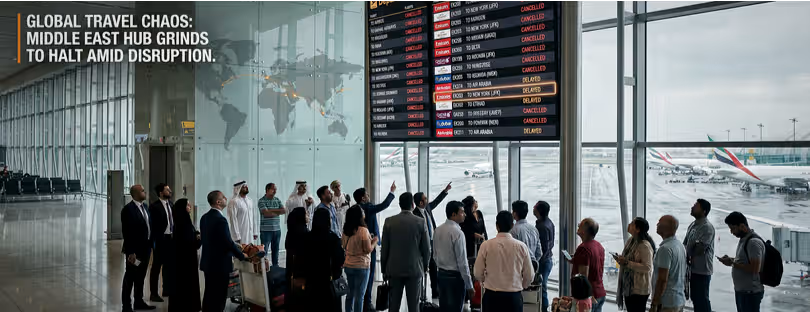
The conflict has forced widespread airspace closures and operational changes, dramatically reducing flight activity across the region.
Data from aviation tracking platform Flightradar24 illustrates the scale of the disruption.
On 24 February, three of the region’s biggest airlines were operating near-normal schedules:
- Emirates: 527 flights
- Etihad Airways: 325 flights
- Qatar Airways: 563 flights
Just over two weeks later, on 10 March, those numbers dropped dramatically:
- Emirates: 309 flights
- Etihad Airways: 56 flights
- Qatar Airways: 66 flights
For an aviation system built around constant movement and tight schedules, that decline is massive.
Flights are being rerouted, cancelled, or consolidated. Transit passengers are shifting routes through Europe or Asia. And tourism flows into the region are slowing sharply.

Tourism growth suddenly paused
Until recently, tourism in the Gulf was booming.
Large-scale investments across the region, especially in Saudi Arabia, were driving rapid growth in visitor numbers. The kingdom only opened to leisure tourism in 2019 but has since launched some of the most ambitious tourism projects anywhere in the world.
Ibrahim Khaled, head of marketing for the Middle East Travel Alliance, says the region had been enjoying steady growth before the crisis escalated.
“We’ve been seeing steady growth year over year, especially with all the new tourism investments happening across the region,” he tells Euronews Travel.
“Saudi Arabia is currently at about 10%, but it’s growing incredibly fast since they opened up to leisure tourism in 2019. It’s definitely our most exciting up-and-coming destination.”
But in the past two weeks, that momentum has stalled.
“For places that the US and UK governments have put on no-go or no-fly lists, we’ve unfortunately seen a ton of cancellations,” Khaled says. “Flights are disrupted, and trips to those specific areas are pretty much on hold.”
Millions of visitors could disappear
Economists now expect the shock to ripple across the entire regional tourism ecosystem.
A new analysis from Tourism Economics suggests inbound tourism to the Middle East could decline sharply in 2026 compared with earlier projections.
“We estimate inbound arrivals to the Middle East could decline 11%-27% year on year in 2026 due to the conflict, compared to our December forecast that projected 13% growth,”
said Director of Global Forecasting Helen McDermott and Senior Economist Jessie Smith.
“In absolute terms, this would mean a range of 23-38 million fewer international visitors compared to our baseline / previous forecast, and $34bn-$56bn (€29bn-€48bn) loss in visitor spend. This includes expected lingering sentiment impacts beyond the immediate conflict period.”
The report also warns that the tourism impact could exceed that of previous regional conflicts.
One reason is the wider geographical reach of the disruption. Iran’s retaliatory strikes have affected neighboring Gulf Cooperation Council (GCC) countries, which host some of the region’s most established tourism destinations.
Why the Gulf is especially exposed
According to Tourism Economics, GCC countries are likely to suffer the largest absolute tourism losses.
These economies rely heavily on international aviation connectivity and have invested heavily in building reputations as safe and stable travel destinations.
Two countries stand out as particularly exposed:
Both attract large volumes of international visitors and depend heavily on aviation.
Tourism Economics explains that air travel tends to be far more sensitive to sentiment shifts than land transport. If travelers perceive instability, flights are often the first thing to change.
Some Gulf countries are slightly less exposed.
In Qatar, about 32% of arrivals come by land, while in Bahrain, land arrivals account for around 74% of total arrivals.
That means those destinations may see a somewhat softer decline compared with aviation-dependent hubs.

A global aviation ripple effect
The impact is not limited to the Middle East itself.
Because the region functions as a major global transit hub, disruptions are already affecting international travel flows between Europe and the Asia-Pacific region.
When Gulf airlines reduce operations or reroute flights, global network effects follow quickly.
Airlines may have to:
- take longer flight paths
- add fuel stops
- reduce frequencies
- shift passengers through alternative hubs
This adds costs, delays, and complexity across the global aviation network.
In other words, a regional crisis quickly becomes a global aviation challenge.
A resilient tourism sector
Despite the scale of the disruption, tourism experts caution against assuming a long-term collapse.
The Middle East travel industry has historically shown remarkable resilience.
“We aren’t worried about the long-term impact on the company or tourism in the region. The Middle East has always been an incredibly resilient market, and demand always bounces back fast once stability returns,” says Khaled.
The World Travel & Tourism Council echoes that assessment.
Gloria Guevara, president and CEO of the WTTC, says previous crises show that tourism can recover surprisingly quickly.
“The impact of international visitor spending across the Middle East is significant and averages around US$600 million per day, but history shows that the sector can recover quickly, especially when governments support travellers through hotel support or repatriation.”
“Our analysis of previous crises demonstrates that security-related incidents often see the fastest tourism recovery times, in some cases as quickly as two months, when governments and industry work together to restore traveller confidence.”
Conclusion: Tourism is resilient, but connectivity is fragile
If there is one lesson from this moment, it is that modern tourism is fundamentally built on connectivity.
Air routes, transit hubs, and global aviation networks are the invisible infrastructure behind international travel growth. When that infrastructure becomes unstable, tourism can slow almost overnight.
But history suggests that the sector rarely stays down for long.
After the COVID‑19 pandemic, international tourism rebounded faster than most analysts expected. Following conflicts in the region over the past decade, airlines and travelers often returned within months once stability improved.
What makes the Middle East different is its structural role in global aviation. Airlines such as Emirates, Etihad, and Qatar Airways have built enormous hub networks that connect continents. When those networks pause, the ripple effects reach far beyond the region itself.
For the travel industry, this crisis is a reminder that tourism growth is not only about destinations or marketing campaigns. It depends on something more fundamental: open skies, stable infrastructure, and traveler confidence.
And when those conditions return, history suggests that travelers will return with them.